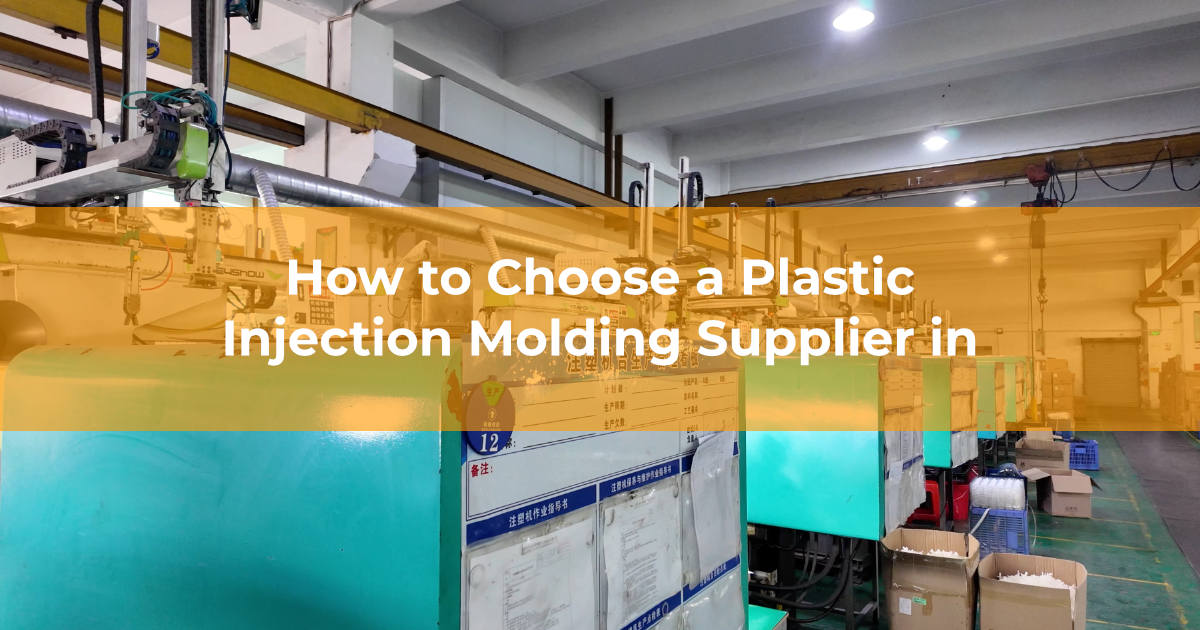
How to Choose a Plastic Injection Molding Supplier in China: 7 Criteria That Matter
Sourcing plastic injection molding from China is a well-trodden path for product companies worldwide — whether you are a US OEM sourcing FDA-compliant parts, a German automotive supplier navigating PPAP documentation, or a UK product company developing a new device. The cost advantages are real. So are the risks — and most of them are avoidable if you evaluate suppliers correctly before placing a tooling order.
This guide covers seven criteria that experienced sourcing managers use to separate reliable Chinese injection molding factories from ones that will cost you more in the long run.
Why Supplier Selection Matters More Than Price
The tooling investment — your mold — locks you into a supplier relationship for the life of the product. A mold built poorly, or by a factory that can’t maintain communication, quality, or lead times, will cost far more to correct than the initial savings justified.
The question is never just “who is cheapest?” It is “who will still be reliably supplying parts in three years?”
Criterion 1: In-House Toolroom
The single most important question: Do you manufacture molds in-house, or do you outsource tooling?
Many factories present themselves as full-service mold makers but outsource all tooling to third parties — sometimes without telling customers. When this happens:
- Quality control between design intent and manufactured mold breaks down
- Lead times become unpredictable
- Accountability for mold quality becomes ambiguous
What to ask: Request photos of their toolroom equipment — CNC machining centers, EDM, wire-cut. Ask specifically: “Is all tooling manufactured on your premises by your employees?”
Criterion 2: DFM Before Quoting
A capable engineering-led supplier will return a written DFM (Design for Manufacturability) report before or alongside a quote — identifying specific issues with wall thickness, draft angles, undercuts, and gate location options.
A factory focused purely on production will quote your part as drawn and start cutting steel. Problems discovered after tooling has begun are expensive to fix.
What to ask: Send your 3D file and ask for a DFM review. Evaluate the specificity of the response. Generic comments are worth less than observations tied to your actual part geometry.
Criterion 3: Quality Documentation
Minimum baseline: ISO 9001:2015 certification. Ask to verify the certification body is accredited.
Beyond that, ask specifically:
- Do you provide First Article Inspection (FAI) reports with dimensional data?
- Do you provide material certificates traceable to resin lot numbers?
- What is your in-process inspection protocol?
- What is your defect rate for established production programs?
Red flag: “We do 100% inspection before shipping” without describing in-process controls. End-of-line visual inspection is the least effective quality control method.
Criterion 4: Communication and Accountability
This is where supplier relationships most often fail in practice, even when the factory is technically competent.
The issues are usually not about language fluency — they are about:
- Who is your point of contact? A dedicated engineer-account manager, or a sales intermediary who relays messages?
- Response time: 48–72 hours to a simple technical question predicts how the relationship works under pressure
- Transparency: Does the supplier proactively report T1 issues, or do you find out when you receive out-of-tolerance samples?
Look for a supplier where the person managing your account can answer a mold design question directly — not just forward emails.
Criterion 5: Lead Time Credibility
Every supplier will tell you they can meet your deadline. Evaluating credibility requires more than taking it at face value.
Realistic Chinese tooling lead times:
| Mold Type | Typical T1 Lead Time |
|---|---|
| Simple single-cavity, cold runner | 18–22 business days |
| Medium complexity, 2–4 cavity | 22–28 business days |
| Hot runner, complex geometry | 28–40 business days |
Ask for a specific committed date — not a range. A supplier who won’t commit to a date is telling you something.
Criterion 6: References and Track Record
Useful reference questions:
- What was the quoted vs. actual lead time to T1 samples?
- How many trial iterations before first article approval?
- What was the defect rate in the first 90 days of production?
- How did the supplier handle the most significant problem that arose?
Request case studies with documented outcomes — measured Cpk values and timeline data, not just narrative descriptions.
Criterion 7: Factory Visit or Virtual Audit
Before placing a significant first tooling order, a factory visit or structured virtual audit is worth the time.
What a visit reveals that documents cannot:
- Actual equipment in the toolroom vs. the capability sheet
- Workshop organization — a reliable indicator of process discipline
- Whether engineering staff can discuss your project knowledgeably
A supplier reluctant to show you their facility on a video call has a reason for that reluctance.
Summary Checklist
- Molds manufactured in-house (not outsourced)
- Written DFM report provided before or with quotation
- ISO 9001:2015 certificate verified (not just claimed)
- FAI report and material certificates provided as standard
- Single point of contact with engineering knowledge
- Specific T1 date committed in writing
- At least two verifiable references from your industry
- Factory visit or virtual audit completed
The supplier who passes this checklist may not be the cheapest option. They will almost certainly be the most cost-effective one over the life of the program.
For country-specific guidance on tariffs, shipping routes, and regulatory documentation — see our sourcing and buying guides.