Multi-Cavity Mold Manufacturing | Multi-Cavity Injection Molds | JBRplas
Multi-cavity injection mold manufacturing — proven 16-cavity tools, Cpk 1.52 cavity weight balance, family molds, hot runner systems. T1 in 25–35 days.
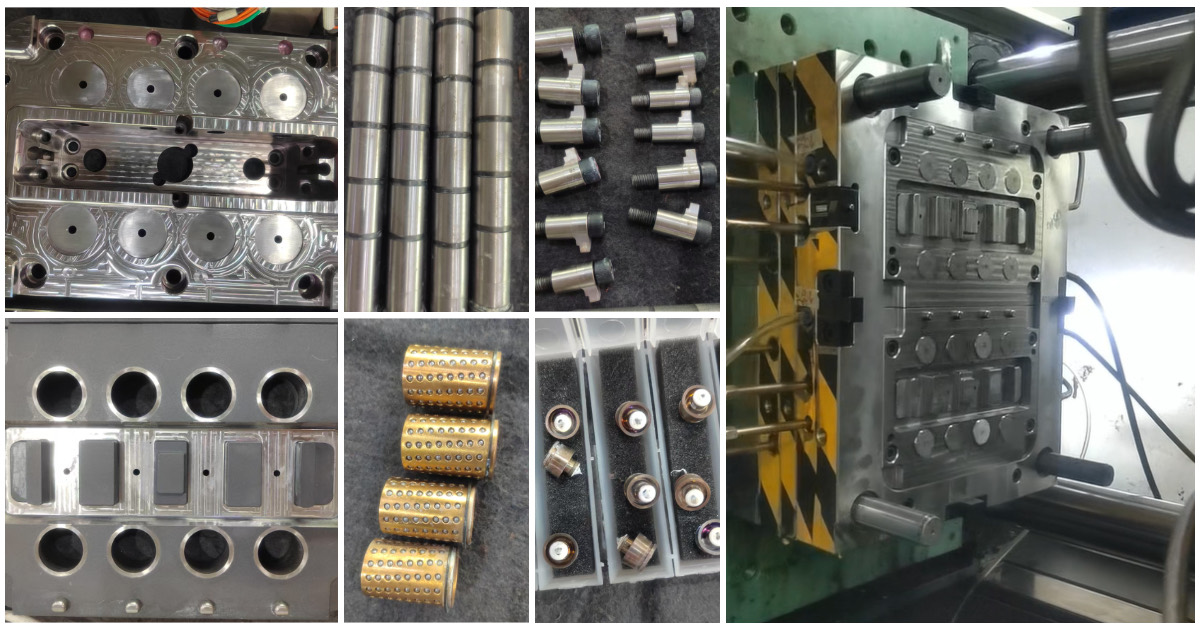
Multi-Cavity Mold Manufacturing
A multi-cavity mold exists for one reason: to divide the tool cost across more parts per cycle. If a single-cavity mold makes 100 parts per hour and a 16-cavity mold makes 1,600, the same press, operator, and overhead produce sixteen times the output. The trade-off is a larger, more complex tool — and everything that complexity implies for balancing, thermal control, and maintenance.
JBRplas designs, builds, and validates multi-cavity injection molds in our Shenzhen toolroom. We have delivered more than 3,000 molds since 1995, with published production programs at 8 and 16 cavities. This page covers the tool side: cavity count decisions, balanced fill, hot runner systems, machining, and validation. For how we run these tools in production — press fleet, SPC, supply continuity — see high volume manufacturing.
When Multi-Cavity Makes Sense
Cavity count is a DFM decision, not a preference. The starting reference:
| Annual Volume | Typical Cavitation |
|---|---|
| 10K – 50K | 1–2 cavities |
| 50K – 250K | 2–4 cavities |
| 250K – 1M | 4–8 cavities |
| 1M+ | 8–16+ cavities |
The final number depends on four variables:
- Annual volume and forecast stability — the tool must amortize across real orders, not projections.
- Part size and projected area — cavity count is limited by the clamp tonnage of the press that will run the tool. Sixteen cavities of a 100 mm × 100 mm part need very different tonnage than sixteen cavities of a 10 mm × 10 mm part.
- Material and wall thickness — fill time and cooling dominate cycle time. Thin-wall PC parts and thick PP parts fill on different timescales, and balanced fill gets harder as cavity count rises.
- Family molds — when a product ships as a set (housing + cover + bracket), a family mold can replace three separate tools. Our automotive OBD program runs a 1+1+1 configuration.
The economics are covered in detail in Multi-Cavity Mold Economics — Cavity Count, Runner Balancing, and Family Mold Risks.
Cavity Layout & Balanced Fill
A multi-cavity mold is only as good as its worst cavity.
- Geometrically balanced layouts: Runner length to every cavity is equal, so every cavity sees the same pressure drop. Layout is set in the design phase, not corrected on the press.
- Moldflow simulation before steel is cut: Fill pattern, pressure distribution, and weld line position are simulated for the full cavity layout. If simulation shows a fill imbalance, the layout changes before machining begins.
- Cavity weight balance as an acceptance criterion: Our published Type-C charger housing program holds Cpk 1.52 on cavity-to-cavity weight balance on a 16-cavity production tool.
- Family mold balancing: Dissimilar parts have different flow lengths and fill requirements. Per-cavity gate sizing and runner restriction are engineered in DFM — balancing a family mold is design work, not a trial-and-error exercise at the press.
Hot Runner Systems
Hot runners are selected for cycle time and material compatibility, not brand preference. We work with Yudo, Mold-Masters, Husky, and Synventive systems.
- Valve gate for cosmetic surfaces where gate vestige is unacceptable.
- Hot drops vs. cold runner: hot runners eliminate the runner regrind cycle and shorten cooling time — justified at higher cavity counts and for materials where the runner-to-part weight ratio makes cold-runner regrind costly.
- Cold runner still the right choice for many 2–4 cavity tools, family molds where runner regrind is acceptable, and materials sensitive to residence time in a hot manifold.
In-House Toolroom
Multi-cavity molds multiply the machining work — every cavity, core, and ejector pin must be cut to the same geometry. We machine the tool in-house:
| Equipment | Quantity | Accuracy |
|---|---|---|
| CNC machining centers | 9 | ±0.003–0.02 mm |
| EDM sinkers | 10 | ±0.005–0.01 mm |
| Wire-cut EDM | 7 | ±0.003 mm |
| Surface grinders | 6 | ±0.0015 mm |
Full inventory in the equipment list. Steel selection follows the same logic as the cavity count — matched to resin and shot life requirement:
| Steel | Hardness | Best For | Shot Life |
|---|---|---|---|
| P20 (718H) | 28–34 HRC | General purpose, PP, ABS, PC | 300K–500K |
| H13 | 48–52 HRC | High-temp resins, PA, POM, PEEK | 500K–1M |
| S136 (420SS) | 48–52 HRC | Corrosive resins, PVC, PC optical | 500K–1M |
| 2344 | 44–52 HRC | High-pressure, automotive | 800K–1M+ |
Mold types include stack molds, unscrewing molds, collapsible core molds, two-shot/2K tooling, and gas-assist molds. Spare inserts and cavity repairs are machined in the same toolroom that built the mold — maintenance is a machining task, not a shipping task. See mold manufacturing for the full tooling scope.
Mold Validation
A multi-cavity mold ships only after cavity-by-cavity validation:
- T1 trial with the production-grade resin, not a stand-in material.
- Per-cavity CMM inspection — the dimensional report lists every cavity separately, not a pooled sample. A cavity that trends toward a tolerance limit is corrected before it produces scrap.
- Cavity weight balance study with Cpk tracking, as demonstrated on the Type-C charger housing program.
- FAI and PPAP — First Article Inspection per cavity; PPAP Level 3 documentation available for automotive programs.
- Warranty — guaranteed shot life: 300,000 shots for P20 tools, 1,000,000 for H13/S136. Workmanship defects are repaired or replaced at no charge.
Multi-Cavity Track Record
Published case studies with verified cavitation:
| Program | Cavitation | What It Proves |
|---|---|---|
| Type-C charger housing | 16 | Cpk 1.52 cavity weight balance, 2.5M pcs/yr |
| Portable microphone housing | 16 | T1 in 22 days, 16-hole precision layout, gradient finish |
| Construction toy system | Up to 16 | 4 molds, 16 part numbers, 50M+ pcs/yr |
| Smartwatch back cover | 8 | 18–22s cycle time, 2M+ pcs/yr |
| Smart plug housing | 8 | Sustained consumer electronics volume |
| Electronics enclosure | 4 | 30-second target cycle, 1.2M pcs/yr |
| Wireless microphone charging dock | 4 | S136 steel, SPI A1 finish, 2 g part |
| Automotive OBD | 1+1+1 | Family mold, three dissimilar parts |
Lead Times
| Phase | Duration |
|---|---|
| RFQ response | Within 24 hours |
| DFM report | 2–3 business days |
| Mold design (multi-cavity / hot runner) | 8–15 business days |
| T1 samples (multi-cavity or hot runner) | 25–35 business days |
| T1 samples (single-cavity reference) | 18–22 business days |
Frequently Asked Questions
How many cavities should my mold have? It is decided in DFM against annual volume, part size, press tonnage, and material. As a starting reference: 1–2 cavities below 50K pieces per year, 2–4 at 50K–250K, 4–8 at 250K–1M, and 8 or more above 1M. The crossover where added cavities stop paying for themselves depends on tool cost growth versus per-part cost reduction — we calculate both numbers in the quote.
What does a multi-cavity tool cost compared to a single-cavity tool? The tool costs more — steel, machining hours, and validation work all scale with cavity count. Per-part tooling amortization falls. We show both figures in the quote so the decision is arithmetic, not assumption.
Can you build family molds with dissimilar parts? Yes. Our automotive OBD program runs a 1+1+1 family mold producing a connector, rear cover, and support bracket from one tool. Dissimilar parts are balanced with per-cavity gate sizing during design — part of the DFM, not a press-side adjustment.
What Cpk do you hold on cavity balance? Our published Type-C charger housing program holds Cpk 1.52 on cavity-to-cavity weight balance on a 16-cavity tool. Balance targets are agreed in the mold specification before design starts.
Do all multi-cavity molds need hot runners? No. Hot runners are selected for cycle time and material compatibility. They are typically justified at higher cavity counts and for materials where cold-runner regrind is costly; cold runner remains the economical choice for many 2–4 cavity tools.
What is the T1 lead time for a multi-cavity mold? 25–35 business days for multi-cavity or hot runner tools, from design approval. Single-cavity tools run 18–22 business days. We commit a specific date at order, not a range at delivery.
Related
- Industries: Automotive, Medical, Electronics & Appliances, Branded Toys, Smart Home
- Related services: Mold Manufacturing, Mold Design, 2K Mold Manufacturing, Injection Molding, High Volume Manufacturing, Rapid Tooling
- Further reading: Multi-Cavity Mold Economics — Cavity Count, Runner Balancing, and Family Mold Risks, How to Choose a High-Volume Injection Molding Supplier, Equipment List, Injection Molding Cost Guide
You may also be interested in
Custom Plastic Injection Molding Services
JBRplas operates a 24/7 injection molding …
High Volume Plastic Injection Molding
At 100,000 pieces per year, a molding program …
Rapid Tooling & Prototype Injection Molding
When you need injection-molded parts for …