What Is Injection Molding? A Complete Guide for Engineers and Buyers
Plastic injection molding is the most widely used manufacturing process for producing plastic parts at scale. If you’re an engineer specifying a plastic component, a buyer sourcing from China, or a product manager evaluating manufacturing options, this guide covers everything you need to know.
How Injection Molding Works
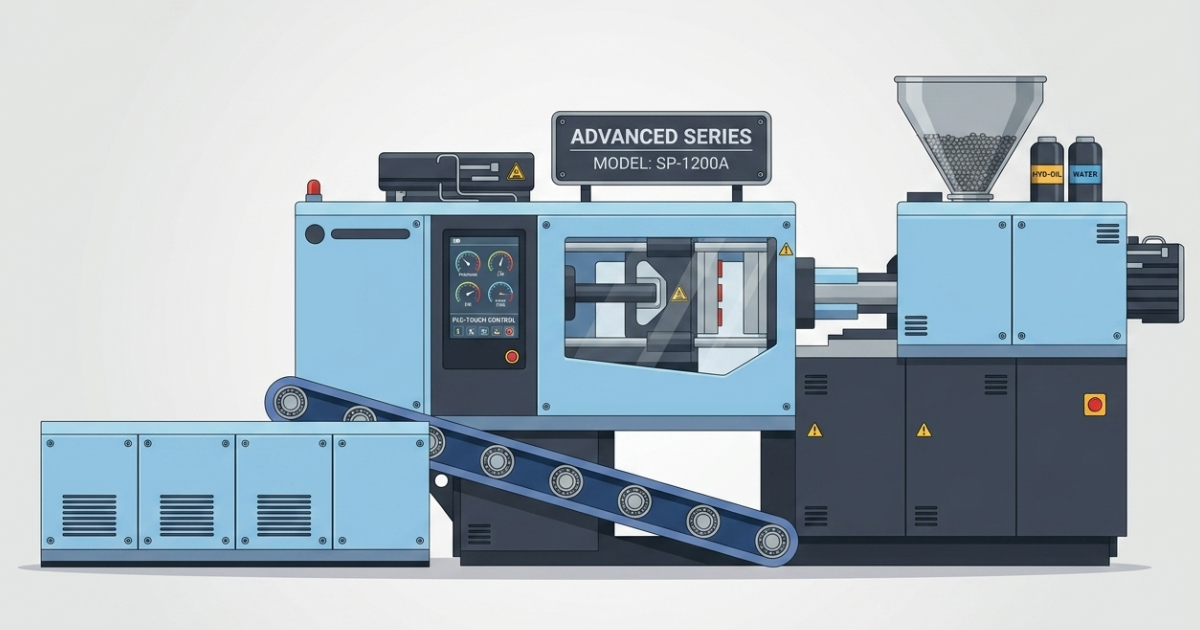
Injection molding is a cyclic manufacturing process with four distinct phases:
1. Clamping
The injection mold — a precision-machined steel tool with a cavity in the shape of your part — is held closed under high pressure by the clamping unit of the injection molding machine. Clamping force is measured in tonnes and must exceed the injection pressure multiplied by the projected area of the part.
2. Injection
Plastic pellets (resin) are fed from a hopper into a heated barrel, where a reciprocating screw melts the material and pushes it forward. At the injection stage, the screw acts as a ram, forcing molten plastic into the closed mold at high pressure (typically 500–1,500 bar) through a gate — a narrow channel designed to fill the cavity completely before the plastic freezes.
3. Cooling & Packing
Once the cavity is filled, the mold is held under pack pressure to compensate for the shrinkage that occurs as the plastic cools. Cooling channels machined into the mold carry water or coolant to remove heat rapidly. Cycle time is dominated by cooling time — typically 60–80% of the total cycle.
4. Ejection
Once the part has cooled sufficiently to be rigid (but not necessarily fully cooled to ambient temperature), the mold opens and ejector pins push the part out of the cavity. The mold then closes, and the cycle begins again.
A complete cycle for a typical industrial part takes 15–60 seconds, depending on part geometry, wall thickness, and material.
What Can Be Made with Injection Molding?
Injection molding produces parts ranging from microscopic medical components weighing 0.1 grams to large automotive bumper fascias weighing several kilograms. Almost any plastic part with a consistent cross-section — cups, enclosures, brackets, gears, connectors, housings — can be injection molded.
Not suited to injection molding:
- Parts with very thick sections (use machining, casting, or foam injection)
- Extremely low quantities (fewer than ~500 pieces, where 3D printing or CNC may be more economical)
- Parts that require continuous lengths (use extrusion)
Material choice drives most of the cost and property outcome. The materials library covers per-polymer properties, grade families and DFM notes; the material selection guide explains how to narrow 500+ available resins down to three candidates.
Injection Molding vs Alternative Processes
| Process | Minimum Volume | Unit Cost | Tooling Cost | Lead Time |
|---|---|---|---|---|
| Injection molding | ~1,000+ | Low | $2,000–$50,000 | 4–8 weeks T1 |
| 3D printing (FDM/SLS) | 1 | High | None | Days |
| CNC machining | 1–1,000 | Medium-high | Low | 1–3 weeks |
| Blow molding | 5,000+ | Low | $5,000–$30,000 | 6–10 weeks |
| Thermoforming | 500+ | Low-medium | $1,000–$15,000 | 3–6 weeks |
Injection molding becomes cost-competitive with 3D printing at approximately 500–1,000 pieces for small parts, dropping dramatically in unit cost for volumes above 10,000 pieces per year. For the full model — tooling amortisation, cycle time, scrap and finishing — see the injection molding cost breakdown.
The Cost of Injection Molding
Injection molding cost has two components:
Tooling (Mold) Cost
A mold is a one-time capital cost. The mold is yours — it is stored and maintained at the factory for the life of the production program. Tooling cost depends on:
- Part size — larger parts require larger mold bases and more steel
- Part complexity — undercuts requiring side actions, complex gating, hot runner systems
- Number of cavities — an 8-cavity mold costs more than a single-cavity mold but reduces unit cost
- Steel grade — P20 (standard) vs H13 (high-volume) vs S136 (corrosive resins)
Indicative mold costs for simple to medium-complexity parts produced in China:
| Complexity | Example | Indicative Mold Cost |
|---|---|---|
| Simple single-cavity | Bottle cap, simple cover | $2,000–$6,000 |
| Medium single-cavity | Electronics enclosure | $6,000–$15,000 |
| Complex or multi-cavity | Automotive connector (8-cavity) | $15,000–$40,000 |
| High complexity | Hot runner, medical device | $30,000–$80,000+ |
Mold price is only part of tooling spend; maintenance, repairs and end-of-life replacement are the rest. Mold total cost of ownership works through the full number.
Part Cost (Piece Price)
Part cost is driven by:
- Cycle time × machine hourly rate
- Material consumption (weight + sprue/runner)
- Labour (automation vs manual)
- Yield / scrap rate
For context, a simple PP enclosure of ~50g produced in China in volume might cost $0.10–$0.50 per piece, depending on volume, complexity, and finishes. Three levers move piece price most — wall thickness, cycle time and cavitation — covered in plastic part cost reduction strategies.
Choosing an Injection Molding Supplier
When evaluating suppliers, look beyond quoted price. Key supplier criteria:
- In-house tooling — suppliers who make their own molds control quality and lead time. Third-party tooling adds risk
- Engineering support — do they review your design before quoting? A supplier who skips DFM will cost you more in revisions
- Quality certifications — ISO 9001 is the baseline; ISO 13485 for medical, IATF 16949 for automotive
- Transparent T1 lead times — request a commitment, not an estimate
- References — ask for examples from your industry
The list above is the short version. The supplier qualification checklist turns each point into a document you can request, and choosing an injection molding supplier in China covers the commercial evaluation. Certification scope and validity matter more than the certificate logo — our certifications page lists both for ISO 9001 and ISO 13485.
Common Injection Molding Defects and How to Avoid Them
| Defect | Cause | Prevention |
|---|---|---|
| Sink marks | Thick sections, insufficient pack pressure | Uniform wall thickness, correct gate sizing |
| Warpage | Non-uniform cooling, asymmetric geometry | Balanced cooling, correct material choice |
| Short shots | Insufficient injection pressure or volume | Gate sizing, correct process settings |
| Flash | Insufficient clamping force, worn mold | Correct clamping, mold maintenance |
| Weld lines | Melt meeting at junction after flowing around a hole | Gate relocation, material change |
| Burn marks | Trapped air, excessive injection speed | Venting, optimised injection speed |
Each defect has a dedicated troubleshooting guide: sink marks, warpage, weld lines, splay and silver streaks, plus a full defects overview for short shots, flash and burn marks. Dimensional problems are a separate category — injection molding tolerances explains what a DIN 16901 tolerance actually permits.
Getting Started with JBRplas
JBRplas provides a free Design for Manufacturability (DFM) review with every quote. Send us your 3D file and 2D drawing and receive a DFM report within 2–3 business days — at no cost and with no obligation.
What that review covers is described in the DFM guide; for machine range and process capability, see injection molding services.