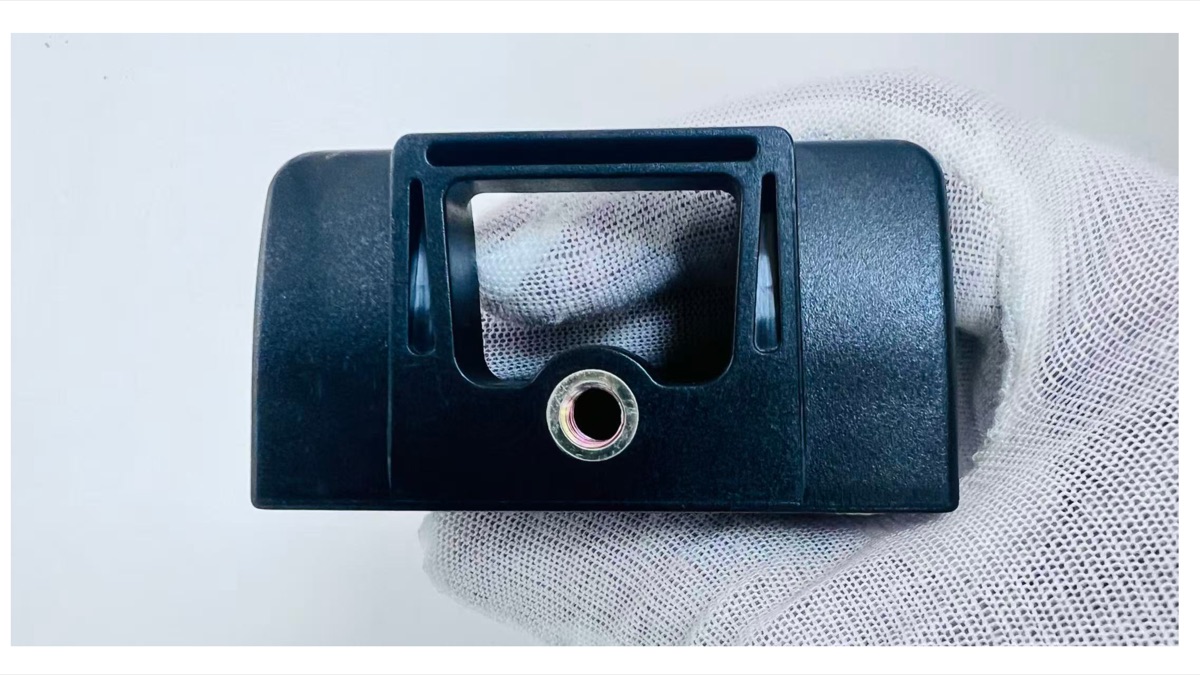
Threaded Inserts for Plastic Parts — Design, Installation, and Pull-Out Strength
A plastic boss is not a thread. It is a smooth cylinder waiting to become a fastening point. The moment a product needs a screw — to mount a PCB, to close a housing, to attach a bracket — the designer must decide: self-tapping screw directly into plastic, or a threaded insert?
Self-tapping screws work once. Maybe twice. On the third disassembly, the threads in the plastic strip and the boss becomes a hole. For any product that will be serviced, reassembled, or subjected to repeated loading, the answer is a metal threaded insert — a brass or stainless steel bushing pressed, staked, or molded into the plastic that provides a reusable, durable thread.
This guide covers the three installation methods, material selection criteria, boss design parameters, and the pull-out and torque-out strength values that let you size the insert correctly.
1. Three Installation Methods
Heat Staking
A heated tool tip contacts the brass insert, softening the surrounding plastic as the insert is pressed into a pre-molded boss. The plastic flows into the knurls and undercuts on the insert body. When the tool retracts and the plastic cools, the insert is mechanically locked in place.
Advantages:
- Low equipment cost. A basic heat staking station with thermal controller costs $600–1,500. Multi-tip tools for multi-insert parts add $200–400 per tip.
- Process tolerant. The heat-softening approach works across a wide range of boss diameters and insert sizes with minimal setup adjustment.
- No vibration stress on adjacent components. Safe for parts with pre-installed PCBs or delicate features near the insert boss.
Limitations:
- Cycle time: 5–12 seconds per insert depending on insert size and plastic material. A part with 8 inserts takes 40–90 seconds of staking time.
- Temperature control is critical. Overheating burns the plastic around the insert (visible discoloration, reduced strength). Underheating leaves the insert proud of the surface or with insufficient plastic flow into the knurl.
- Glass-filled materials (PA66-GF30, PP-GF20) conduct heat away from the insert tip faster than unfilled grades, requiring higher tip temperatures and longer dwell times.
Ultrasonic Insertion
An ultrasonic horn vibrates the insert at 20–40 kHz, generating frictional heat at the plastic-insert interface. The plastic melts locally and flows into the insert knurls. Unlike heat staking, the heat is generated at the interface rather than conducted through the insert body.
Advantages:
- Faster than heat staking: 1–3 seconds per insert. A part with 8 inserts processes in 8–24 seconds.
- Consistent insertion depth. Ultrasonic systems use travel or force limits that produce repeatable results cycle-to-cycle.
- Cleaner process. No external heat source, minimal risk of surface burning when parameters are set correctly.
Limitations:
- Higher equipment cost. An ultrasonic insertion system costs $3,000–8,000 plus horn tooling ($400–1,200).
- Material dependent. Amorphous plastics (ABS, PC, PMMA) transmit ultrasonic energy efficiently and work well. Semi-crystalline plastics (PA, PP, POM) absorb more energy before melting, requiring higher amplitude and more precise parameter control.
- Insert geometry matters. Inserts designed for heat staking may not perform well under ultrasonic insertion — the knurl pattern and lead-in taper are different. Specify the installation method when ordering inserts.
Molded-In (Insert Molding)
The insert is placed into the mold cavity before injection. Molten plastic flows around the insert, encapsulating it in the molded part. No secondary operation required — the part comes out of the press with inserts installed.
Advantages:
- No secondary operation. The fastest per-part insert installation because it happens during molding, not after.
- Highest pull-out strength. The insert is fully encapsulated — plastic surrounds the entire body, not just the knurled section pushed into a boss. Pull-out strength for a molded-in insert is typically 20–40% higher than the same insert heat-staked into an equivalent boss.
- Zero risk of insertion misalignment. The insert position is set by the mold, not by an operator or machine alignment.
Limitations:
- Slower molding cycle. Placing inserts into the mold adds 5–15 seconds per cycle depending on insert count and placement complexity. This can be automated (end-of-arm tooling, bowl feeder) or manual (operator with tweezers).
- Risk of insert displacement. If an insert shifts during mold closing or injection, it damages the cavity. A displaced insert in a $15,000 mold cavity is a very expensive mistake.
- Inserts must withstand mold temperature (typically 40–90°C) and injection pressure without deforming. This is rarely an issue for brass or stainless steel, but rules out some specialty insert materials.
2. Material Selection: Brass vs Stainless Steel
| Property | Brass (C36000) | Stainless Steel (303/304) |
|---|---|---|
| Thread strength | Good | Excellent |
| Corrosion resistance | Moderate (tarnishes in humid environments) | Excellent |
| Thermal conductivity | High (3× stainless) | Low |
| Cost per insert (M3) | $0.02–0.06 | $0.06–0.15 |
| Magnetic | No | Slight (304) |
| Best installation method | Heat staking (conducts heat well) | Ultrasonic or molded-in |
Choose brass when: cost is the primary driver, the product is used indoors, and the installation method is heat staking. Brass accounts for approximately 80% of threaded inserts in consumer and industrial products.
Choose stainless steel when: the product is exposed to moisture, cleaning agents, or sterilization (medical devices, food equipment, marine). Also when the threaded joint must withstand high torque — stainless threads are less likely to gall or strip under repeated use.
Choose molded-in specifically when: pull-out strength is the critical design requirement, and the production volume justifies the slower cycle time. The strength advantage of full encapsulation makes molded-in the default choice for automotive structural brackets and high-load industrial components.
3. Boss Design Guidelines
The plastic boss that receives the insert must be dimensioned to provide adequate material volume for the insert body and the molten plastic flow during installation.
Heat Staking / Ultrasonic Boss
| Parameter | Recommendation | Notes |
|---|---|---|
| Boss OD | ≥ 2.0× insert OD | Prevents boss cracking during insertion |
| Boss ID | 0.1–0.2 mm smaller than insert OD | Interference fit keeps insert aligned before staking |
| Boss height | Insert length + 0.3–0.5 mm | Extra height provides melt material to flow into knurl |
| Hole depth | Insert length + 0.5 mm | Clearance for displaced plastic below insert |
| Wall thickness (boss to edge) | ≥ 1.0 mm for unfilled, ≥ 1.5 mm for filled | Filled materials are more brittle, need more wall stock |
| Draft angle on boss OD | 0.5–1.0° | Required for mold release |
Molded-In Boss
The design parameters differ because the plastic flows around the insert rather than the insert being pushed into a pre-formed hole.
| Parameter | Recommendation | Notes |
|---|---|---|
| Plastic thickness around insert | ≥ 1.5 mm radial | Ensures complete encapsulation |
| Insert standoff from mold wall | ≥ 0.5 mm | Prevents insert from touching cavity surface |
| Insert locating feature | Pin or shoulder in mold | Positive location prevents displacement |
| Gate position | Avoid gating directly onto insert | High-velocity melt hitting insert can dislodge it |
Common Failure Modes
Boss cracking. The insert OD is too large relative to the boss OD, or the material is too brittle (glass-filled grades with >30% fiber content). Fix: increase boss OD or reduce insert size. If the design cannot change, pre-heat the insert to reduce the thermal shock during installation.
Insert pull-out. The boss provides insufficient material volume, or the insert knurl depth is inadequate for the boss material. Fix: increase boss height, switch to an insert with deeper knurls, or change installation method to molded-in.
Insert spinning. The knurls have engaged but the anti-rotation features are inadequate for the applied torque. Fix: use an insert with radial barbs or flanges specifically designed for torque resistance, or add a mechanical anti-rotation feature to the boss geometry (a flat or keyway).
4. Pull-Out and Torque-Out Strength
The two critical mechanical properties of an inserted joint are:
- Pull-out strength (N): the axial force required to pull the insert out of the boss. This is a function of the boss material, the insert knurl engagement area, and the installation quality.
- Torque-out strength (N·m): the rotational torque required to spin the insert in the boss. This is a function of the insert’s anti-rotation features and the boss material shear strength.
Typical Pull-Out Values — Heat-Staked Brass Insert in ABS
| Insert Thread | Boss OD (mm) | Boss Height (mm) | Pull-Out (N) | Torque-Out (N·m) |
|---|---|---|---|---|
| M2 | 5.0 | 3.8 | 280–400 | 0.5–0.8 |
| M2.5 | 6.0 | 4.5 | 450–600 | 0.8–1.2 |
| M3 | 7.0 | 5.0 | 650–850 | 1.2–1.8 |
| M4 | 8.5 | 6.5 | 950–1,250 | 2.0–3.0 |
| M5 | 10.0 | 7.5 | 1,350–1,800 | 3.5–5.0 |
| M6 | 12.0 | 9.0 | 1,800–2,500 | 5.5–8.0 |
Values are for knurled brass inserts in unfilled ABS with proper installation. Reduce by 15–25% for PP (lower shear strength). Reduce by 10–20% for glass-filled PA66 (higher strength but less plastic flow into knurl). Increase by 20–40% for molded-in installation.
Important: These are design estimates, not guarantees. Pull-out and torque-out values should be validated on T1 samples with the actual production insert, material, and installation parameters. A 10°C difference in heat staking tip temperature can shift pull-out strength by 15%. Run at least 30 test samples when qualifying an insert joint for a production part.
Design Safety Factor
Apply a minimum 2.5× safety factor on pull-out and torque-out values for static applications (enclosure screws, bracket mounts). Apply 4.0× for dynamic applications (hinge mounts, components subject to vibration). These factors account for material batch variation, installation process variation, and plastic creep under sustained load.
5. Specifying Inserts in Your RFQ
When requesting a quote for parts with threaded inserts, provide:
- Insert specification. Thread size (M3, #4-40, M4), insert type (knurled body, flanged, through-hole, blind), material (brass, stainless), and a part number if you have a preferred supplier.
- Installation method. Heat staking, ultrasonic, or molded-in. If you don’t specify, the supplier will choose heat staking as the default.
- Assembly torque specification. The torque that will be applied to the screw during product assembly. This determines whether the insert’s torque-out resistance is adequate.
- Disassembly requirement. How many times the screw will be removed and reinstalled over the product life. A service panel opened 50 times during the product lifetime needs a different insert quality than an internal bracket assembled once.
A threaded insert costs two to six cents and solves a problem that will otherwise cost a returned product, a warranty claim, or a field service call. Specify the insert, the installation method, and the boss geometry as a system — not as three independent decisions — and the joint will survive every disassembly the product sees.
Request a quote with your insert and assembly requirements →