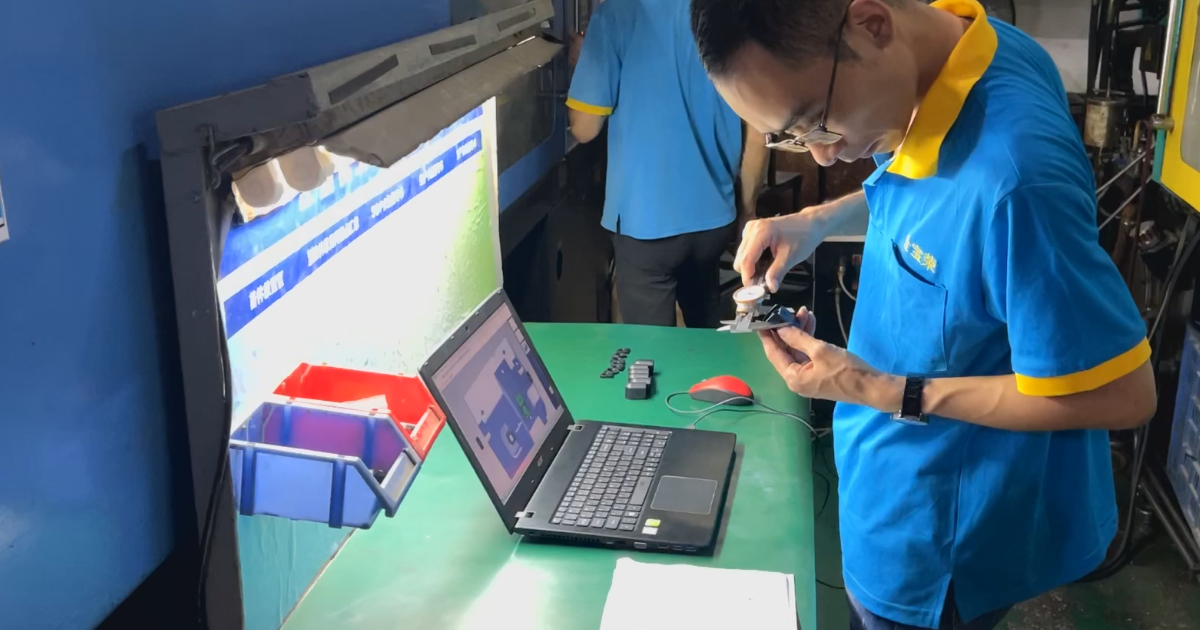
Quality Control in Injection Molding — CMM, SPC, and Inspection Workflow
A buyer receives a shipment of 10,000 molded parts. The dimensional report says everything is within tolerance. The visual inspection report says no defects were found. The certificate of conformance is signed and dated.
Three weeks later, the assembly line stops. The parts do not fit. The dimensional report — it turns out — measured five parts from one cavity of an eight-cavity tool. The other seven cavities were running 0.15 mm over nominal on a critical boss. The report was not wrong. It was incomplete. The buyer did not know what to ask for, so the supplier provided what was asked for: a report, any report, with “pass” written on it.
Quality control in injection molding is not about the certificate. It is about the data behind the certificate — what was measured, how many were measured, when they were measured, and what the measurements actually say. This guide walks through the inspection workflow a competent molder runs on every production order, and what a buyer should expect to receive at each stage.
1. The Five-Stage Inspection Workflow
A production order at a quality-managed injection molding facility passes through five inspection gates. Each gate produces documentation. If a gate is skipped, the documentation from subsequent gates is unreliable.
Stage 1 — Incoming Material Inspection
Before any material enters the press, the resin lot is verified against the purchase order and the material specification.
What happens: The incoming resin is checked for correct grade (e.g., PA66-GF30, not PA6-GF30), correct supplier, and correct lot number. A sample may be moisture-tested if the material is hygroscopic (PA, PC, PET). The material certificate from the resin supplier is filed for traceability.
Documentation produced: Material receiving record with lot number, supplier name, grade verification, and moisture test result (if applicable).
What the buyer should see: The lot number on the material cert should trace forward to every shipment of finished parts produced from that lot. If you ask “which resin lot was used for the parts in shipment #247?” and the supplier cannot answer in under five minutes, their traceability system does not exist.
Stage 2 — First-Article Inspection
The first shots from the production run — after the process has stabilized — are pulled for a full dimensional inspection. This is the most important inspection gate because it verifies that the mold, material, and process parameters are producing parts that match the drawing before the run proceeds.
What happens: Typically 3–5 shots are taken once the process reaches steady-state (stable melt temperature, consistent fill time, consistent cushion). Every dimension on the drawing is measured and recorded against nominal and tolerance. For multi-cavity tools, parts from each cavity are measured separately — cavity-to-cavity variation is documented.
Documentation produced: First-Article Inspection Report. This is a dimension-by-dimension table showing the drawing callout, nominal value, upper/lower tolerance, and measured values for each cavity.
What the buyer should see: The FAI report should show which cavity each measurement came from. A single column of measurements labeled “sample #1” with no cavity identification is a red flag — the supplier either does not know which cavity produced which part, or measured only one cavity and is presenting the data as representative of all cavities.
Stage 3 — In-Process Inspection
During the production run, parts are pulled at defined intervals for ongoing dimensional and visual checks. This catches process drift — a dimension that was in tolerance at first article but has moved toward the limit as the mold temperature stabilized, the material lot shows variation, or a cavity begins to wear.
What happens: At intervals defined by the control plan (typically every 2–4 hours, or every Nth shot), the operator pulls 1–3 shots from each cavity. Critical dimensions — not all dimensions, but the 3–8 that matter most for fit and function — are measured and recorded on a control chart.
Documentation produced: In-process inspection records with control charts (X-bar and R, or individual and moving range) for critical dimensions.
What the buyer should see: The control chart should show data points over time with control limits. A flat line at nominal with no variation is not good — it means nobody is actually measuring. Real measured data has variation.
Stage 4 — Final Inspection
After the production run is complete and before parts are packed, a final inspection samples the finished parts for dimensional, visual, and functional checks.
What happens: A sample is drawn per AQL (Acceptable Quality Limit) sampling plan — typically AQL 1.0 or 0.65 for critical defects, AQL 2.5 or 4.0 for minor defects. The sample size depends on the lot size. A lot of 3,200–10,000 parts at AQL 1.0 requires 125 samples inspected, with a maximum of 3 defectives allowed.
Documentation produced: Final inspection report with AQL sampling plan, defect classification (critical/major/minor), quantities inspected, defects found per category, and accept/reject decision.
What the buyer should see: The AQL level and sample size should be stated explicitly. A report that says “inspected 100% — no defects” on a lot of 5,000 parts is false. Nobody inspects 5,000 parts 100% unless the parts are worth more than the inspection labor.
Stage 5 — Pre-Shipment Inspection (出货检验)
A final verification before the parts are loaded into the shipping container. This is typically the last checkpoint and the one closest to the buyer’s receiving inspection.
What happens: A sample is drawn from the packed cartons — not from the production line — to verify that the parts being shipped match the approved samples and the packing specification. Dimensions may be checked on a subset. Packaging quality, labeling, and quantity per carton are verified.
Documentation produced: Pre-shipment inspection report, packing list with carton-level contents.
2. Reading a CMM Report
A Coordinate Measuring Machine uses a touch probe to measure part dimensions by recording the X, Y, Z coordinates of specific points on the part surface. The output is a report that lists each measured dimension, the nominal value, the upper and lower tolerance limits, the actual measured value, and the deviation.
What a good CMM report tells you:
- The part number, revision level, and drawing number — so you know which version was measured.
- The measurement date and the instrument used — traceability to a calibrated instrument.
- For each dimension: the measured value, the deviation from nominal, and whether it is in or out of tolerance.
- Cavity identification — each cavity measured and reported separately.
- The CMM program reference — so the same measurement routine can be repeated on future lots.
What to look for:
- All dimensions in tolerance, but biased. If every critical dimension is +0.05 from nominal (within a ±0.10 tolerance), the process is running at one edge of the tolerance band. A slight material batch shift or tool wear will push it out of tolerance. This is not a report to accept without discussion — it is a report that says “we need to adjust the process to center.”
- One dimension out, everything else perfect. If 25 dimensions are within tolerance and one is out by 0.02 mm, the mold may need a minor adjustment — or the drawing tolerance on that dimension may be unrealistically tight for the material and geometry. Either way, the report has done its job by surfacing the issue before parts ship.
- No report at all. The buyer requests a CMM report and receives a one-page summary that says “all dimensions in tolerance” with no measured values. This is not a CMM report. It is a letter of assurance, and it is worthless.
3. Understanding SPC Data
Statistical Process Control uses control charts to distinguish between normal process variation (common cause — always present) and unusual variation (special cause — something changed that needs investigation).
The two most common control charts in injection molding:
X-bar and R chart: For each inspection interval, a small sample (typically 3–5 parts) is measured. The average (X-bar) and range (R) of each sample are plotted. The X-bar chart shows whether the process average is stable. The R chart shows whether the within-sample variation is stable. A shift in the X-bar chart without a corresponding shift in R means the process average moved — possibly mold temperature change, material viscosity shift, or a cavity beginning to wear. A shift in R without X-bar means variation increased — possibly inconsistent packing, check ring wear, or material moisture variation.
Individual and moving range (I-MR) chart: Used when only one measurement is taken per inspection interval. The individual chart plots each measurement. The moving range chart plots the absolute difference between consecutive measurements. I-MR charts are common in injection molding for dimensions that are slow to measure — CMM measurements where each data point takes 5–10 minutes to generate.
What a buyer should ask:
- “What Cpk are you holding on the critical dimensions?” Cpk ≥ 1.33 is the standard answer for a capable process. Cpk ≥ 1.67 is the automotive/medical expectation. If the supplier cannot produce a Cpk value, they are not running SPC — they are measuring parts and filing the data without analyzing it.
- “Show me the last three production runs for this part.” Process capability is not a one-time measurement. A Cpk of 1.67 on one run and 0.95 on the next two means the process is not stable, regardless of what the first report says.
4. Documentation Standards: FAI, PPAP, and ISO 13485
First Article Inspection Report
The FAI is the most common documentation request from buyers. It verifies that the first parts from a production run meet the drawing requirements. A complete FAI package includes:
- Dimensional report (all drawing dimensions, measured values, pass/fail per dimension)
- Material certificate (resin grade, lot number, supplier)
- Appearance approval (color, surface finish against reference sample)
- Functional test results (if applicable — leak test, drop test, pull test)
The industry standard for FAI is AS9102 (aerospace) or the PPAP dimensional requirements (automotive). Most general industrial buyers do not need AS9102 format — they need the content, not the form.
PPAP (Production Part Approval Process)
PPAP is an automotive industry requirement, but its structure is useful for any buyer placing a high-volume production order. A PPAP Level 3 submission includes 18 elements — the key ones for an injection molding buyer:
- Design records (the drawing you approved)
- Dimensional results (CMM or manual — every dimension, every cavity)
- Material certifications (resin supplier’s cert, plus any secondary material certs)
- Process flow diagram (material drying → molding → degating → inspection → packing)
- Control plan (what is inspected, how often, by what method, to what specification)
- Measurement system analysis (Gage R&R — proves the measurement method is repeatable)
- Initial process capability study (Cpk data for critical dimensions)
- Part submission warrant (the signed cover sheet that says “these parts are production-ready”)
A buyer who requests PPAP from a supplier unfamiliar with it will receive a blank look. A buyer who requests it from a supplier who knows what it is will receive a binder of data that answers every question before the question is asked.
ISO 13485 Documentation
For medical device components, ISO 13485 adds documentation requirements beyond ISO 9001:
- Batch traceability — every part traceable to its resin lot, production date, machine, operator, and mold cavity
- Clean room monitoring records — particle counts, temperature, humidity, and pressure differential logged per shift
- Change control documentation — any process, material, or tooling change documented with rationale, validation data, and customer approval record
- Retention period — records maintained for minimum 10 years (device lifetime + post-market surveillance)
5. Questions to Ask Your Supplier’s Quality Team
Before placing a production order, ask these five questions. The answers — or the inability to answer them — will tell you more about the supplier’s quality system than any certificate on the wall.
“Show me a dimensional report from your last production run — not a sample report, the actual report from the parts you shipped.” A supplier with a real quality system can produce this in minutes. A supplier who demurs or offers to create one is telling you the reports are generated after the fact.
“What is your cavity identification system?” In a multi-cavity mold, each cavity should be physically marked (engraved cavity number on a non-cosmetic surface) so that parts can be traced to the cavity that produced them. If the cavities are not marked, cavity-specific inspection data is impossible.
“What happens when an in-process inspection finds an out-of-tolerance dimension?” The answer should describe a defined procedure: stop production, quarantine parts back to the last good inspection, investigate root cause, correct, document. The answer should not be “we adjust the dimension and keep running” without mention of quarantine or investigation.
“Can I visit the inspection department during production?” Not as a formal audit — just to see it operating. A clean, organized, well-lit inspection room with calibrated equipment and parts flowing through it is the most honest quality certificate there is.
“Who signs the certificate of conformance, and what are they certifying?” If the answer is “a QC inspector certifies that the parts meet the drawing,” ask the follow-up: “Does that inspector have the drawing in front of them when they sign?” The CoC should reference specific documents: “Parts conform to drawing REV C per FAI report #2026-0472 dated 03-Jun-2026.”
A quality system is not the certificates on the lobby wall. It is the data from the inspection department, produced during production, by people who know that someone on the other end will actually read it. Before you place an order, ask to see the data. If what you receive is a one-page summary with no measurements, request the underlying reports. A supplier who has them will send them. A supplier who does not will make excuses. That distinction is worth more than any audit checklist.