Post-Molding Operations Guide — From Pad Printing to Assembly
You have a plastic part. It is molded. It comes out of the press dimensionally correct, the right material, no flash or sink marks. And it is still not ready to ship.
It needs a logo printed on it. A brass insert pressed into a boss. A lens ultrasonically welded to a housing. A coating that will not peel off after six months in the sun. Suddenly the injection molding quote — which looked straightforward — is one piece of a multi-process puzzle. Every operation adds cost, lead time, and a potential point of failure. Getting the secondary operations right matters as much as getting the mold right.
This guide covers the six most common post-molding operations — pad printing, ultrasonic welding, heat staking, spray painting, laser marking, and assembly — from the perspective of a buyer writing an RFQ. What each process does. What it costs. What the supplier needs to know to quote it accurately.
1. Pad Printing
Pad printing transfers a 2D image onto a 3D plastic surface using a silicone pad that picks ink from an etched cliché plate and presses it onto the part. It is the go-to process for logos, regulatory markings, and multi-color graphics on curved or textured surfaces.
Where it is used: Consumer electronics housings (brand logos, input labels), medical device markings (scale graduations, warnings), automotive interior parts (button symbols, gear indicators).
What drives cost:
- Color count. Each color requires a separate pass with its own cliché plate and pad. A one-color logo costs roughly $0.02–0.05 per part. A four-color graphic costs 4× that plus a setup charge of $80–150 per color for the cliché.
- Surface geometry. A logo on a flat surface is straightforward. A logo wrapping around a compound curve may require a custom-shaped pad and fixture. Complex geometry adds $100–300 in fixturing cost.
- Volume. Cliché plates wear after approximately 50,000 impressions. For runs exceeding that, factor in plate replacement costs.
Design rules:
- Minimum line thickness: 0.2 mm for legible text. Finer detail is possible but increases rejection rate.
- Registration tolerance: ±0.3 mm for single-color. ±0.5 mm for multi-color (accumulated error).
- Ink adhesion depends on surface energy. Polypropylene and polyethylene require flame or corona pre-treatment before printing. ABS, PC, and PMMA print well without treatment.
2. Ultrasonic Welding
Ultrasonic welding joins two thermoplastic parts by applying high-frequency vibration (typically 20 kHz or 40 kHz) through a horn that contacts the upper part. The vibration generates frictional heat at the joint interface, melting the plastic locally and creating a structural bond in under a second.
Where it is used: Enclosure sealing (two-shell housings), medical device assembly (filter housings, fluid chambers), automotive lighting (lens-to-housing welds), consumer electronics (charger cases, power tool housings).
What drives cost:
- Joint design. A properly designed energy director — a triangular ridge molded into one half of the joint — is essential. If your part was not designed with an energy director, the mold may need modification ($200–600 per cavity). If the part was designed with one from the start, the welding setup cost is typically $300–800 for the horn and fixture.
- Material pairing. Similar materials weld well (ABS to ABS, PC to PC). Dissimilar materials generally do not — ABS does not weld to PP, and PC does not weld to PA. The material selection decision you made months ago determines whether ultrasonic welding is even an option.
- Part size. A small charger case welds on a 20 kHz bench-top system in 0.5 seconds. A large automotive lens requires a 15 kHz system with a custom horn array, higher setup costs ($1,000–2,500), and longer cycle time.
Design rules:
- Energy director height: 0.3–0.8 mm depending on material. ABS: 0.4–0.6 mm. PC: 0.5–0.8 mm. PP: 0.3–0.5 mm.
- Joint must be in the plane of the horn contact. Welding at an angle or on a non-parallel surface introduces inconsistent pressure and weak bonds.
- Keep the distance from horn contact to joint under 6 mm (near-field welding). Distances beyond 6 mm (far-field) are possible but reduce weld strength and consistency.
3. Heat Staking
Heat staking uses a heated tool to soften a plastic boss or rib and form it into a head that mechanically retains another component — a PCB, a metal contact, a lens, a threaded insert. Unlike welding, heat staking does not join two plastic parts. It deforms one plastic feature to capture a dissimilar material.
Where it is used: PCB mounting in electronic housings, threaded insert installation, lens retention in lighting assemblies, membrane switch attachment.
What drives cost:
- Stake count. Each stake point requires its own heated tip on the tool. A part with 4 stake points costs less to tool than a part with 24. Tooling cost ranges from $400–1,200 depending on stake count and geometry.
- Insert installation. Heat staking a brass threaded insert into a plastic boss requires precise temperature control — too hot and the insert melts surrounding material, too cool and it sits proud of the surface. Insert staking stations are typically $600–1,500 for the heated tip, thermal controller, and insert feed mechanism.
- Cycle time. A 4-stake part processes in 8–15 seconds. Each additional stake point adds approximately 2–3 seconds.
Design rules:
- Boss outer diameter for inserts: minimum 2× the insert diameter to prevent boss cracking during installation.
- Boss height: 0.3–0.5 mm taller than the insert length to allow for melt flow into the knurl.
- Stake head diameter after forming: 1.5× the boss diameter for adequate retention. The mold must provide enough material volume above the retained component.
4. Spray Painting
Spray painting applies a liquid coating to molded parts for aesthetic, protective, or functional purposes. It ranges from simple matte black coating for light-blocking to high-gloss piano-black finishes requiring primer, base coat, top coat, and UV clear coat.
Where it is used: Consumer electronics (high-gloss front panels), automotive interior trim (soft-touch feel, color matching), appliance fascias (metallic effect), EMI shielding (conductive paint).
What drives cost:
- Number of coats. Single-coat matte: $0.08–0.20 per part. Primer + base + clear coat: $0.30–0.80 per part. Each coat adds material cost, cycle time, and a potential quality hold point.
- Surface preparation. Molded parts come out of the press with residual mold release and low surface energy. A power wash or solvent wipe is the minimum pre-treatment. For high-adhesion requirements (automotive interior spec), plasma or flame treatment adds $0.03–0.08 per part.
- Yield. Spray painting is the highest-rejection secondary operation. Dust, orange peel, runs, and color mismatch can push rejection rates to 5–15% on high-gloss finishes. These yield losses are built into the unit price — a $0.30 paint quote on a 90% yield part effectively costs $0.33 per good part.
Design rules:
- Masking: any surface that must remain unpainted — snap-fit features, weld joints, boss tops — requires masking. Masking is manual, slow, and expensive ($0.05–0.15 per masked area). Design the part so that surfaces requiring paint are geometrically isolated from surfaces that must stay clean.
- Hanging features: parts need a non-cosmetic surface with a hole or hook for hanging on the paint line conveyor. If no such feature exists, one must be added to the mold.
- Paint thickness: 15–30 μm per coat. Account for this in snap-fit clearances — a 20 μm paint layer on both halves of a snap reduces the gap by 40 μm.
5. Laser Marking
Laser marking uses a focused beam to create a permanent mark on a plastic surface — darkening the material (carbonization), bleaching the pigment (foaming), or ablating a printed coating. Unlike pad printing, laser marking requires no consumables and produces no ink waste. Unlike labels, it cannot peel off.
Where it is used: Medical device UDI codes, automotive part traceability barcodes, electronic enclosure regulatory marks, brand logos on premium consumer products.
What drives cost:
- Mark area and complexity. A simple logo under 10 × 10 mm takes under 1 second to mark. A full UDI barcode with human-readable text takes 3–8 seconds. The per-part cost is almost entirely cycle time driven — approximately $0.005–0.03 per mark.
- Material. Not all plastics mark equally. ABS and PC mark well with a fiber laser. PP marks poorly without a laser-sensitive additive (approximately $0.50–1.00/kg added to resin cost). PA marks well with a UV laser but inconsistently with fiber. Specify the marking requirement at the material selection stage — retrofitting a laser additive to an existing production part is expensive.
- Contrast requirements. Dark mark on light substrate works on most materials. Light mark on dark substrate (white-on-black) requires specific pigment chemistry. Verify contrast with the laser supplier before committing to a color scheme.
Design rules:
- The marked surface must be flat or near-flat (±0.5 mm depth of field for standard optics). Marking on a curved surface requires a 3-axis or galvo head with dynamic focus — higher equipment cost but negligible per-part cost difference.
- Mark location must be accessible to the laser beam with no line-of-sight obstructions from adjacent part geometry.
- Surface finish affects mark quality. A smooth surface (SPI A-2 or B-1) produces a clean, high-contrast mark. A textured surface (VDI 24+) produces a diffused mark with lower apparent contrast.
6. Assembly
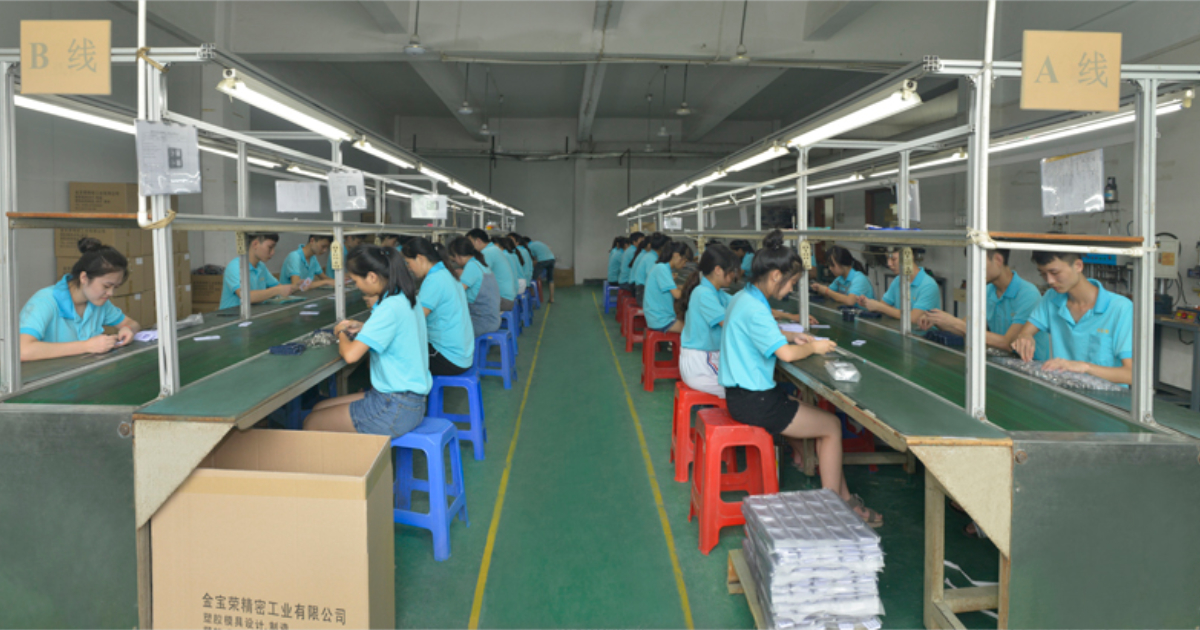
Assembly covers everything from simple two-part snap-fits to multi-station lines handling PCBs, fasteners, springs, gaskets, cables, and labels. For the buyer, the value proposition is straightforward: receive a ship-ready product instead of a box of components that still need to be put together.
Where it is used: Any product that is more than one part. Consumer electronics, medical devices, automotive sub-assemblies, appliance components.
What drives cost:
- Labor content. Assembly is the most labor-intensive secondary operation. A simple snap-fit takes 5–10 seconds of operator time. A 12-step assembly with screws, springs, and connectors takes 2–5 minutes. At Shenzhen assembly labor rates ($4–7/hour loaded), the labor cost for that 12-step assembly is $0.13–0.58 per unit.
- Inspection overhead. Every assembly station should include in-process inspection — torque verification on screws, push-test on snap-fits, continuity check on electrical connections. This adds 20–40% to the assembly cycle time but prevents a defective batch from reaching the customer.
- Packaging. Retail-ready packaging (blister pack, color box, barcode label) adds material cost and another assembly station. Industrial bulk pack (polybag + carton) is the lowest-cost option.
Design rules:
- Design for poka-yoke (mistake-proofing): if a component can be installed backwards, it will be — eventually. A small asymmetry in the geometry (an offset boss, a keyed connector) eliminates the failure mode at zero per-unit cost.
- Minimize fastener types: if a product uses M3 × 8 mm and M3 × 12 mm screws, the operator must distinguish between them on every cycle. Using a single length eliminates sorting time and the risk of a short screw in a deep boss.
Choosing the Right Combination
Most production parts use two or more secondary operations. A typical consumer electronics enclosure might combine pad printing (logo), ultrasonic welding (housing seal), and heat staking (PCB retention). A medical device housing adds laser marking (UDI code) and clean room assembly.
The cost of secondary operations is not simply the sum of individual process costs. Interaction effects matter:
- Sequence matters. Pad-print before painting, not after. Weld before assembly, not after. A process that damages a previously completed operation doubles the scrap cost.
- Handling between operations. Every time a part moves from one station to another, it is handled. Handling adds labor and introduces the risk of scratches, contamination, and misorientation. Consolidating operations at a single supplier eliminates inter-facility transport and reduces handling to intra-facility transfer.
- Clean room requirements. If any operation requires a clean room (medical, optical), all downstream operations must occur in clean conditions. A part that leaves the clean room for spray painting cannot re-enter for assembly without re-cleaning.
What to Send in Your RFQ
When requesting a quote for molded parts with secondary operations, include:
- Finished part drawing showing ALL post-molding features — printed graphics with dimensions, insert locations with tolerances, weld joint cross-sections, paint areas with color references (Pantone or RAL).
- Assembly BOM (if applicable) listing every component, its material, and its source. Indicate whether JBRplas sources the components or you supply them.
- Quality requirements — AQL level, specific tests (pull test on welds, cross-hatch adhesion test on paint, torque test on inserts), and documentation requirements (inspection reports, certificates).
- Target annual volume. Secondary operation pricing is volume-sensitive. A $1,200 fixture amortized over 5,000 parts adds $0.24 per part. The same fixture over 100,000 parts adds $0.012 per part.
- Packaging specification. If you don’t specify, you get industrial bulk pack. If you need retail-ready packaging, specify it — it changes the quote materially.
A part that comes out of the press is half-finished. The secondary operations are not an afterthought — they are part of the part. Specify them with the same precision as the mold design, and you get back a quote that reflects reality, not a low number that doubles when the PO arrives.
Request a quote with your secondary operation requirements →