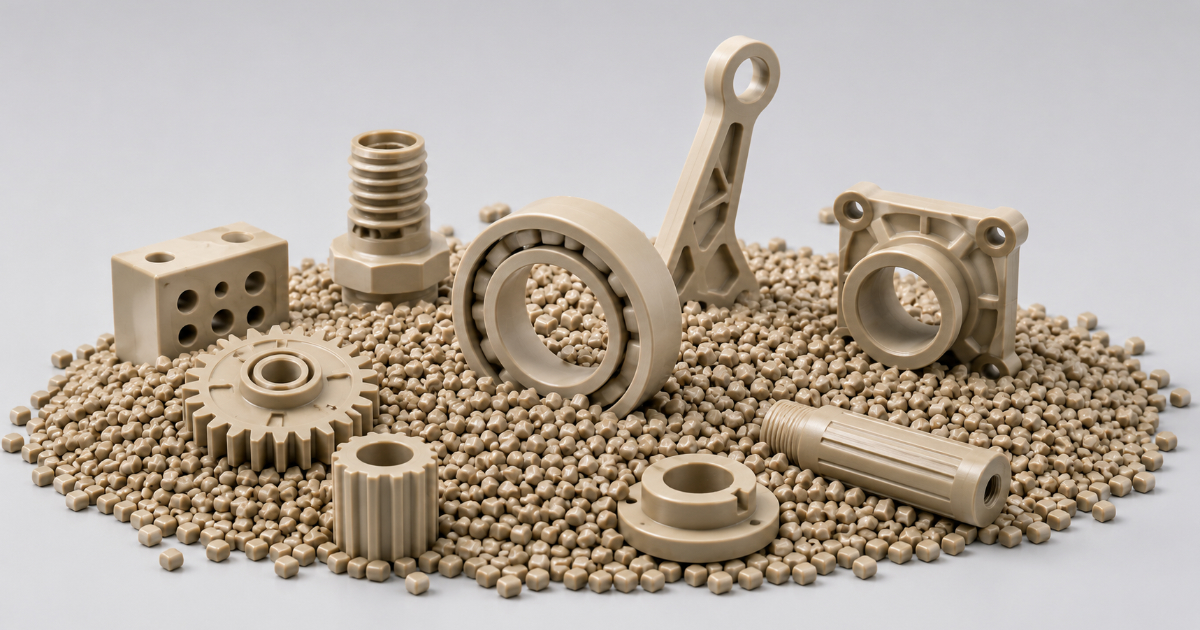
PEEK and High-Performance Plastics Injection Molding — A Technical Guide for Demanding Environments
A design engineer at a medical device company is specifying the housing for an implantable surgical tool that will be autoclaved at 134°C between procedures. The part is 65 mm long with 2.2 mm walls, four threaded inserts, and a snap-fit lid. The first prototype was machined from PEEK rod stock and worked perfectly — but at $380 per machined part, the production cost model does not close at 5,000 units per year. The obvious answer is injection molding. The less obvious answer is that molding PEEK is not the same as molding ABS with a hotter barrel.
A different engineer — at an oil and gas instrumentation supplier — is designing a downhole sensor housing that must survive continuous exposure to 180°C, 15 MPa pressure, and hydrogen sulfide. The shortlist of materials that work in this environment has exactly one entry: PPS. But PPS processes at 320–340°C, attacks standard mold steel with corrosive off-gassing, and has the melt viscosity of cold honey. The local molding shop quoted the job in standard ABS cycle time assumptions and walked away when they saw the material data sheet.
High-performance thermoplastics — PEEK, PPS, PEI (Ultem), LCP, PSU (polysulfone), and PES — occupy a different universe from the ABS, PP, and nylon that fill most injection molding production schedules. They require barrel temperatures from 300°C to 420°C, mold temperatures from 120°C to 200°C, specialized steel alloys that resist both heat and corrosion, and processing discipline that leaves zero margin for error. This guide covers what changes when you move from engineering resins into the high-performance tier.
What Makes a Plastic “High-Performance”
The plastics industry sorts thermoplastics into three tiers by continuous service temperature and cost:
| Tier | Continuous Use Temp | Price Range ($/kg) | Examples |
|---|---|---|---|
| Commodity | <80°C | $1.50–3.00 | PP, PE, PS, PVC |
| Engineering | 80–140°C | $3.50–8.00 | ABS, PC, PA6/66, POM, PBT |
| High-performance | >150°C | $25–120+ | PEEK, PPS, PEI, LCP, PSU, PES, PAI, PI |
The boundary between engineering and high-performance is not just temperature. It is processing difficulty and cost per kilogram. When a material costs $80/kg, a 20 g shot weighs $1.60 in raw material alone — before you add machine time, labor, and overhead. A runner system that wastes 40% of the shot becomes a cost problem that standard cold-runner designs were never built to handle. A single short shot with PEEK at $80/kg costs more in wasted material than an entire day’s scrap rate with ABS.
High-performance plastics share four characteristics that define the molding approach:
- Barrel temperatures above 300°C — approaching the thermal degradation threshold of the polymer itself, leaving a narrow processing window.
- Mold temperatures above 120°C — requiring oil heating or electric cartridge heaters instead of water, and eliminating standard water-line cooling.
- Corrosive off-gassing — sulfur compounds from PPS, fluorine traces from fluoropolymers, and acidic byproducts that attack P20 and standard tool steels.
- High melt viscosity — PEEK at 380°C flows more like cold polycarbonate than hot ABS, requiring higher injection pressures and larger gates despite the elevated temperature.
These are not materials you can run on a general-purpose press with a standard P20 mold and expect production-quality parts.
Material Profiles — When to Use Which
PEEK (Polyetheretherketone)
The best-known high-performance thermoplastic and the one most engineers encounter first when their application outgrows standard materials.
| Property | Unfilled PEEK | 30% Glass-Filled PEEK | 30% Carbon-Filled PEEK |
|---|---|---|---|
| Tensile strength | 95–100 MPa | 155–170 MPa | 210–230 MPa |
| Flexural modulus | 4.0 GPa | 9.5–10.5 GPa | 13–15 GPa |
| HDT @ 1.8 MPa | 152°C | 315°C | 320°C |
| Continuous use temp | 250°C | 250°C | 260°C |
| Processing temp | 360–400°C | 370–400°C | 380–410°C |
| Mold temp required | 160–190°C | 170–200°C | 180–200°C |
| Price ($/kg) | $80–110 | $65–85 | $90–130 |
PEEK’s defining characteristic is its combination of high continuous-use temperature (250°C), excellent chemical resistance (resists almost everything except concentrated sulfuric and nitric acids), and mechanical properties that approach aluminum at one-fifth the weight. Medical-grade PEEK (Invibio PEEK-OPTIMA, Solvay Zeniva) adds ISO 10993 biocompatibility for implantable and surgical applications.
The processing challenge: PEEK is semi-crystalline, meaning it must be molded into a mold at 160–200°C to allow the polymer chains to organize into crystalline structures during cooling. If the mold is too cold, the part freezes in an amorphous state with reduced mechanical properties, lower chemical resistance, and higher dimensional instability on subsequent thermal exposure. A PEEK part molded at 100°C mold temperature will have roughly 20–30% crystallinity; at 180°C, it reaches 35–40% — and the difference in wear resistance and chemical resistance is significant enough to determine whether the part passes or fails qualification.
PPS (Polyphenylene Sulfide)
The workhorse of chemical processing and automotive under-hood applications. Less expensive than PEEK ($12–25/kg) and inherently flame-retardant without additives.
| Property | Unfilled PPS | 40% Glass-Filled PPS |
|---|---|---|
| Tensile strength | 70–85 MPa | 150–170 MPa |
| Flexural modulus | 3.8 GPa | 12–14 GPa |
| HDT @ 1.8 MPa | 110°C | 260°C |
| Continuous use temp | 200°C | 220°C |
| Processing temp | 310–340°C | 320–345°C |
| Mold temp required | 130–150°C | 135–150°C |
PPS is the most chemically resistant of the affordable high-performance plastics — resistant to virtually all solvents, acids, and bases below 200°C, including the hydrogen sulfide and brine environments found in oil and gas downhole equipment. Where PEEK costs $80–110/kg, 40% glass-filled PPS at $8–15/kg makes high-temperature chemical resistance economically viable for production volumes.
The processing liability: PPS generates sulfur-containing off-gases during molding that corrode standard mold steel. P20 molds running PPS show visible surface pitting within 5,000–10,000 shots. The solution is corrosion-resistant mold steel — H13 with chrome plating, stainless 420, or for longer runs, precipitation-hardening grades like 1.2083 or M340. The added steel cost is offset by avoiding the tool refurbishment cycle that P20 would require.
PEI (Polyetherimide, brand name Ultem)
The transparent-amber engineering workhorse that bridges engineering and high-performance tiers. PEI offers a continuous service temperature of 170°C at roughly $15–25/kg.
| Property | Unfilled PEI | 30% Glass-Filled PEI |
|---|---|---|
| Tensile strength | 105 MPa | 150–160 MPa |
| Flexural modulus | 3.3 GPa | 8.5–9.0 GPa |
| HDT @ 1.8 MPa | 200°C | 210°C |
| Processing temp | 340–400°C | 350–400°C |
| Mold temp required | 130–165°C | 135–165°C |
PEI is the default choice for medical devices that must withstand repeated steam autoclave sterilization at 134°C — surgical instrument handles, dental tool housings, and sterilization trays. It carries ISO 10993 and USP Class VI biocompatibility ratings, is inherently flame-retardant (UL 94 V-0 at 0.4 mm), and offers transparency for applications where visual inspection of internal components is required.
The processing caveat: PEI is hygroscopic and absorbs moisture rapidly from ambient air. Processing PEI with moisture content above 0.02% produces hydrolysis during melting, which degrades the polymer chains and produces both visible splay on the part surface and reduced mechanical properties. Drying requirements are strict: 150°C for a minimum of 4 hours in a desiccant dryer with a dew point below −30°C. A hopper dryer is not adequate — the material must be dried in a closed-loop desiccant system and conveyed to the press in dry air.
LCP (Liquid Crystal Polymer)
The specialist for thin-wall, high-precision electronic components. LCP fills walls as thin as 0.2 mm and delivers dimensional stability that no other thermoplastic can match.
| Property | Unfilled LCP | 30% Glass-Filled LCP |
|---|---|---|
| Tensile strength | 140–180 MPa | 150–180 MPa |
| Flexural modulus | 9–12 GPa | 13–16 GPa |
| HDT @ 1.8 MPa | 250–310°C | 270–320°C |
| Processing temp | 300–350°C | 330–380°C |
| Mold temp | 80–120°C | 80–120°C |
LCP is unique among high-performance thermoplastics in that it can be molded with conventional mold temperature ranges — 80–120°C is achievable with pressurized water, eliminating the oil-heating requirement that complicates PEEK and PPS tooling. LCP flows like water at processing temperature because the rod-like molecular structure aligns in the direction of flow, creating self-reinforcing behavior that produces exceptional strength in the flow direction.
The trade-off: LCP properties are highly anisotropic. Tensile strength in the flow direction can be 3–4× higher than in the transverse direction. Weld lines in LCP are mechanical weak points because the molecular orientation does not cross the weld interface — unlike semicrystalline materials where polymer chains can partially diffuse across the interface. Gate placement for LCP must be designed to avoid weld lines in mechanically loaded regions.
Mold Design for High-Temperature Processing
Steel Selection
Standard P20 (1.2311) mold steel is rated for mold operating temperatures up to approximately 180°C. Above this temperature, P20 undergoes temper softening — the hardness drops from the initial 28–32 HRC, and the steel loses wear resistance at the parting line, ejector bores, and gate areas.
| Mold Steel | Max Mold Temp | Corrosion Resistance | Typical Application |
|---|---|---|---|
| P20 (1.2311) | ~180°C | Low | Not recommended for high-performance polymers |
| H13 (1.2344) | ~250°C | Low | PEEK short runs (<50k shots) |
| H13 chrome-plated | ~250°C | Medium | PEEK, PEI medium runs |
| Stainless 420 (1.2083) | ~250°C | High | PPS, PEEK production runs |
| M340 / M333 | ~280°C | Very High | PEEK, PPS, PEI long production runs |
| H13 nitrided | ~260°C | Medium-High | Extended PEEK/PPS runs, improved wear |
For mold manufacturing with high-performance materials, the default recommendation is H13 (48–52 HRC) with chrome plating on cavity surfaces for PEEK and PEI, and stainless 420 or M340 for PPS where corrosion resistance is mandatory.
Thermal Management
A mold running at 180°C requires a fundamentally different thermal management approach than one running at 60°C:
Oil heating, not water. Water at atmospheric pressure boils at 100°C. Pressurized water systems can reach 140–160°C but require pressure-rated plumbing, safety relief valves, and ongoing maintenance. For mold temperatures above 160°C, oil-based mold temperature controllers (oil TCUs) are the standard solution, circulating heat-transfer oil at up to 200–220°C.
Insulation plates. A mold running at 180°C mounted directly to a press platen acts as a heat sink into the machine frame, creating temperature gradients between the center and edges of the mold. Insulation plates (typically 10–15 mm phenolic or glass-reinforced composite) between the mold base and the press platens reduce heat loss to the machine by 60–70% and improve temperature uniformity across the cavity.
Cartridge heaters for local zones. Hot oil provides the baseline mold temperature, but local areas — deep cores, thin steel sections, areas distant from oil lines — require supplemental electric cartridge heaters with independent PID control. A conformal cooling approach using 3D-printed inserts with conformal heating channels can deliver uniform heating to complex cavity geometries that drilled straight oil lines cannot reach.
Gate and Runner Design
High-performance materials change the economics of runner systems. At $80/kg for PEEK, a cold runner that consumes 30 g per shot and regrinds it adds $2.40 per shot in material that must be recovered. But PEEK regrind cannot simply be blended back at 100% — thermal history during each molding cycle slightly degrades the polymer chains, and most PEEK processors limit regrind to 20–30% of the virgin material charge to maintain mechanical properties.
The result: for PEEK and similarly expensive materials, a hot runner system that eliminates the runner entirely pays for itself rapidly. The cost of a hot runner system — typically $3,000–8,000 per drop for high-temperature capable systems — is recovered in material savings within 1,000–3,000 shots at PEEK pricing.
Hot runner systems for high-temperature materials must be rated for continuous operation at 380–420°C, use corrosion-resistant components in the melt path, and maintain temperature uniformity within ±2°C across all drops. Standard hot runner systems rated for 300°C will fail rapidly when processing PEEK — the internal seals, heater bands, and thermocouple insulation are not designed for sustained operation at 400°C.
Processing Parameters — What the Data Sheet Does Not Tell You
Material manufacturers publish recommended processing windows, but the practical reality of running these materials is narrower than the datasheet implies:
PEEK Processing Reality
| Parameter | Datasheet Range | Practical Window | Why |
|---|---|---|---|
| Barrel temperature | 340–400°C | 370–390°C | Below 370°C, melt viscosity is too high for thin walls. Above 390°C, degradation begins within 5–8 minutes of residence time |
| Mold temperature | 140–220°C | 170–190°C | Below 170°C, crystallinity drops below 30%. Above 190°C, cycle time extends beyond practical limits for most part geometries |
| Injection speed | Medium-Fast | Fast | PEEK melt solidifies rapidly on contact with any surface below 350°C. A slow fill produces hesitation marks at every wall thickness transition |
| Holding pressure | 60–100 MPa | 80–100 MPa | PEEK has high molded density (1.30–1.55 g/cm³ depending on filler) and correspondingly high volumetric shrinkage. Low holding pressure produces voids in thick sections |
| Cooling time | Variable | As short as possible | The “cooling” phase with PEEK is actually the crystallization phase — the mold is at 180°C, so the part is not cooling below Tg in the traditional sense. The cycle-determining factor is the time to reach sufficient crystallinity for dimensional stability on ejection |
The Crystallinity Problem
Semicrystalline high-performance polymers — PEEK, PPS, and to a lesser extent PEI — derive their mechanical and chemical resistance properties from the crystalline structure that forms during controlled cooling from the melt. The degree of crystallinity is determined by the cooling rate from the melt temperature to below the glass transition temperature:
- Fast cooling (cold mold, thin wall): low crystallinity → lower strength, lower chemical resistance, higher dimensional change on subsequent heating
- Slow cooling (hot mold, thick wall): high crystallinity → higher strength, higher chemical resistance, dimensional stability on heating
- Annealing: post-molding heat treatment can increase crystallinity in parts that were molded with insufficient mold temperature, but adds a secondary process step and risks dimensional change during the annealing cycle
The practical implication: a PEEK part molded at 140°C mold temperature and later exposed to 200°C in service will undergo additional crystallization at the service temperature, producing dimensional change of up to 0.5–1.0%. A part molded at 180°C mold temperature will have already achieved near-equilibrium crystallinity and will show negligible dimensional change at 200°C. The mold temperature is not just a process parameter — it determines whether the part will fit in the assembly after the first thermal cycle in the field.
Applications and Selection Logic
Medical Devices
PEEK is the default material for surgical instrument handles, endoscopic device components, and implantable device housings that require repeated steam autoclave sterilization. The 134°C autoclave cycle eliminates standard engineering plastics — ABS and PC would soften and distort; nylon 6/6 would hydrolyze within 50–100 cycles. PEEK survives thousands of autoclave cycles with no measurable property degradation.
PEI (Ultem) is the transparent alternative for medical devices where visual inspection of internal components through the housing is required. PEI’s natural amber transparency and steam resistance make it the standard material for sterilization trays and dental handpiece housings.
Aerospace
PEEK and PEI compete for aircraft interior components where the FAA flammability requirements (14 CFR 25.853) eliminate most commodity and engineering plastics. PEEK meets the most stringent OSU heat release requirements without flame-retardant additives — an advantage over PEI, which relies on its inherent FR chemistry but can produce slightly higher smoke density in some grades.
Carbon-fiber-filled PEEK is increasingly used for metal replacement in structural aircraft brackets, replacing machined aluminum with injection-molded parts at 70% weight reduction. The metal-to-plastic conversion economics are compelling when the weight savings translate to fuel consumption reduction over the aircraft’s service life.
Oil and Gas
PPS dominates downhole instrumentation and sensor housings. The combination of continuous service at 180–200°C, resistance to H₂S, brine, and hydrocarbon exposure, and cost that is viable at production volumes ($12–25/kg for filled grades) makes PPS the material of choice for this industry. PEEK is used where the temperature requirement exceeds 220°C or where higher mechanical loads are present, but at 4–8× the material cost.
Electronics and Connectors
LCP is the standard material for high-density electrical connectors, surface-mount device (SMD) sockets, and chip carriers. The combination of 0.2 mm wall capability, dimensional stability through lead-free soldering temperatures (260°C peak), and inherent flame retardancy makes LCP irreplaceable in precision electronic applications.
Quality Control for High-Performance Parts
Quality control for high-performance plastic parts adds several checks beyond the standard inspection protocol:
- Crystallinity verification — Differential Scanning Calorimetry (DSC) on molded specimens measures the degree of crystallinity and the glass transition temperature. On 1:1,000 sampling for PEEK and PPS parts where the application involves thermal cycling or chemical exposure.
- Residual stress check — Polarized light inspection or solvent-immersion stress cracking test (per ASTM D543) detects molded-in stress that could cause environmental stress cracking in service. Relevant for PEI and PSU (polysulfone) medical devices exposed to cleaning agents and disinfectants.
- Melt flow rate (MFR) retest — Each material lot should have MFR tested before use. High-performance materials that have absorbed moisture or been stored improperly will show MFR deviation from the supplier’s certification value — indicating polymer degradation before the material ever enters the barrel.
- Dimensional stability after thermal conditioning — Critical dimensions measured before and after a 2-hour bake at the maximum service temperature to detect parts molded with insufficient crystallinity. Pass/fail: Δ dimension <0.2% after thermal exposure.
- 100% visual under magnification — At $80+/kg material cost, customer expectations for cosmetic quality are correspondingly high. Splay, contamination specks, and flow marks that would be acceptable on an ABS part are rejectable on a PEEK medical device component.
The engineer at the medical device company ultimately received a production mold in stainless 420 steel, hot runner system, oil-heated to 180°C, running unfilled medical-grade PEEK at 385°C barrel temperature with a 48-second cycle time. Per-part cost dropped from $380 (machined) to $18.50 (molded) — and the part passed 1,000 autoclave cycles with no dimensional change.
The oil and gas instrumentation engineer moved to 40% glass-filled PPS in an H13 chrome-plated mold at 145°C, running 330°C barrel temperature. The sensor housing passed the customer’s 180°C / 15 MPa qualification test and entered volume production at $28 per housing — versus the alternative of machined stainless steel at $320.
High-performance thermoplastics reward process discipline. The window is narrower, the steel costs more, and the material is less forgiving — but the result is a plastic part that performs in environments where most metals need a cooling jacket.
Material data: property tables for the common engineering and commodity resins in the injection molding materials guide →.