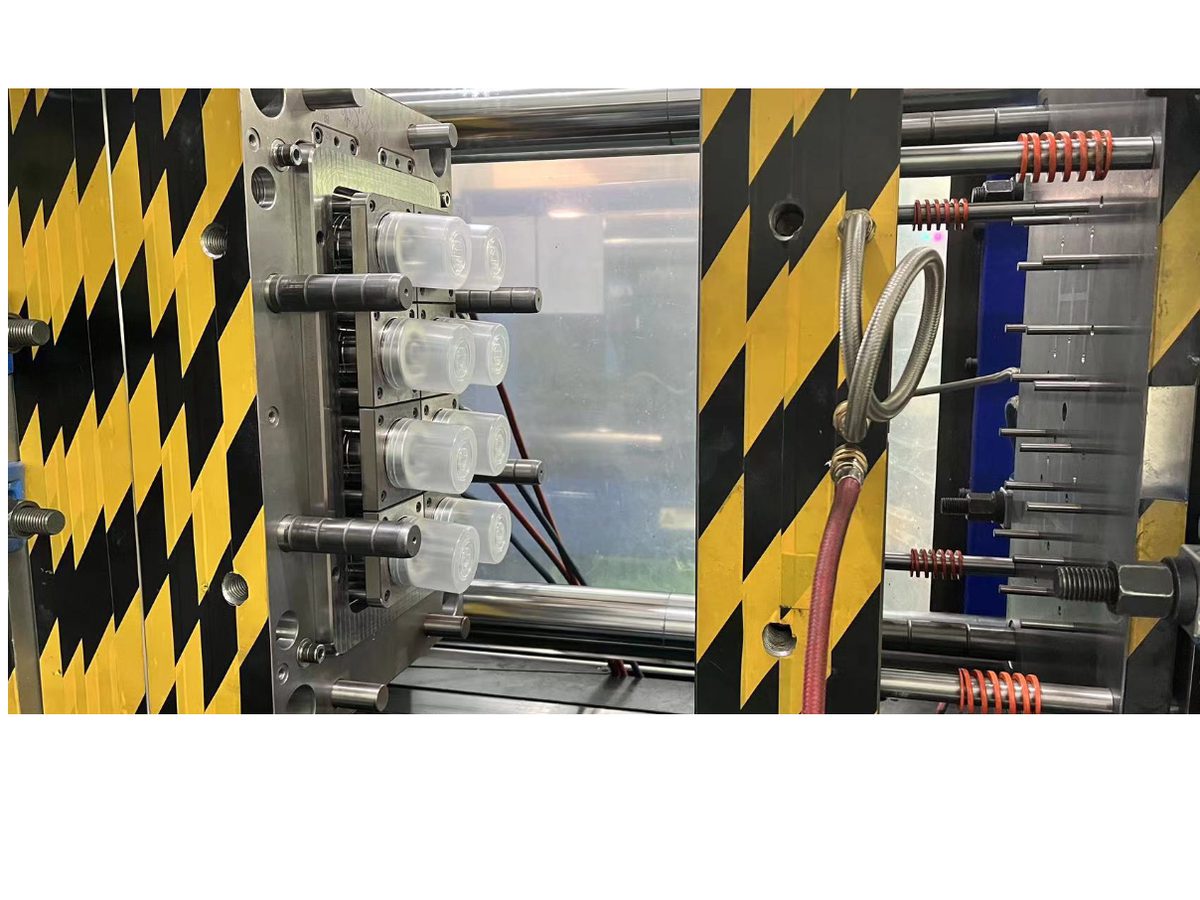
Multi-Cavity Mold Economics — Cavity Count, Runner Balancing, and Family Mold Risks
A buyer needs a connector housing in PA66-GF25. Annual volume: 600,000. The DFM report comes back recommending a 4-cavity mold. The buyer pushes back — the mold cost is 3× the single-cavity quote. They approve a single-cavity tool instead, reasoning that they can add cavities later if demand holds.
Six months in, the single-cavity mold is running 24/6 to keep up with orders. The press is a bottleneck. The per-part cost is $0.48. The buyer orders a second single-cavity mold to add capacity — same part, different cavity. Now they have two molds producing nominally identical parts with slightly different process windows, different wear rates, and a 0.03 mm dimensional offset between the two cavities that QA catches during assembly fit-check. The fix: sort parts by cavity, segregate inventory, adjust the mating component. Annual cost of that 0.03 mm: $12,000 in sorting labour and scrapped assemblies.
The 4-cavity mold would have cost $22,000 more upfront and reduced the per-part cost to $0.18 — saving $180,000 in processing cost over the first year. The cavity decision is the single largest economic lever in injection molding after the part design itself. This guide explains how to make it correctly.
1. Cavity Count Economics
A multi-cavity mold produces multiple identical parts per cycle. A single-cavity mold produces one. The economics are a trade between tooling investment and per-part cost — and the trade only makes sense when the production volume justifies the tooling premium.
How Cavity Count Scales
| Cavities | Relative Mold Cost | Parts per Hour (25s cycle) | Processing Cost per Part | Best For |
|---|---|---|---|---|
| 1 | 1× (baseline) | 144 | 1× (baseline) | < 50,000 parts/year |
| 2 | 1.6–1.8× | 288 | ~0.50× | 50K–200K parts/year |
| 4 | 2.5–3.0× | 576 | ~0.25× | 200K–1M parts/year |
| 8 | 4.0–5.0× | 1,152 | ~0.13× | 1M–3M parts/year |
| 16 | 7.0–9.0× | 2,304 | ~0.06× | > 3M parts/year |
Mold cost does not scale linearly with cavity count because the mold base, cooling manifold, ejector system, and parting line are shared across all cavities. A 4-cavity mold is not four single-cavity molds bolted together — it is one mold with four cavity inserts machined into the same plates.
The Breakeven Calculation
For a 12-gram ABS part running on a 160-tonne press:
| 1-Cavity | 4-Cavity | |
|---|---|---|
| Mold cost | $6,500 | $18,000 |
| Cycle time | 22s | 24s (+2s for balanced fill) |
| Parts per hour | 164 | 600 |
| Material per part | $0.036 | $0.036 |
| Processing per part | $0.17 | $0.047 |
| Total per part | $0.21 | $0.083 |
| Parts to breakeven | — | 90,500 parts |
The 4-cavity mold premium of $11,500 pays back after 90,500 parts through processing cost savings alone. At 600,000 parts per year, the 4-cavity tool saves $76,200 in the first year of production.
The rule of thumb: if annual volume exceeds the single-cavity annual output by more than 40%, and the program will run for more than one year, multi-cavity is the correct economic decision. The only exceptions are: very large parts where a multi-cavity mold exceeds available press tonnage, parts with extremely tight tolerances that make cavity-to-cavity variation unacceptable, or products with uncertain demand where the market has not been proven.
2. Runner Balancing
In a single-cavity mold, the runner is a single path from the sprue to the gate. In a multi-cavity mold, the runner splits into branches — and every branch must deliver melt to its cavity at the same flow rate, same pressure, and same temperature. If the runner is unbalanced, cavities fill at different times, pack at different pressures, and produce parts with different dimensions, weights, and mechanical properties.
Naturally Balanced Runners
A naturally balanced runner layout gives every cavity an identical flow path from the sprue to the gate. Every cavity sees the same runner length, the same number of turns, the same shear history, and the same pressure drop.
The classic layouts:
- 2 cavities: H-pattern — sprue splits into two equal-length branches
- 4 cavities: H-pattern (double-split) or radial (cross) — each cavity at equal radius from sprue
- 8 cavities: Double H-pattern — two levels of branching, each path identical
- 16 cavities: Quadruple H or radial array
Naturally balanced runners are the standard for precision parts and engineering-grade materials. The machining is straightforward — the runner channels are milled into the parting line following the balanced layout — but the layout consumes more mold base area than an unbalanced arrangement. A naturally balanced 4-cavity H-pattern requires a mold base approximately 20–30% larger than an unbalanced linear arrangement of the same four cavities.
Artificially Balanced Runners
An artificially balanced runner uses different runner diameters or flow restrictors to compensate for different flow path lengths. Cavities closer to the sprue get a smaller runner diameter; cavities farther away get a larger diameter. The goal is equal pressure drop across unequal path lengths.
This approach saves mold base area — cavities can be arranged in a compact linear layout — but introduces sensitivity. A balanced-diameter runner calculated for one material and one fill time will be unbalanced for a different material or a different injection speed. Change the material from ABS to PC, and the viscosity difference shifts the balance point. Speed up the cycle to meet a delivery date, and the shear-thinning behavior changes the effective flow resistance of each branch.
Artificially balanced runners work for commodity materials (PP, PE, general-purpose ABS) with forgiving process windows and dimensional tolerances of ±0.15 mm or wider. For engineering resins, glass-filled materials, and tolerances tighter than ±0.10 mm, specify a naturally balanced layout.
Shear-Induced Imbalance
Even a geometrically balanced runner can produce unbalanced filling due to a phenomenon called shear-induced imbalance. In the primary runner channel, melt near the channel wall experiences high shear; melt at the center experiences low shear. When the runner splits at a branch point, the high-shear (low-viscosity) melt tends to go to one side and the low-shear (high-viscosity) melt to the other. Cavities served by the high-shear side fill faster.
The result: in an 8-cavity H-pattern mold, the inner four cavities and outer four cavities can see fill time differences of 5–15% despite geometrically identical runner paths. The melt temperature at the gate can differ by 5–10°C between inner and outer cavities — enough to shift the as-molded dimension by 0.02–0.05 mm.
Mitigation options:
- Melt flipper / MeltFlipper® technology — a patented runner geometry (Beaumont Technologies) that rotates the melt at the branch point, redistributing the shear profile evenly to both branches
- Oversized primary runner — a larger-diameter main runner reduces shear variation by lowering the overall shear rate
- Cavity-specific gate tuning — adjusting gate land length per cavity to compensate for fill imbalance (requires iterative T0 sampling, adds time and cost)
3. Family Molds — When Dissimilar Parts Share a Tool
A family mold produces two or more different parts in the same cycle. Common applications: left-hand and right-hand housing halves, a base and a cover that mate together, or a set of gears with different tooth counts for a single assembly. The parts are molded simultaneously in the same shot, in the same mold, on the same press.
The appeal is obvious: one mold instead of two. One purchase order. One press. Parts that need to fit together are made together, from the same material lot, under the same process conditions. For low-volume production — under 30,000 assemblies per year — a family mold can reduce tooling investment by 40–50% versus two separate molds.
The Problem With Family Molds
Family molds have an inherent problem: the cavities are for different parts, with different volumes, different flow lengths, different wall thicknesses, and different cooling requirements. One cavity might be a thin-wall cover (1.5 mm wall, 8 grams, 15-second cooling time) and the other a structural base (3.5 mm wall, 45 grams, 28-second cooling time). The cycle time is dictated by the slowest-cooling cavity — the base runs at 28 seconds while the cover could be ejected at 15 seconds. The cover sits in the mold for an extra 13 seconds every cycle, accumulating unnecessary heat history.
The four failure modes of family molds:
1. Fill imbalance. The smaller part fills first. During the remaining fill time for the larger part, the smaller cavity sits under full injection pressure — overpacked. The larger cavity may be underpacked. Result: the small part is overweight, dimensionally oversized, and may flash. The large part is underweight, has sink marks, and is dimensionally undersized.
2. Cycle time penalty. The slowest-cooling cavity sets the cycle time. All other cavities wait. A mold is only as fast as its largest, thickest part.
3. Unequal wear. If the annual demand for the two parts differs — 100,000 covers, 60,000 bases — one cavity runs at reduced utilization. When the cavities wear at different rates, the dimensional drift of one cavity relative to the other eventually causes fit problems in assembly. You cannot replace one cavity in a family mold — the entire insert set must be re-cut or the mold replaced.
4. Scrap multiplication. In a single-part mold, a rejected part produces one piece of scrap. In a family mold, if one cavity produces scrap but the other cavities produce good parts, the entire shot is lost — or you pay someone to sort good parts from bad at the press. If the smaller cavity flashes, you are throwing away good parts from the other cavities every cycle until the flash is corrected.
When a Family Mold Makes Sense
| Condition | Family Mold | Separate Molds |
|---|---|---|
| Assembly parts, matched demand, < 30K assemblies/year | ✓ Good fit | Over-investment |
| Assembly parts, matched demand, > 100K assemblies/year | Cycle time penalty too large | ✓ Better economics |
| Dissimilar demand (Part A: 100K, Part B: 20K) | One cavity runs at 20% utilization | ✓ Right-size each tool |
| Tight-tolerance assembly fit (≤ 0.05 mm) | Cavity-to-cavity variation risk | ✓ Independent process control |
| Large part + small part (weight ratio > 5:1) | Fill imbalance risk | ✓ Separate tools |
| Prototype or bridge tooling, < 5,000 shots | ✓ Minimize upfront cost | Unnecessary |
The short answer: family molds are a low-volume strategy. They save tooling cost at the expense of cycle time, process robustness, and long-term flexibility. Above 30,000 assemblies per year, the cycle time penalty and scrap risk usually outweigh the tooling savings.
4. Real Cost Comparison: 1, 4, 8, and 16 Cavities
A real part — ABS electronics enclosure, 45 grams, 120 × 80 × 30 mm, two side actions, SPI B-1 finish, P20 steel, cold runner. Annual volume: 1,200,000 parts.
| 1-Cavity | 4-Cavity | 8-Cavity | 16-Cavity | |
|---|---|---|---|---|
| Mold cost | $12,000 | $32,000 | $55,000 | $95,000 |
| Press tonnage | 120 t | 200 t | 300 t | 450 t |
| Cycle time | 28s | 30s | 32s | 34s |
| Parts per hour | 129 | 480 | 900 | 1,694 |
| Material cost/part | $0.14 | $0.14 | $0.14 | $0.14 |
| Processing cost/part | $0.22 | $0.058 | $0.031 | $0.017 |
| Total cost/part | $0.36 | $0.20 | $0.17 | $0.16 |
| Press hours for 1.2M parts | 9,302 | 2,500 | 1,333 | 708 |
| Annual processing cost | $260,500 | $70,000 | $37,300 | $19,800 |
The jump from 1 to 4 cavities is dramatic — 44% lower part cost, and the mold premium pays back in under 4 weeks of production. The jump from 8 to 16 cavities is marginal — per-part cost drops by only $0.014, while the mold cost increases by $40,000. The diminishing returns set in because the process cost is already low, and the cycle time increases slightly with each doubling due to the longer flow paths and larger mold mass.
The practical sweet spot: for volumes of 200,000–1,000,000 parts per year, 4-cavity tools offer the best balance of mold investment and per-part savings. Above 2,000,000 parts per year, 8 or 16 cavities become economical, but the decision should factor in press availability, maintenance complexity, and the cost of downtime — a 16-cavity tool that goes down for repair stops 16× the production of a single-cavity tool.
5. DFM Considerations for Multi-Cavity Molds
Multi-cavity mold design introduces requirements that do not exist in single-cavity tools.
Cavity numbering and traceability. Every cavity should be identified with a small engraved number (0.5–1.0 mm character height) on a non-functional surface of the part. This allows cavity-specific quality tracking. If cavity #3 starts producing parts 0.03 mm oversize, you know which insert to inspect — without numbering, you have a dimensional distribution and no way to isolate the source.
Gate design per cavity. In a single-cavity mold, the gate is optimized for that part. In a multi-cavity mold, every gate must be identical — same type, same land length, same land diameter, same gate position relative to the part geometry. A gate land that is 0.02 mm deeper on cavity #4 than cavities #1–3 will produce a measurable dimensional difference. Gate insert standardization and in-process verification during mold manufacturing prevent this.
Cooling uniformity. Every cavity must see the same cooling rate. Cooling channels should be laid out symmetrically around each cavity, with equal distance from the cavity wall to the cooling line. A cavity at the edge of the mold base that runs 5°C hotter than a cavity in the center produces parts with different shrinkage rates — and different dimensions.
Ejector balance. The ejection force must be evenly distributed across all cavities. Uneven ejection — one cavity ejecting before another due to a slight plate deflection — bends the parts and leaves ejector pin marks at different depths. The ejector plate must be thick enough to resist deflection under the combined ejection load of all cavities.
Tolerance accounting. A dimension specified as ±0.05 mm on the drawing applies to parts from every cavity. If the cavity-to-cavity variation is ±0.02 mm, the per-cavity machining tolerance must be tightened to ±0.03 mm to keep the full distribution within the drawing tolerance. This adds cost to the mold manufacturing. The buyer should understand that a ±0.05 mm tolerance on a 16-cavity mold is a significantly more demanding mold-making requirement than ±0.05 mm on a single-cavity tool.
6. Frequently Asked Questions
Can I start with a single cavity and add cavities later?
Technically yes, economically usually no. Adding cavities requires re-cutting the cavity plates — the existing cavity insert pockets, runner channels, and cooling lines cannot be reused. In practice, “adding cavities” means manufacturing a new mold. If you expect to need four cavities within 18 months, buy the 4-cavity mold upfront. The money saved by deferring the investment is typically less than the cost of buying a second mold.
How do I verify cavity balance during mold qualification?
Run a short-shot series — inject a partial fill (70–95% of full shot) at the nominal injection speed and compare the fill percentage across all cavities. At the same screw position, all cavities should be filled to within ±2% of each other. If cavity #2 shows 85% fill and cavity #4 shows 92% fill, the runner is unbalanced. Weigh parts from each cavity across a 30-shot sample. Cavity-to-cavity weight variation should be under 0.5% of the mean part weight for engineering resins.
What is the practical limit on cavity count?
The limit is set by three factors: press tonnage (more cavities = more projected area = more clamp force), mold base size (must fit between the press tie bars), and the buyer’s tolerance for risk concentration. A 32-cavity mold produces a lot of parts per hour — but if one cavity flashes, 31 good parts go into the granulator with the bad one. For most commercial injection molding, 16 cavities is the practical upper limit. Beyond that, the marginal per-part savings are small and the downtime risk is large.
Is a hot runner mandatory for multi-cavity molds?
No. Cold runner multi-cavity molds are common for commodity materials and moderate volumes. However, as cavity count increases, the cold runner becomes larger, thicker, and longer to cool — adding cycle time. Hot runners eliminate the runner cooling time entirely and become increasingly advantageous above 4 cavities. For 8+ cavities, a hot runner is standard because the cold runner volume would dominate the shot weight.
A cavity count decision made at the mold design stage determines the per-part cost, the press utilization, and the quality risk for the life of the program. The correct cavity count is the one that minimizes total program cost at the expected production volume — not the one that minimizes the mold quote. Family molds are a separate decision entirely: they look like a tooling cost saving and often become a production cost generator. Before approving a family mold layout, confirm that the demand for all parts in the family is matched, the cycle time penalty is acceptable, and the tolerance risk has been quantified. If any of those three checks fails, split the family into separate tools and buy back the process control you gave away.
Request a DFM review for your part design →