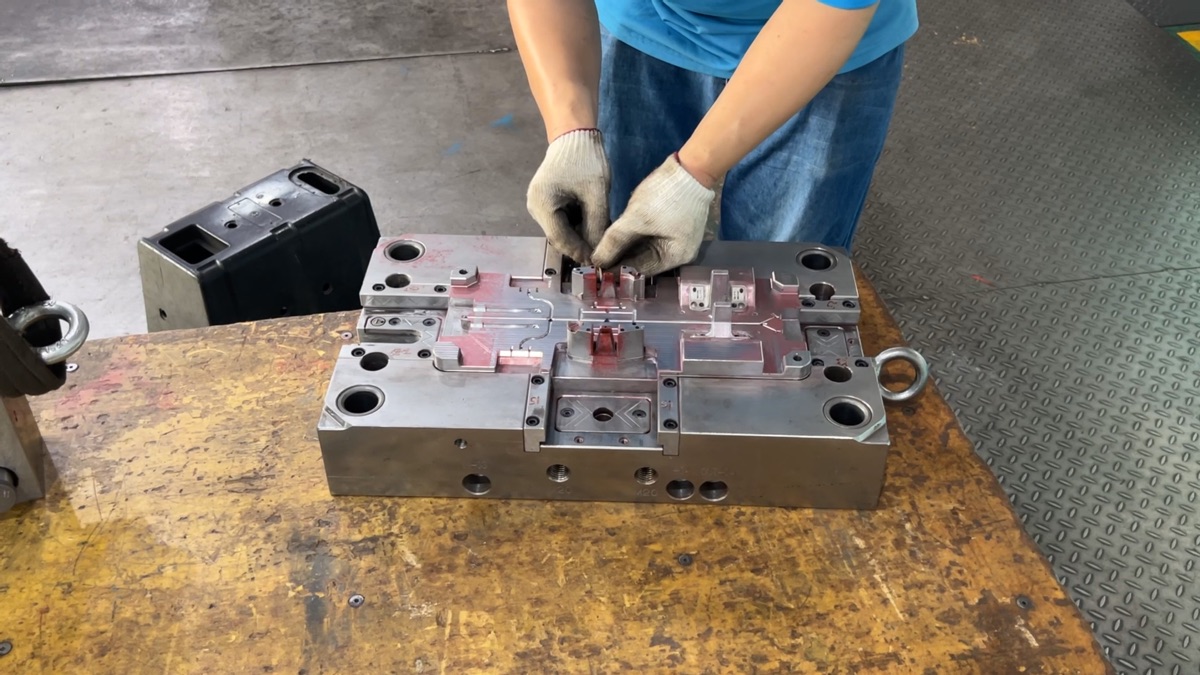
Injection Mold Total Cost of Ownership — The Real Cost of a Cheap Mold
Two buyers order the same part from two suppliers. Buyer A pays $6,000 for the mold. Buyer B pays $11,000. Eighteen months later, Buyer A’s tool has been in the maintenance room four times, runs a 38-second cycle against a quoted 30, and produces a 2.1% scrap rate. Buyer B’s tool has had one scheduled service, holds its 28-second cycle, and runs at 0.4% scrap.
Which buyer got the cheaper mold? On the invoice, Buyer A did. On the P&L, Buyer A is paying for that mold every single production day — and will keep paying until the program ends.
This post lays out the total cost of ownership (TCO) calculation for injection molds: the five cost streams beyond the mold invoice, a worked example, and the conditions under which a cheap mold is genuinely the right choice.
The Five Cost Streams Beyond the Invoice
The mold price is a single line item. The mold’s true cost accumulates across five streams over the tool’s life:
| Cost Stream | What It Is | Typical Range |
|---|---|---|
| Maintenance | Planned service, worn component replacement, repairs | $500–$3,000 per incident, increasing with age |
| Downtime | Production hours lost to repairs, each with a rescheduling cost | $100–$500 per hour of line stoppage |
| Scrap & rework | Parts rejected at the press or downstream | 0.5–5% of part volume, at full part cost |
| Cycle time penalty | A tool that runs slower than it should — forever | 10–30% on processing cost per part |
| Premature replacement | A tool that dies before the program ends | The full cost of a second mold, unplanned |
The last stream is the one that converts a cheap mold into an expensive disaster: a program planned for 800,000 parts whose tool fails at 200,000 requires an emergency second mold — priced under time pressure, with no design leverage left.
The TCO Calculation
Mold TCO = Mold Price + (Maintenance Cost × Incidents) + (Downtime Hours × Line Cost) + (Scrap Rate × Volume × Part Cost) + (Cycle Penalty × Volume × Machine-Hour Rate ÷ 3,600 × Cycle Seconds)
It looks complicated until you see it as three questions:
- How often will this tool stop? — maintenance incidents and downtime hours
- What will it waste while running? — scrap rate and cycle penalty
- Will it survive the program? — shot life versus planned volume
The steel grade answers all three. That is why steel selection is the first decision in any mold program, and why a quote that does not state the steel is a quote for an unknown tool — the point we make in the quote comparison method.
Worked Example: The $6,000 Tool vs the $11,000 Tool
A device housing, 85 grams in PC/ABS, planned volume 400,000 parts over three years. Two tooling strategies, using figures consistent with our cost breakdown:
| Line | Cheap Tool (P20, minimal cooling) | Proper Tool (H13, conformal cooling, hardened) |
|---|---|---|
| Mold price | $6,000 | $11,000 |
| Cycle time | 38 s (quoted 30) | 28 s |
| Scrap rate | 2.1% | 0.4% |
| Maintenance incidents over life | 6 ($800 avg) | 2 ($600 avg, scheduled) |
| Downtime per incident | 4 h at $150/h | 2 h at $150/h |
| Processing cost per part | $0.30 | $0.22 |
| Scrap cost over 400K parts | $5,880 | $1,120 |
| Maintenance + downtime total | $8,400 | $1,800 |
| Processing total over 400K parts | $120,000 | $88,000 |
| Program total (mold + everything) | $140,280 | $101,920 |
The $5,000 saved on the mold invoice costs $38,360 over the program. The expensive mold is the cheap one.
Figures are illustrative, built from the cost ranges in the cost breakdown article. Your numbers depend on part geometry, material, and volume — the structure of the calculation does not.
When a Cheap Mold Is the Right Choice
TCO cuts both ways. The right tool for 5,000 parts is not the right tool for 400,000:
- Prototypes and market tests — an aluminum mold at $3,000–$5,000 for 10,000 parts is correct engineering. Tool life is irrelevant because the program will not outlive the tool.
- Bridge tooling — a temporary steel tool to cover production while the production tool is built. See rapid tooling.
- Low, stable annual volumes — under ~30,000 parts per year, a P20 single-cavity tool may never reach the failure modes that make H13 necessary.
The error is not buying a cheap mold. The error is buying a cheap mold for a volume program — and discovering the difference in year two, when the tool is worn, the scrap is climbing, and the program still needs 200,000 more parts.
How to Buy a Mold by TCO, Not Invoice
Require the assumptions in writing. Steel grade, hardness spec, expected shot life, quoted cycle time, and maintenance plan — the ten comparison lines — turn a mold quote into a TCO estimate. A supplier that will not state them is quoting you the invoice price and keeping the operating cost.
Calculate TCO before comparing quotes. Two quotes are only comparable after the five streams are estimated. This is routine work for a sourcing team and takes an hour with the framework above.
Buy the mold for the program, not the part. A mold quoted for “this part” without a stated volume is a mold built for nobody’s program. The volume drives steel, cavitation, and cooling — see the high-volume manufacturing economics and the bulk cost reduction strategies for what changes above 100,000 parts per year.
Price the maintenance into the contract. Ask what scheduled maintenance the supplier recommends and what it costs — before the tool exists. A mold builder who has a maintenance answer is one who has seen its tools come back; a builder who does not is telling you what year three will look like. Our mold maintenance article covers what a real maintenance program contains.
Bottom Line
The cheapest mold invoice is a real answer — for short programs. For anything that must run for years, TCO is the only number that matters, and TCO is decided by the steel, the cooling design, and the build quality — all of which are visible in the quote, if the quote states its assumptions.
If you are comparing mold quotes now, our engineers will map them against the TCO framework at no charge — send the quotes with your part file and annual volume, and we will show you what each tool will actually cost to own.