Mold Payment Terms and Ownership — Structuring a Tooling Contract That Protects You
The mold is the buyer’s asset — paid for by the buyer, built for the buyer’s part — but it lives in the supplier’s factory, maintained by the supplier’s toolroom, and moved only with the supplier’s cooperation. That physical reality makes payment terms and ownership documentation the two most under-negotiated items in tooling contracts.
Buyers negotiate part price down to the cent and sign mold agreements that never state who owns the tool, what happens if the relationship ends, or when the balance is actually due. This post covers the payment structures in common use, the ownership clauses that matter, and how to read a tooling contract like an asset purchase — because that is what it is.
Payment Structures and What They Mean
Mold payment terms are milestone-based. The structure matters because it decides who carries the risk when something goes wrong at each stage.
| Structure | Milestones | Risk Profile |
|---|---|---|
| 50 / 40 / 10 | 50% on order, 40% at T1 samples, 10% at production approval | Supplier carries the most risk through the build |
| 40 / 40 / 20 | 40% on order, 40% at T1, 20% at approval | Balanced; common for established relationships |
| 30 / 40 / 30 | 30% on order, 40% at T1, 30% at approval | Heavier final gate — buyer holds real leverage until the tool runs |
| 50 / 50 | Half on order, half at T1 | Fast but thin protection: samples can look right while the tool is not production-ready |
Three principles apply regardless of structure:
The deposit is the buyer’s working capital at risk. A 50% deposit means the supplier has been paid half the tool cost before proving anything. A supplier demanding a large deposit is not automatically suspicious — steel must be purchased before machining starts — but the deposit should be proportional to the supplier’s actual upfront cost, which is material, not labour.
Milestones should be verification events, not calendar dates. “40% on T1 samples” is only meaningful if T1 samples are defined — dimensional data, material cert, and trial documentation, not a box of parts. The supplier qualification checklist defines what sample approval actually requires.
The final payment is your leverage; spend it slowly. The last 10–20% should not be released until the tool runs at production cadence with the documented cycle time, scrap rate, and quality data. Releasing it “to maintain the relationship” is how buyers end up funding tools that never meet their quoted performance.
Mold Ownership: The Clauses That Matter
Ownership disputes rarely start as disputes. They start as a tool that was never clearly owned. A written tooling agreement should settle five questions:
1. Who owns the tool, from when? Standard practice: the buyer owns the tool from the date the agreement is signed, with title passing as payments are made — or outright, with payments structured as milestones. What matters is that ownership is stated in writing, not implied by “you paid for it.”
2. What happens to the design files? The mold design — 3D files, drawings, BOM, steel certificates — belongs to the buyer along with the tool. Without the design files, the tool cannot be repaired, modified, or transferred by anyone except the original builder. This is how buyers become permanently tied to a single supplier.
3. What are the maintenance and storage obligations? A tool stored badly rusts; a tool maintained badly wears. The agreement should state the maintenance schedule, who pays for it, and the storage conditions — temperature, humidity, corrosion protection — plus the insurance position while the tool sits in the supplier’s facility.
4. What happens on termination or dispute? The transfer clause: the supplier releases the tool and all documentation to the buyer or a designated third party within a stated number of days, with no lien against unpaid part orders. Our tool transfer page documents what a complete transfer package contains.
5. Can the supplier use the tool for other customers? The answer should be no, in writing. A tool built for your part runs your part. Any other use — even “testing” — is a breach. This is also the moment to confirm the NDA and IP protection position covers the tool design itself.
The Failure Scenarios the Contract Should Cover
Supplier financial trouble. If the supplier goes under, your tool is sitting in a facility you do not control, potentially listed as an asset by the supplier’s creditors. The ownership agreement — registered, with the tool serialized and nameplated to your company — is what proves the tool is not part of the supplier’s estate. This is not hypothetical; it is the standard reason ownership documentation exists.
The “tooling hostage” pattern. A supplier that owns the tool, or holds the design files, can make leaving expensive: transfer fees, delayed release, or outright refusal until outstanding claims are paid. The defense is structural: ownership documented before the build, design files delivered as the program proceeds, and a transfer clause with a hard deadline. If a supplier resists any of these three, treat it as a signal about how the relationship will end.
Silent modifications. A supplier changes the gate, the steel, or the cooling layout “to improve things” without approval. The agreement should require written approval for any deviation from the approved design — including the steel certificates and hardness reports that prove what was actually built. This connects directly to the quote comparison point: if the quote does not state the steel, the contract cannot hold the supplier to it.
What We Put in Writing
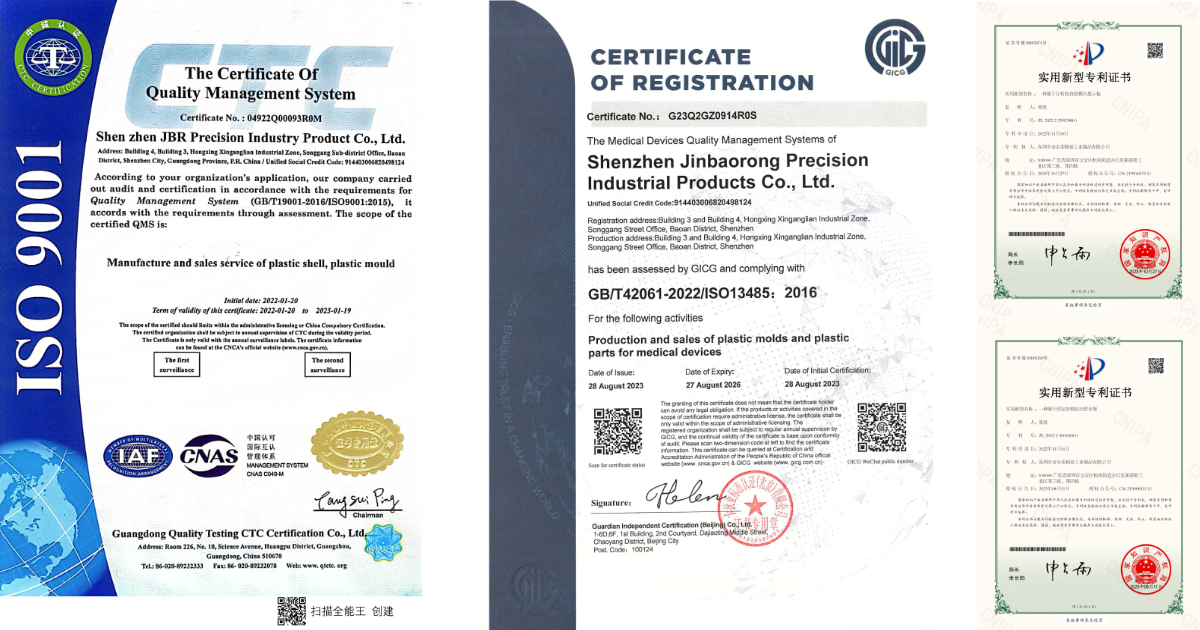
Every JBRplas tooling agreement includes, as standard:
- Named steel grade and hardness spec, with certificates delivered with the tool
- Design file delivery — 3D files, 2D drawings, BOM, and steel certs at T1, not at program end
- Serialized tool with buyer nameplate, photographed and documented
- Written transfer clause — release to buyer or third party within 15 days, no lien
- Maintenance records for the tool’s life, available on request — see our mold maintenance program
- IP clause covering the tool design, the part design, and all process data — see IP protection
None of these are concessions we grant after negotiation; they are the contract. A supplier that treats ownership documentation as a favour is telling you that your asset is not safe — and there are thousands of molders. The supplier selection guide covers how to filter on exactly this early, before you spend weeks on a candidate that fails at the contract stage.
Bottom Line
The mold is a capital asset that happens to live in someone else’s building. Payment terms decide who carries the risk while it is built; ownership documentation decides who controls it after. Both belong in the RFQ, in the quote comparison, and in the contract — not in the drawer of issues to discuss “if it comes up.”
Request a quote and you will see the payment structure and ownership terms in writing, before you commit to anything. See our RFQ guide for the complete request checklist.