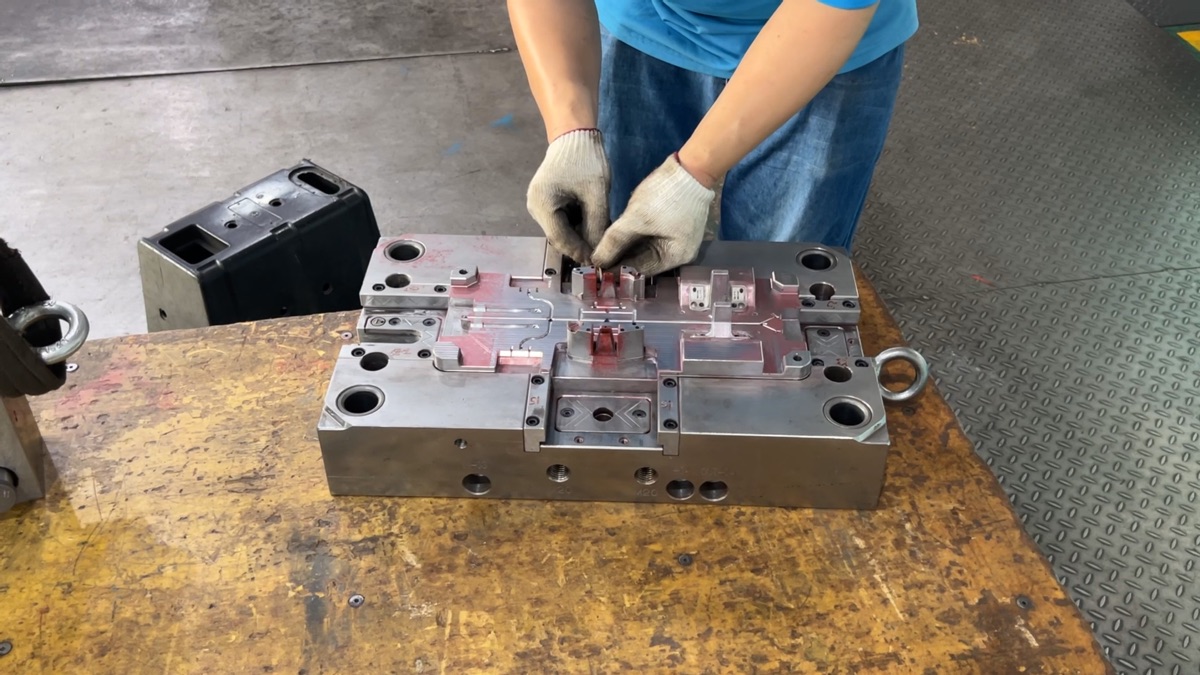
Mold Maintenance & Tool Life — Preventive Plans and Steel Selection
A $25,000 injection mold runs for 18 months and starts producing flash on the parting line. The buyer calls the mold maker. The mold maker asks for the maintenance log. There is no maintenance log — the mold has been running essentially continuously since T1 approval, pausing only for material changes and the occasional weekend shutdown.
The repair quote is $4,800. The cause: a worn leader pin bushing that allowed the A and B plates to shift 0.08 mm out of alignment, producing uneven wear on the shut-off surfaces. A $40 bushing replaced at the 500,000-shot mark would have prevented the $4,800 repair. But nobody was counting shots.
Mold maintenance is the least glamorous topic in injection molding. It is also the difference between a tool that produces consistent parts for 1.5 million shots and one that requires major repair at 300,000. This guide covers what drives tool life, what a preventive maintenance schedule looks like, and how steel selection determines the maintenance burden from the day the mold design is approved.
1. What Determines Mold Tool Life
Tool life is not a single number. It is the intersection of four factors, and the weakest one sets the limit.
Steel Grade
The mold steel determines the base wear resistance. The common choices, in order of increasing tool life:
| Steel | Hardness (HRC) | Expected Life (shots) | Typical Application |
|---|---|---|---|
| P20 (1.2311) | 28–32 | 300,000–500,000 | General purpose production, unfilled materials |
| H13 (1.2344) | 48–52 | 500,000–1,000,000 | Glass-filled materials, high-volume production |
| S136 (1.2083) | 48–52 | 500,000–1,000,000 | Optical/transparent parts, corrosive materials (PVC, FR grades) |
| NAK80 | 38–42 | 300,000–500,000 | High-polish cosmetic surfaces, short cycle times |
| 1.2343 (H11) | 46–50 | 500,000–800,000 | High thermal conductivity, fast-cycle applications |
P20 is the most common production steel and represents the minimum acceptable quality for a tool expected to run beyond prototype volumes. It is machinable, polishable, and weldable for repair. It is also soft enough that glass-filled materials (PA66-GF30, PBT-GF20, PP-GF30) will erode gates, vents, and sharp corners measurably within 100,000–200,000 shots.
H13 is the standard for tools running glass-filled materials or exceeding 500,000 shots per year. The higher hardness resists abrasive wear from fiber-filled resins and maintains parting line integrity over longer runs. The trade-off: H13 costs 20–40% more in raw material than P20, and machining time is longer due to the higher hardness.
Material Being Molded
The resin running through the mold is the primary wear agent.
| Material Type | Wear Aggressiveness | Primary Wear Mechanism | Mitigation |
|---|---|---|---|
| Unfilled (ABS, PP, PE, PS) | Low | General friction | Standard maintenance schedule |
| Glass-filled (PA66-GF30, PP-GF30) | High | Abrasive erosion at gates, corners, vents | H13 or harder steel, hard chrome coating on wear surfaces |
| Flame-retardant (ABS FR, PC FR, PA FR V-0) | Medium–High | Chemical corrosion + abrasive wear | S136 or chrome-plated cavities, increased vent cleaning frequency |
| PVC | High | Chemical corrosion (HCl off-gassing) | S136 or stainless steel, chrome plating mandatory |
| PPS, PEEK, LCP (high-temp) | Medium | Thermal fatigue, corrosion | H13 with nitriding, frequent cooling channel inspection |
| Optical grades (PMMA, PC) | Low | Surface degradation (micro-scratches) | S136, protective handling procedures, reduced cleaning cycles |
The rule of thumb: glass-filled materials at 30% fiber content reduce tool life by approximately 50% compared to the same tool running unfilled material. A P20 tool rated for 500,000 shots in ABS might deliver 250,000 in PA66-GF30 before requiring significant rework.
Cycle Count and Frequency
A mold running 24/6 at a 30-second cycle produces 86,400 shots per week, 4.3 million shots per year. This is a different maintenance reality from a mold running 5,000 shots per month for a low-volume program.
The key metric is not calendar time but shot count. A maintenance schedule defined by time (“lubricate every month”) makes no sense without knowing the cycle count. A mold running 5,000 shots per month needs monthly lubrication. The same mold running 86,000 shots per week needs daily lubrication. Both might be on a “monthly” calendar schedule for a maintenance technician who does not know the difference.
Maintenance Discipline
This is the factor that separates tools that reach their rated life from tools that fail at half their rated life. It is entirely within the molder’s control and entirely invisible to the buyer until a problem appears.
A tool maintained properly receives:
- Shot counter monitoring. Every press has a shot counter. The maintenance schedule is driven by shot count milestones, not calendar dates.
- Documented inspections. At each maintenance interval, the tool is inspected for specific wear indicators — parting line wear, vent depth, ejector pin clearance, gate condition, cooling channel flow — with findings recorded.
- Predictive replacement. High-wear components (leader pin bushings, return pins, ejector sleeves, gate inserts) are replaced at defined shot-count intervals, not when they fail.
A tool maintained poorly runs until it stops producing acceptable parts. By that point, the damage is compound — the worn bushing has worn the bore it sits in, the clogged vent has burned the vent land, the dull gate has eroded the gate insert seat. A $40 bushing replacement becomes a $4,800 plate reconditioning.
2. Preventive Maintenance Schedule
A standard PM schedule for a production injection mold, keyed to shot count:
| Interval (Shots) | Maintenance Action | Notes |
|---|---|---|
| Every shift | Visual check: part quality, flash, ejection | Operator-level. Any change from baseline triggers QC review |
| 50,000 | Clean mold faces and parting line. Inspect vents for clogging. Lubricate leader pins, return pins, ejector guide pins, and cam/slide mechanisms | Standard PM stop. 30–60 minutes for a simple two-plate mold |
| 100,000 | Remove and clean ejector system. Inspect ejector pins for bending or galling. Measure vent depth (should match original spec). Inspect gate wear under magnification | Half-day stop. Replace worn components |
| 250,000 | Full disassembly. Clean all plates, cavities, and cores. Inspect all moving components for wear. Replace ejector pins, return pins, and leader pin bushings as a set. Polish cavity surfaces if needed. Flow-test cooling channels for blockage | Full-day to two-day stop. May require mold shipped to toolroom |
| 500,000 | Complete overhaul. Replace all wear components. Re-cut vents to original depth. Re-polish cavity and core surfaces. Verify all dimensions against original mold drawing. Replace gate insert if applicable | Major service. 3–7 days. Equivalent to a mold reconditioning |
| 1,000,000 | Full reconditioning or retirement evaluation | Dimensional audit against drawing. Economic decision: recondition or replace |
For molds running glass-filled materials, halve the intervals. The 50,000-shot PM becomes 25,000. The 100,000 becomes 50,000. The wear mechanisms operate at roughly double the rate.
3. Reading Wear Patterns
When a mold comes out of the press for maintenance, the wear patterns on the steel tell you what is happening in the process. They are diagnostic information — not just damage to be repaired.
Gate Erosion
What it looks like: The gate land shows a dull, frosted appearance or measurable material loss at the gate entry point. Under magnification, the sharp edge where the gate meets the cavity is rounded.
What it means: The material being molded contains abrasive filler (glass fiber, mineral filler) and the gate velocity is high. The combination of high-speed flow and abrasive particles is literally sandblasting the gate.
Response: Replace the gate insert (if the tool has a replaceable gate insert) or re-cut the gate land. If the tool is P20, consider upgrading the gate insert to H13 or adding a hard chrome coating. Reduce injection velocity if process allows — lower gate velocity reduces erosion rate.
Vent Clogging
What it looks like: The vent channels — the shallow grooves ground into the parting line at the end of fill — are filled with compacted residue. The vent depth is reduced or the vent is completely blocked.
What it means: The material is outgassing volatiles (moisture, low-molecular-weight additives, flame retardant decomposition products) that condense in the vents and solidify. Blocked vents cause short shots (air cannot escape the cavity), burn marks (compressed air heats to ignition temperature), and increased cavity pressure.
Response: Clean vents at every PM stop. If a particular vent clogs more frequently than others, the vent depth may be too shallow for the material — increase vent depth by 0.005–0.010 mm within the material’s flash threshold. For FR materials that produce heavy deposits, reduce the PM interval specifically for the affected vents.
Parting Line Wear
What it looks like: The parting line — the surface where the A and B plates meet — shows uneven wear, with one side visibly worn more than the other. Flash appears in specific areas of the parting line, not uniformly.
What it means: The mold is running out of alignment. The most common cause is worn leader pin bushings that allow the moving half to shift slightly relative to the fixed half during each cycle. Over thousands of cycles, the misalignment wears the parting line unevenly.
Response: Replace leader pin bushings immediately. If the parting line is already uneven, the mold may need to be re-ground flat — a major repair. This is the exact scenario that preventive bushing replacement is designed to prevent.
Ejector Pin Galling
What it looks like: Ejector pins show longitudinal scoring marks or a frosted appearance on the working surface. In advanced cases, the pin seizes in its bore and either sticks (won’t retract) or breaks (pin head separates from pin body).
What it means: Insufficient lubrication, or the pin clearance is too tight for the operating temperature (thermal expansion of the pin closing the clearance gap). Galling is more common in tools running at high temperatures (PC, PSU, PPS — mold temps above 100°C).
Response: Replace galled pins and ream the bores to ensure correct clearance. Switch to a high-temperature ejector pin lubricant. If galling recurs, increase pin-to-bore clearance by 0.003–0.005 mm.
Cooling Channel Deposits
What it looks like: Reduced cooling water flow rate at constant pump pressure. Disassembly reveals rust, scale, or mineral deposits on the internal surface of the cooling channels.
What it means: Untreated water in the cooling circuit plus heat plus time equals scale. The deposits insulate the cooling channel — heat transfer drops, cycle time increases (the mold takes longer to cool between shots), and part quality may suffer (warp from uneven cooling).
Response: Flush cooling channels with descaling solution at every major PM interval (250,000 shots). Use treated water (corrosion inhibitor, biocide) in the cooling circuit. For tools running above 80°C mold temperature, consider a closed-loop temperature control unit with treated water rather than plant water.
4. Steel Selection and Maintenance Burden
Steel selection is a maintenance decision made at the mold design stage. The choice affects not just the tool purchase price but the maintenance cost for the life of the tool.
When P20 Is the Right Choice
- Production volume under 250,000 shots per year
- Unfilled or lightly filled materials (ABS, PC, PP, unfilled PA)
- Budget-constrained programs where the upfront tooling cost is the primary concern
- Parts with generous tolerances (±0.10 mm or wider) where minor wear is acceptable
A P20 tool maintained on schedule will reliably reach 500,000 shots. The maintenance cost at each PM is lower because P20 is easier to machine, polish, and weld than harder steels.
When H13 Justifies the Premium
- Production volume exceeding 250,000 shots per year
- Glass-filled or mineral-filled materials at any volume
- Tight tolerances (±0.05 mm or tighter) that cannot tolerate cavity wear
- Programs where the cost of downtime — a production line waiting for mold repair — exceeds the tooling premium
The H13 premium (20–40% on material cost, 10–20% on machining time) pays back at the first avoided major repair. An H13 tool running PA66-GF30 that reaches 800,000 shots without parting line reconditioning has paid for its premium several times over compared to a P20 tool that requires major rework at 300,000 shots.
When S136 or Stainless Is Required
- PVC or other corrosive materials — no alternative, chrome-plated stainless is mandatory
- Optical/transparent parts — S136 takes and holds a higher polish than P20 or H13
- Medical devices requiring clean room molding — S136 resists the hydrogen peroxide and other sterilizing agents used in clean room environments
- Long-term programs (>5 years) where corrosion, not wear, is the expected failure mode
A mold that produces 100,000 parts without maintenance has not been reliable. It has been lucky. The question is not whether it will need maintenance. It is whether the maintenance will be a scheduled one-hour stop at the 50,000-shot mark, or an unscheduled one-week repair at the 300,000-shot mark. The difference is a maintenance log that someone actually fills in — and a buyer who asks to see it.