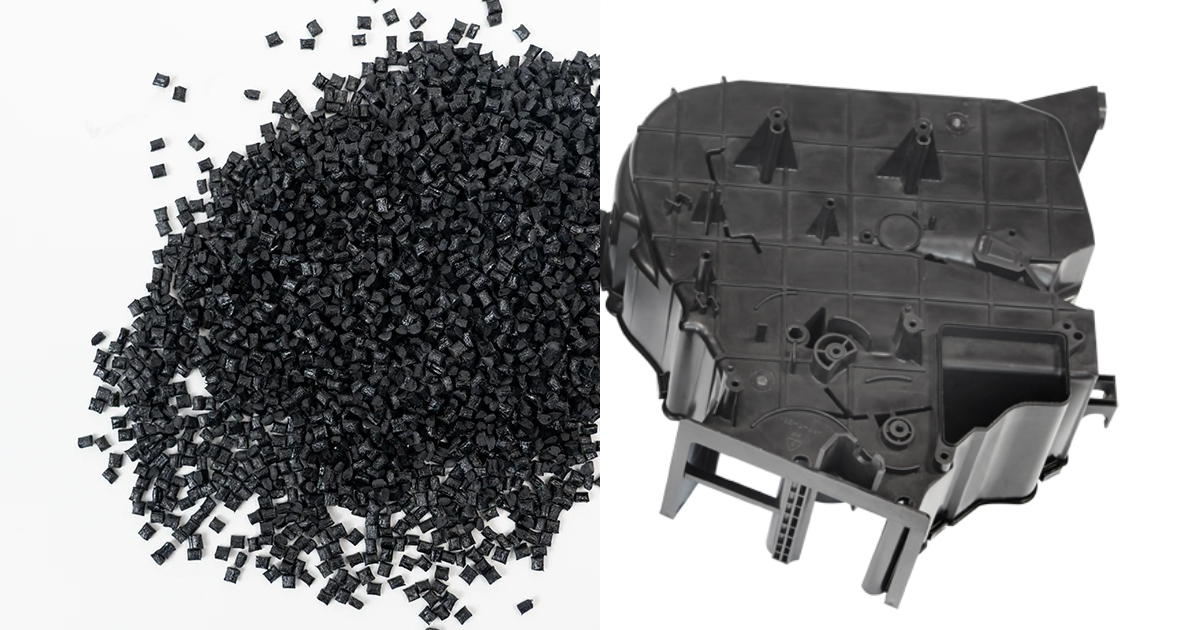
Metal-to-Plastic Conversion Guide — Cost, Weight, and Design Considerations
A product engineer inherits a machined aluminum bracket — 380 grams, 14 manufacturing steps, a $4.70 unit cost at 50,000 pieces per year. The bracket connects three subassemblies. It has eight tapped holes, two press-fit bushings, and a milled locating feature. It has been in the BOM since the product launched in 2013. Nobody has questioned it.
The engineer runs the numbers on a conversion to injection-molded PA66-GF50. The plastic bracket weighs 210 grams — a 45% weight reduction. The 14 manufacturing steps collapse to one: injection mold, done. The eight tapped holes become molded-in threaded inserts. The two press-fit bushings become molded-in features. The milled locating feature becomes a molded rib. Tooling cost: $18,000. Part cost at 50,000/year: $1.15. Annual savings: $177,500. Payback: 5 weeks.
Metal-to-plastic conversion is not about replacing one material with a cheaper one. It is about replacing a manufacturing process with a fundamentally different one — and capturing the design freedom that injection molding provides. This guide covers when the conversion makes engineering and economic sense, and how to approach it without trading a metal problem for a plastic one.
1. When Conversion Makes Sense
Not every metal part should be plastic. The conversion is a set of trade-offs, and the analysis starts with the part’s functional requirements — load, temperature, chemical exposure, dimensional stability, and production volume.
| Criterion | Favors Metal | Favors Plastic |
|---|---|---|
| Continuous service temperature | > 150°C | < 150°C (PPA, PPS, PEEK extend to 200–260°C) |
| Tensile strength required | > 200 MPa | < 200 MPa (PA66-GF50: ~210 MPa at 23°C) |
| Dimensional tolerance | < ±0.02 mm | ±0.05–0.15 mm typical for engineering resins |
| Chemical exposure | Aggressive solvents, strong acids/bases | Most automotive fluids, mild chemicals |
| Electrical requirement | Conductivity needed | Insulation needed |
| Annual volume | < 5,000 (machining wins) | > 10,000 (tooling amortized) |
| Part geometry | Simple, prismatic | Complex, contoured, organic shapes |
| Assembly consolidation | 1–2 parts | 3+ parts can often combine into one molded part |
The economic signal. The strongest indicator that a metal part should be reviewed for conversion is a high secondary-operations count. Every machining step, every tap, every bushing press, every deburring operation — each is a cost that injection molding eliminates by forming the finished geometry in the tool. A metal part with 10+ manufacturing steps is a conversion candidate regardless of the part’s size or material.
The engineering signal. Metal parts that are over-engineered for their functional load — a bracket specified in 6061-T6 aluminum where the peak stress is 40 MPa against a 276 MPa yield strength — carry a weight and cost penalty that a correctly designed engineering-plastic replacement can eliminate. The safety factor that made sense when the part was machined from billet may be unnecessary when the part is designed specifically for the load.
2. Strength Comparison: Engineering Resins vs Metals
The question buyers ask first is: “Is plastic strong enough?” The answer is: it depends on which plastic, which metal, and which property matters for the function.
| Property | 6061-T6 Aluminum | Mild Steel (1018) | PA66-GF30 | PA66-GF50 | PPS-GF40 | PEEK-GF30 |
|---|---|---|---|---|---|---|
| Density (g/cm³) | 2.70 | 7.87 | 1.38 | 1.56 | 1.66 | 1.49 |
| Tensile strength (MPa) | 310 | 440 | 180 | 210 | 170 | 160 |
| Tensile modulus (GPa) | 69 | 205 | 10 | 16 | 14 | 10 |
| Flexural modulus (GPa) | 69 | 205 | 8.5 | 14 | 13 | 9 |
| HDT @ 1.82 MPa (°C) | — | — | 250 | 255 | 270 | 315 |
| Notched Izod (J/m) | — | — | 110 | 130 | 80 | 95 |
| CLTE (×10⁻⁶/°C) | 23 | 12 | 30–35 | 18–25 | 20–25 | 20–25 |
The numbers show the real picture: plastic is not a direct substitute for metal. A PA66-GF50 bracket has one-third the stiffness of the aluminum part it replaces. This is not a problem — it is a design constraint. The plastic part must be redesigned with ribs, gussets, and thicker sections at load points to compensate for the lower modulus. A properly designed plastic bracket is not a metal bracket in a different material. It is a bracket designed for the material.
The rib rule. For a plastic part to match the bending stiffness of a metal part of identical envelope dimensions, the section modulus must increase by the ratio of the elastic moduli. A PA66-GF50 part replacing 6061-T6 aluminum needs approximately 4.3× the section modulus of the aluminum part to achieve equal bending stiffness (69 GPa ÷ 16 GPa). This is achieved through ribbing — the rib height and spacing are engineered to deliver the required stiffness without increasing the nominal wall thickness.
When glass fiber makes the difference. Unfilled PA66 has a tensile strength of ~80 MPa and a flexural modulus of ~3 GPa — no match for even the softest structural metal. Adding 30% glass fiber (PA66-GF30) more than doubles the strength and nearly triples the modulus. Adding 50% glass fiber (PA66-GF50) pushes the modulus to 16 GPa — still well below aluminum, but high enough that a ribbed design can close the stiffness gap. Glass fiber is what makes structural metal replacement possible.
3. Weight Reduction
For a given part envelope, switching from metal to plastic reduces weight by 40–70% after accounting for the ribbing and section increases needed to compensate for the lower modulus.
| Metal Part | Weight (g) | Plastic Equivalent | Weight (g) | Reduction |
|---|---|---|---|---|
| Aluminum bracket (machined) | 380 | PA66-GF50 (ribbed, molded) | 210 | 45% |
| Steel mounting plate (stamped) | 850 | PA6-GF30 (molded) | 340 | 60% |
| Die-cast zinc housing | 520 | PC/ABS (molded) | 195 | 63% |
| Steel weldment (4-piece assembly) | 2,400 | PP-GF40 (single molded part) | 820 | 66% |
Weight reduction matters for three reasons beyond the material cost savings: lower shipping weight (every kilogram saved on a vehicle component is worth approximately $3–5 in fuel savings over the vehicle life), lower handling and assembly effort, and — for handheld, portable, or vehicle-mounted products — improved user experience and reduced motor/actuator sizing.
4. Part Consolidation
The most valuable metal-to-plastic conversions are not material swaps. They are part consolidations — replacing a multi-piece metal assembly with a single injection-molded part.
A metal assembly that requires: a stamped bracket, a machined locating pin, two spot-welded tabs, a riveted spring clip, and an operator to assemble them — can often be replaced by a single injection-molded part incorporating all five features directly from the mold. The mold costs more than any one of the metal fabrication tools. It costs less than the sum of all of them, plus the assembly labour.
Consolidation example — automotive HVAC bracket:
| Metal Assembly | Plastic Conversion | |
|---|---|---|
| Components | 4 (machined bracket, 2 bushings, fastener clip) | 1 molded part |
| Manufacturing steps | 12 (machine, deburr, tap × 8, press × 2, QC) | 1 (injection mold) |
| Assembly steps | 3 (install bushings, clip, torque check) | 0 — all features molded in |
| Weight | 380 g (aluminum) | 210 g (PA66-GF50) |
| Cost per unit (50K/year) | $4.70 | $1.15 |
| Tooling investment | $3,500 (fixtures) | $18,000 (mold) |
The mold paid for itself in under 5 weeks of production. After that, every bracket produced was $3.55 cheaper than its metal predecessor. Annual savings: $177,500.
5. Secondary Operations Elimination
Every secondary operation on a metal part is a cost that a well-designed plastic part eliminates. This is where the conversion economics become compelling.
| Metal Operation | Plastic Equivalent | Savings |
|---|---|---|
| Tapping threads | Molded-in brass/stainless threaded inserts | Eliminates tapping + insert installation labour. Inserts installed during molding (insert molding) or heat-staked post-mold. |
| Deburring | Not required — parting line flash is controlled by mold fit and process | Eliminated entirely |
| Press-fit bushings | Molded-in bearing surfaces or insert-molded bushings | Eliminates press operation + bushing inventory |
| Spot welding / riveting | Molded snap-fits, bosses, or living hinges | Eliminates secondary joining process |
| Anodizing / plating / painting | Molded-in color (masterbatch) or pad printing for markings | Eliminates finishing process. Note: requires UV-stabilized resin for outdoor applications |
| Machining locating features | Molded ribs, bosses, datum pads — formed in the cavity | Eliminated entirely |
The corollary: if a metal part has no secondary operations — a simple stamped bracket that goes straight from the press to the assembly line — there is far less economic incentive to convert it. The conversion value comes from collapsing the process chain, not from the raw material delta.
6. DFM Rules for Conversion Parts
A metal part copied into plastic will fail. The design must be re-engineered for the material and the process.
Wall thickness uniformity. Metal parts can have thick bosses and thin webs because metal is isotropic and homogeneous. Plastic shrinks as it cools, and thick sections shrink more than thin sections — causing sink marks, internal voids, and warpage. Every section of a conversion part must be designed to a uniform nominal wall thickness, typically 2–3 mm for structural applications. Thick sections must be cored out; thin sections must be thickened.
Draft angles. Metal parts have zero-draft walls. A machined aluminum part is exactly perpendicular to the parting plane. Plastic parts need draft — typically 1–3° on exterior walls and 0.5–1° on ribs and bosses — to release from the mold. Adding draft to a converted part geometry is not optional; it is a requirement of the process.
Rib design. Ribs provide stiffness without adding wall thickness. The rule: rib base thickness ≤ 60% of the nominal wall thickness to avoid sink on the opposite surface. Rib height ≤ 3× the nominal wall thickness for moldability. Rib spacing ≥ 2× the nominal wall thickness to allow steel between ribs.
Fastener bosses. Metal parts use tapped holes. Plastic parts use molded-in threaded inserts or self-tapping screws into molded bosses. The boss outer diameter should be 2× the insert diameter, and the boss should be tied to the side wall with gusset ribs to distribute the fastening load.
Material shrinkage. Metal parts are machined to size. Plastic parts shrink as they cool — PA66-GF30 shrinks 0.3–0.5% from the mold cavity dimension. The mold cavity must be cut oversize by the shrinkage factor, and the shrinkage is anisotropic — higher in the flow direction than across it. The mold designer compensates for this, but the part designer must understand that as-molded dimensions have a wider tolerance band than machined dimensions.
Frequently Asked Questions
Can I convert a structural part with a safety requirement?
Yes, with the right material and validation. PA66-GF50, PPA-GF40, and PPS-GF40 are used in under-hood automotive structural brackets, engine covers, and transmission components — all safety-relevant applications. The key is material-specific FEA with accurate creep and fatigue data, followed by component-level validation testing at temperature. Do not extrapolate from the metal part’s FEA.
What about creep?
Creep — the tendency of a material to deform under constant load over time — is the fundamental difference between metal and plastic structural behavior. Metal creep is negligible below roughly 0.3–0.4× the melting temperature (in Kelvin). For aluminum at room temperature, that threshold is ~200°C — creep is not a concern. For PA66 at room temperature, creep is measurable. A plastic structural part must be designed so that the sustained stress is below the material’s creep-limited allowable — typically 20–40% of the short-term tensile strength for continuous loading at room temperature. Glass fiber reinforcement substantially reduces creep; unfilled thermoplastics are generally unsuitable for sustained structural loads.
When does conversion not make sense?
Four conditions. First, when the continuous service temperature exceeds the material’s HDT by more than 20°C — the part will distort under load. Second, when the annual volume is below 5,000 parts — the tooling amortization period becomes too long. Third, when the part requires electrical or thermal conductivity — plastics are insulators (though thermally conductive grades exist at significant cost premiums). Fourth, when a regulatory or customer specification mandates metal — aerospace structural components, certain pressure vessel applications, and some medical implant fixtures are locked into metal by code.
What happens to the existing metal tooling?
It runs out the remaining production while the plastic tool is being built and qualified. The conversion is phased — metal parts until T2 samples are approved, then a cutover. The metal tooling is not scrapped immediately; it is retained until the plastic part has accumulated 6–12 months of production history. If the plastic part develops a field issue, the metal part is a working backup.
Metal-to-plastic conversion is an engineering redesign, not a material substitution. The economic case is strongest when three factors coincide: high secondary-operations count on the metal part, annual volumes above 10,000, and a part geometry that can benefit from the design freedom of injection molding — consolidation, organic shapes, integrated fasteners. The part that emerges from the conversion will look different from the metal part it replaces. It will weigh less, cost less, and assemble faster. But it must be designed for the material from the first sketch, not translated from a metal drawing with the material name crossed out.
Discuss a metal-to-plastic conversion with our mold design team →