Medical Molding Compliance — The Documentation Package Your Molder Should Provide
A molder’s ISO 13485 certificate is the first thing an OEM buyer checks and the last thing that answers the question actually being asked. The certificate proves that an audited quality system exists and states the scope it covers. It does not prove that the parts in the box in front of you were made inside that system, from the resin lot you approved, on the process you validated.
That gap is where medical device programs get into trouble. It shows up months later, when a regulatory affairs team assembling a submission asks for the records behind a specific production lot and the trail stops short of the resin lot number.
This article covers the documents a medical device molder should be able to produce, what each one actually proves, and what to check in each. It is written from the buyer’s side of the table, because the buyer is the one who has to defend the file.
What “Medical Molding Compliance” Actually Requires
Medical molding compliance is not a certificate and it is not a material claim. It is a chain of documented evidence at three distinct levels, and a supplier can be strong at one level and weak at another.
Level 1 — System evidence
The certificate. An ISO 13485:2016 certificate is issued by an accredited certification body after an audit of the quality management system, and it carries a scope statement that defines what was audited.
This is the level most buyers stop at, and it is the level that says the least about your parts. Two things must be read off the certificate itself rather than the supplier’s website:
The scope. A certificate covering “production and sales of plastic molds and plastic parts for medical devices” is not the same as one covering mold design, injection molding, and assembly. If your program relies on the supplier designing the tool or assembling the device, and the scope does not name those activities, the certificate does not cover the work you are buying.
The validity dates. Certificates are issued for a fixed term and are maintained through surveillance audits. An expired or suspended certificate is not evidence of anything, and the date is printed on the document — not inferred from the fact that a certificate image is displayed.
A useful habit: request the certificate as a PDF directly from the supplier rather than reading a website, and confirm the certificate number and status with the issuing body. This takes minutes and it is the single cheapest supplier qualification step available.
Level 2 — Process evidence
Level 2 answers “was the process characterised, or does it just happen to be making good parts today?”
This is the process validation package — IQ, OQ, PQ — plus the scientific molding work that sits underneath it. A validated process is one where the operating window was established from data and the capability was demonstrated across multiple production lots, not one where a technician found settings that produced acceptable parts on a Tuesday. Our guide to scientific molding and IQ/OQ/PQ validation covers how that framework is structured and what a buyer in a regulated industry should expect from it.
Level 2 evidence is what makes Level 3 records meaningful. Without a validated window, an FAI report is a snapshot of one lucky run.
Level 3 — Part and lot evidence
Level 3 is the level that travels with your shipment, and it is the level regulators and your own quality team will ask for by name.
- First Article Inspection (FAI) report — dimensional results for the part, against the drawing
- Material certificate — the resin grade and the specific lot number used
- Process parameter record — the settings the parts were actually made at
- Lot traveller / production record — the manufacturing history of that lot
- Certificate of Conformance (CoC) — the supplier’s signed statement that the lot meets specification
- Traceability chain — resin lot → production lot → part lot → shipment
For FDA-regulated devices, the requirement that captures most of this is the Device History Record (DHR) under 21 CFR 820 — a record of the production history for each batch, unit, or lot. The FDA’s Quality Management System Regulation aligns 21 CFR 820 more closely with ISO 13485, but the DHR requirement is a longstanding one and it survives that alignment. For European market access, the equivalent pressure comes from the technical documentation required under the EU MDR.
Regulatory specifics vary by device class, market, and classification — the requirements below are the general shape, and your regulatory affairs team or notified body is the authority on what your submission needs.
What “FDA compliant” is not
“FDA compliant” is not a certification, a standard, or a document. No body issues an “FDA compliant” certificate. The phrase describes a state of affairs — that the material and the manufacturing process are appropriate for the device and the required records exist — and it must be substantiated by specific documents every time.
When a supplier offers “FDA compliant” as an answer, convert it into a request: which USP Class VI certificate, which ISO 10993 reference data, under which lot number. Our medical grade material and FDA compliance guide covers the material side of that conversation in detail.
What We Issue, and At Which Level
The document set below is what JBRplas produces for medical programs. We list it here so you can hold us — or any supplier — to a specific list rather than a general assurance.
System level
| Document | Detail |
|---|---|
| ISO 9001:2015 certificate | Quality management system |
| ISO 13485:2016 certificate | Medical device quality management system |
| RoHS declaration | EU Directive 2011/65/EU, material-specific |
| REACH SVHC declaration | EU Regulation 1907/2006, material-specific |
All four are audited annually by SGS. Certificate copies are provided with every OEM supplier qualification package, and current validity can be verified on request. The full scope statements and certificate images are on our certifications page.
Design and tooling level
Every project produces a written record before metal is cut:
- Written DFM report with the manufacturability assessment
- Moldflow fill, warp, and cooling simulation results
- Formal engineering design review sign-off
- Customer approval of the 2D and 3D mold design before machining starts
During tooling: CMM verification at critical machining stages, Rockwell hardness tested and recorded per mold component, and assembly verification against design dimensions before trial. All T1 and T2 process parameters are recorded and retained — a tooling record that becomes the baseline for the production process.
First article inspection
The FAI package is the document set most medical buyers actually rely on, and it contains:
- Full dimensional report — every dimension on the drawing measured and recorded, not a selected subset
- Visual inspection against the approved sample or written cosmetic standard
- Material certificate — resin grade and lot traceability
- Process parameter record — the injection settings at the approved-sample production run
- Customer sign-off on first article samples before production release
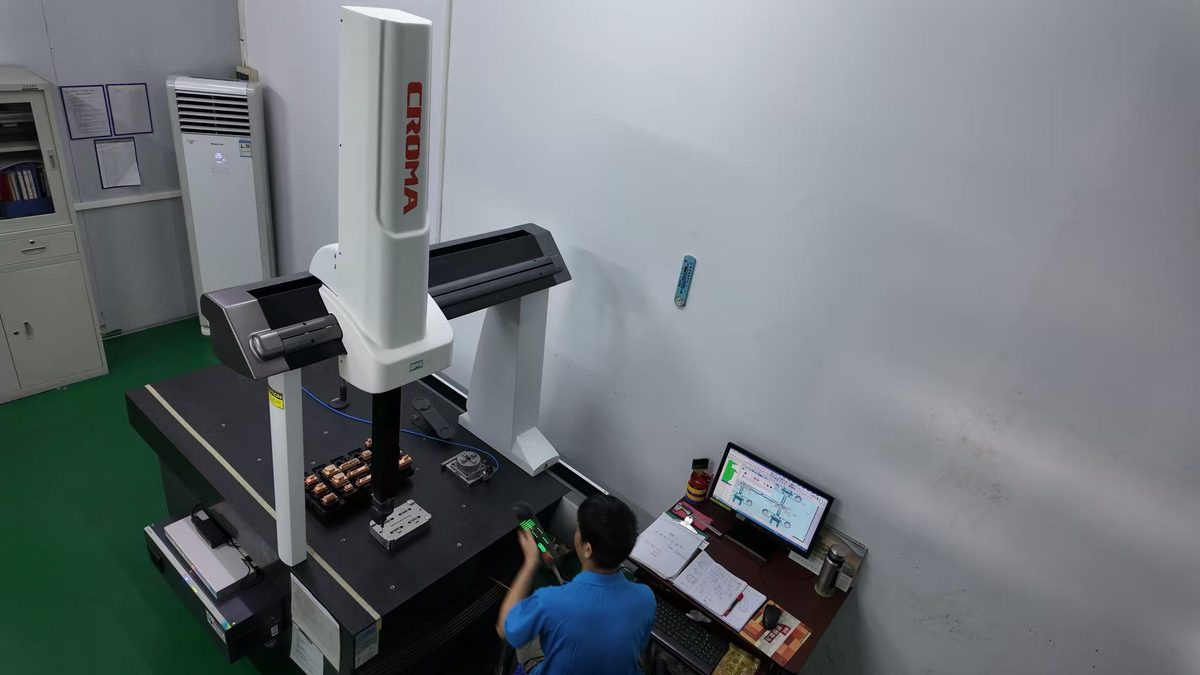
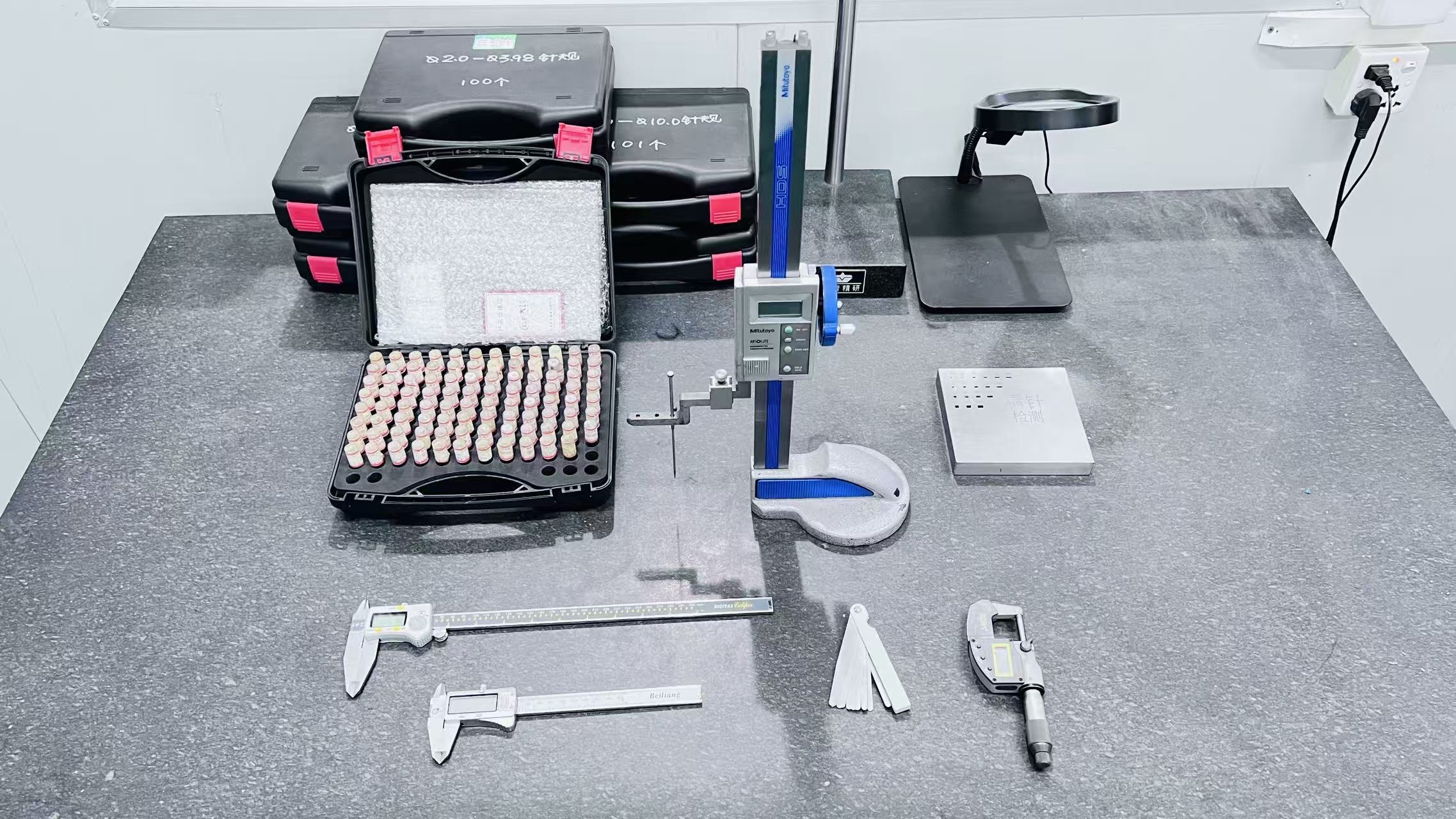
Measured on a SEREIN CMM at ±0.001mm and an optical comparator at ±0.005mm, with calibration traceable to national standards. Our inspection workflow covers the measurement side.
Production and shipment level
| Control | Method | Frequency |
|---|---|---|
| First-off inspection | Full dimensional + visual | Start of every production run |
| In-process visual | Operator 100% inspection | Continuous |
| SPC monitoring | Critical dimension measurement | Every 50–100 shots |
| Outgoing AQL | ANSI/ASQ Z1.4 Level II | Per lot |
| Material verification | Resin lot cross-check | Per production batch |
Each shipment carries a lot traveller, a resin certificate for the lot used, the production process records, and a Certificate of Conformance signed by the quality manager.
For clean room programs, environmental monitoring data — particle counts, temperature, humidity — is logged per shift, and personnel training is documented per ISO 13485 requirements. The clean room molding page describes the monitoring regime.
A worked example
For a Class II blood glucose meter housing molded in medical-grade ABS, the client’s regulatory affairs team required all patient-contact surfaces to be USP Class VI rated for their FDA 510(k) submission. We selected a USP Class VI certified grade and provided its UL Yellow Card and USP Class VI certificate to the client for inclusion in their 510(k) Design History File — alongside the ±0.03mm test strip slot dimensional data.
That is what Level 3 documentation looks like in practice: not a compliance claim, but specific certificates with lot numbers attached to specific parts. The full record is in the blood glucose meter housing case study.
What to Require, Mapped to Purpose
| Document | What it proves | What to check | When it matters most |
|---|---|---|---|
| ISO 13485 certificate | An audited QMS exists within a stated scope | Scope covers design/molding/assembly as you buy them; validity dates current | Every medical program |
| ISO 9001 certificate | Baseline QMS | Current, same scope logic | Non-medical workstreams |
| Resin certificate / UL Yellow Card | The material is the grade specified and certified | Lot number matches the production lot; certificate is for the exact grade | Any patient-contact or fluid-path part |
| USP Class VI / ISO 10993 data | Biocompatibility basis for the material | Test report vs general claim; device contact duration category | Patient-contact parts, 510(k) DHF |
| DFM report + Moldflow | Manufacturability was assessed before tooling | Written, project-specific, addresses your tolerances | Every new tool |
| IQ/OQ/PQ validation | The process was characterised and is capable | Cpk across multiple lots, not a single run | Regulated submissions |
| FAI dimensional report | The part was measured against the drawing | Covers all drawing dimensions; datum scheme defined | Every new tool, every change |
| Process parameter record | The parts were made at approved settings | Matches the validated window; retained per run | Audit defence |
| Lot traveller | The lot’s production history exists | Complete and internally consistent | Recall or complaint investigation |
| CoC | The supplier asserts conformance | Signed, referenced to a lot, backed by data | Every shipment |
| Clean room monitoring log | The environment was controlled | Per-shift data, not a one-off commissioning report | Clean room programs |
| Change control agreement | You will be notified before changes | Written, covers material, process, tooling, and subcontractors | The whole program lifetime |
The Buyer’s Verification Checklist
Six checks that catch most documentation failures before they reach an audit:
1. Match the scope to the work you are buying. Read the scope statement on the certificate, not the website summary. If you buy design services, the scope must include design.
2. Verify the certificate is current, with the issuing body. A certificate image on a website is marketing; a verified status is evidence. This is a five-minute task.
3. Follow the lot number end to end. Pick one shipped lot and ask for the resin certificate. Confirm the lot number on the resin document is the same lot the production record shows being consumed. Traceability that stops at “medical-grade resin” is not traceability.
4. Check that the FAI covers all drawing dimensions. A report that measures only the “critical” dimensions leaves the rest unverified. Where the supplier substituted measurements, ask why.
5. Put change control in writing, with notification and approval. Any change to material, process parameters, tooling, or a subcontractor requires written notification and your approval before implementation. Verbal assurances do not survive staff turnover.
6. Agree the record retention period. Records must remain retrievable for at least the device lifetime and no less than the minimum your regulation specifies. Confirm the period in the quality agreement and confirm the records are actually stored — a supplier who retains records for two years is not adequate for a device with a ten-year lifetime.
Frequently Asked Questions
Does an ISO 13485 certificate mean a molder is compliant for my device?
No. The certificate confirms that an audited quality management system exists within the scope stated on the certificate. It does not confirm that your specific part, material, and process were handled inside that system. Compliance for your device is demonstrated by the records — FAI reports, material certificates with lot numbers, process records, and a validated process — not by the certificate alone.
What is a Device History Record, and do I need one from my molder?
The Device History Record is required under 21 CFR 820 and documents the production history of each batch, lot, or unit, including dates, quantities, and acceptance records. Moulders typically supply the component-level inputs to your DHR rather than the DHR itself, since the DHR belongs to the finished device manufacturer. Ask your supplier to commit to supplying lot travellers, material certificates, and process records in a form you can file. Confirm the exact requirement with your regulatory affairs team.
How do I verify resin lot traceability?
Take one shipped lot and request the resin certificate for it. Then compare three documents: the resin certificate lot number, the production record showing material consumption, and the shipment’s Certificate of Conformance. The three should reference the same lot. If the supplier can only confirm the resin grade rather than the lot, full traceability is not in place.
What is the difference between IQ, OQ, and PQ?
Installation Qualification confirms the equipment and systems are installed as specified. Operational Qualification establishes and challenges the process window — the range of settings that produces conforming parts. Performance Qualification demonstrates that the process produces conforming parts consistently over time, across multiple lots, at production conditions. PQ is the stage that produces the capability data your submission relies on.
What should the change control clause say?
It should require written notification and your prior approval before any change to material or resin grade, process parameters, tooling or mold modifications, manufacturing location, or subcontractors. It should define how you are notified, what data accompanies the notification, and how long before implementation. For medical supply chains this clause is not optional.
Do I need a clean room molder for a Class II device?
Not automatically. A clean room is required when the part’s function or the device’s regulatory pathway demands contamination control — fluid paths, patient-contact surfaces, optical components, or an assembly step that must be conducted in a controlled environment. Many Class II components are molded in a standard cell with controlled measurement and full documentation. The decision should be driven by the device requirement, not by the supplier’s marketing.
Documentation for Medical Programs
We hold ISO 9001:2015 and ISO 13485:2016 certifications audited annually by SGS, and we supply the full document set described above — written DFM reports, tooling records with steel hardness and T1/T2 parameters retained, FAI packages with full dimensional reports and lot-traceable material certificates, per-lot CoC, and clean room environmental logs — as standard for medical programs, not as a premium option. Our quality system describes how each record is produced.
For medical device programs specifically, see our medical device molding capability summary, which covers the device categories we produce and the biocompatible materials we run.
If you are assembling a supplier qualification file, send us your documentation checklist and we will tell you which items we provide as standard and which need to be added to the quality agreement.
Send your documentation requirements or start a medical program enquiry →