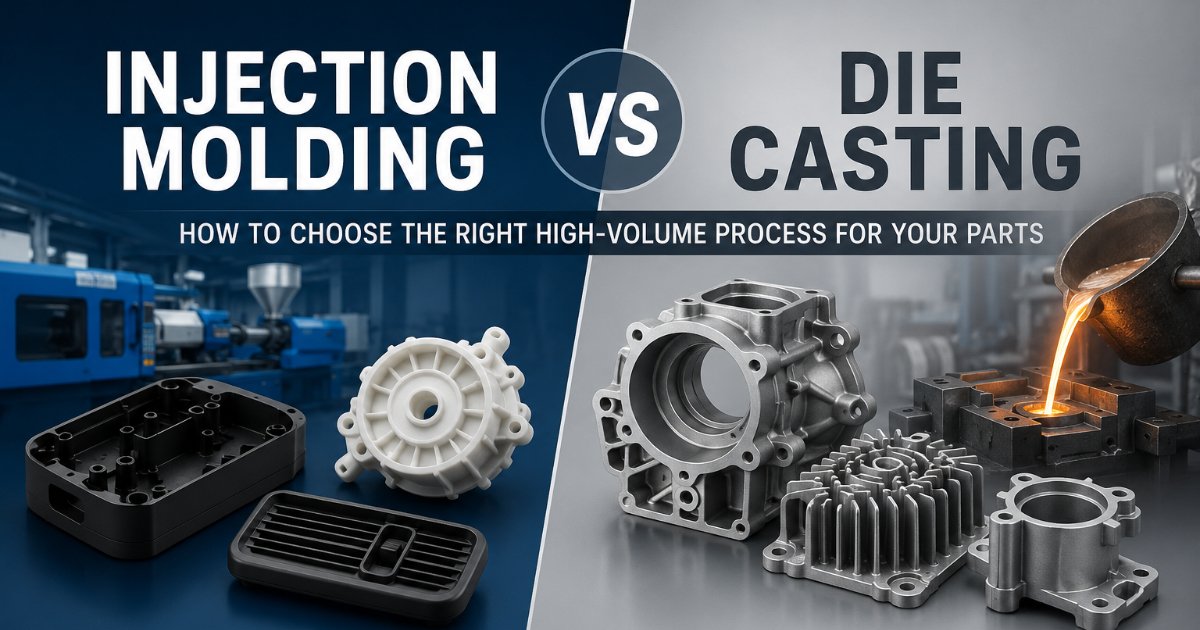
Injection Molding vs Die Casting — How to Choose the Right High-Volume Process for Your Parts
A product engineer at an industrial equipment manufacturer is designing a pump housing. The current version is machined from aluminum billet — 180 × 120 × 80 mm, 6 mm wall thickness, with an O-ring seal groove and four mounting bosses. At 2,000 units per year, the machined cost is $47 per housing. The product manager wants $18. The engineer has two options on the table: injection-molded glass-filled nylon, or die-cast aluminum A380.
The nylon version weighs 190 grams. The aluminum version weighs 520 grams. The nylon mold costs $18,000 and produces parts at $2.80 each. The die-cast tool costs $32,000 and produces parts at $5.20 each. At 2,000 units per year, the annual cost is $23,600 for nylon versus $42,400 for die-cast aluminum. The engineer chooses nylon, the mold is built, the parts ship.
Two years later, the product line expands into a variant that operates at 140°C continuous — above the 120°C heat deflection temperature of the glass-filled nylon. The die-cast tool, which was never built, would have handled 140°C without a margin discussion. The engineer now needs both processes: one for the standard-temperature variant and one for the high-temperature variant.
This guide provides the technical framework for making that process selection correctly the first time — with material property data, tooling cost comparisons, tolerance capabilities, and the decision logic that accounts for temperature, chemical exposure, structural load, and total cost of ownership.
1. What Each Process Does
Injection molding and die casting share a common principle: molten material is forced under high pressure into a reusable steel tool, where it solidifies and is ejected as a finished part. The difference is what melts, and at what temperature.
Injection molding processes thermoplastics — ABS, PC, PP, PA, POM, PBT, PPS, PEEK, and over 500 other commercially available grades. Plastic pellets are heated to 180–400°C in a barrel, injected into a mold at 60–180 MPa, cooled until solid, and ejected. The mold is made from tool steel — P20, H13, S136 — and the process runs at mold temperatures of 20–150°C depending on the resin selection.
Die casting processes non-ferrous metals — aluminum alloys (A380, A383, A413), zinc alloys (Zamak 3, Zamak 5, ZA-8), and magnesium alloys (AZ91D, AM60). Metal ingots are melted in a furnace at 390–700°C, injected into a steel die at 35–140 MPa, solidified in seconds, and ejected. The die is made from hot-work tool steel — H13, H11, DIN 1.2343 — and must withstand thermal cycling from ambient to 300°C die surface temperature every 30–90 seconds for 100,000 cycles or more.
The process similarity means that many parts designed for one process could, with geometry adjustments, be produced by the other. The differences are in the material properties, the tooling economics, and the physics of filling a cavity with a metal at 640°C versus a plastic at 240°C.
| Parameter | Injection Molding | Die Casting |
|---|---|---|
| Feedstock | Thermoplastic pellets | Metal ingots (Al, Zn, Mg) |
| Melt temperature | 180–400°C | 390–700°C |
| Injection pressure | 60–180 MPa | 35–140 MPa |
| Mold/die temperature | 20–150°C | 150–300°C |
| Cycle time | 15–60 seconds | 30–90 seconds |
| Tool life | 100,000–1,000,000+ shots | 100,000–300,000 (Al); 500,000–1,000,000 (Zn) |
| Part weight range | 0.1 g – 10 kg | 10 g – 20 kg |
| Minimum wall thickness | 0.4–0.8 mm | 0.8–1.5 mm (Al); 0.5–1.0 mm (Zn) |
| Typical production volume | 1,000–10,000,000+ | 5,000–500,000+ |
2. The Material Decision — Plastics Can’t Do Everything
The most common reason a die-cast part cannot be converted to injection molding is temperature. The second most common is stiffness. The third is electromagnetic shielding.
Temperature Limits
Engineering thermoplastics have heat deflection temperatures (HDT at 1.82 MPa) that cap their continuous service temperature:
| Plastic | HDT (1.82 MPa) | Continuous Use Limit |
|---|---|---|
| ABS | 85–95°C | 70–80°C |
| PC | 125–135°C | 110–120°C |
| PA66 (GF30) | 240–255°C | 120–140°C |
| PBT (GF30) | 200–210°C | 120–130°C |
| PPS (GF40) | 260–270°C | 200–220°C |
| PEEK | 300–315°C | 240–260°C |
Die-cast metals have no meaningful thermal limit below their melting point. An A380 aluminum housing operates continuously at 150°C with zero mechanical property loss. At 200°C, the strength reduction is negligible. No engineering thermoplastic below PEEK can make that claim — and PEEK at $80–120/kg versus A380 at $3–5/kg changes the economics entirely.
Stiffness and Strength
The tensile modulus of unfilled plastics is 1–4 GPa. Glass-filled engineering grades reach 8–15 GPa. Die-cast aluminum alloys are 70–75 GPa. Zinc alloys are 85–96 GPa. For a structural bracket or a load-bearing housing where deflection under load drives the design, a plastic part may require ribbing, gusseting, and wall thickness increases that erode the weight advantage. At some point, the die-cast part is simpler because the material stiffness does the work instead of the geometry.
EMI/RFI Shielding
Plastics are transparent to electromagnetic interference. A plastic enclosure provides zero shielding unless a conductive coating, metalized paint, or embedded metal mesh is added — all of which add cost and a secondary operation. A die-cast aluminum or zinc housing is inherently conductive and provides 40–60 dB of shielding with no additional processing. For electronics enclosures in industrial environments — motor drives, power supplies, RF modules — this single requirement often makes the process decision before any cost comparison begins.
3. Where Plastics Win — Weight, Corrosion, Integration
Weight
At equal volume, a plastic part weighs 15–20% of an aluminum part and 12–15% of a zinc part. In handheld devices, portable equipment, and automotive components where every gram counts toward fuel efficiency or user fatigue, the weight advantage of plastic is the determining factor. A die-cast zinc enclosure for a handheld diagnostic device weighs 180 grams. The same enclosure in PC/ABS weighs 42 grams. Over 50,000 units, that is 6.9 tonnes of weight eliminated from the supply chain.
Chemical and Corrosion Resistance
Die-cast aluminum corrodes in contact with dissimilar metals unless protected by chromate conversion coating, anodizing, or powder coating — all secondary operations. Die-cast zinc is susceptible to intergranular corrosion in humid environments and requires protective plating. Plastics are inherently corrosion-resistant. A nylon pump housing immersed in water-glycol coolant at 80°C survives 50,000 hours with no surface treatment. An aluminum housing in the same environment requires a corrosion protection system specified, validated, and maintained.
Part Consolidation
A plastic part can integrate snap-fits, living hinges, threaded bosses, and cable management clips directly into the molded geometry — features that would require separate machined components, fasteners, or secondary operations on a die-cast part. This metal-to-plastic conversion approach typically reduces part count by 40–60% compared to an equivalent multi-piece metal assembly. A die-cast housing typically needs threaded inserts pressed or cast-in for screw fastening. A plastic housing molds the thread directly into the boss geometry, eliminating the insert, the insertion operation, and the galvanic corrosion risk at the insert-housing interface.
4. Tooling and Cost Structure
Tooling Cost Comparison
| Parameter | Injection Mold (P20, 1-cavity) | Die-Cast Die (H13, 1-cavity) |
|---|---|---|
| Typical cost | $5,000–$40,000 | $15,000–$80,000 |
| Steel grade | P20, H13, S136 | H13, H11, DIN 1.2343 |
| Tool life | 100,000–1,000,000 shots | 100,000–300,000 (Al) |
| Cooling system | Water lines, 8–12 mm dia. | Oil or water lines, thermal oil TCU |
| Gate type | Edge, pin, submarine, hot runner | Fan, tangential, overflow wells |
| Ejection | Ejector pins, stripper plates | Ejector pins, often larger diameter |
| Surface treatment | Polish, texture, no coating | Nitriding, CrN, or ceramic coating |
Die-cast tooling costs 2–4× more than comparable injection mold tooling for three reasons:
Thermal load. A die-cast die cycles from 150°C to 300°C surface temperature every shot. The thermal expansion and contraction of H13 steel at these temperatures requires larger shrinkage allowances, more robust cooling design, and more frequent preventative maintenance than a plastic injection mold operating at 20–90°C.
Erosion and soldering. Molten aluminum at 640°C is chemically aggressive toward tool steel. Aluminum alloys dissolve iron from the die surface over thousands of cycles — a mechanism called soldering or washout — gradually eroding sharp edges, thin ribs, and gate areas. Die-cast dies require nitriding or ceramic coating (CrN, TiAlN) to resist this attack, adding $2,000–$8,000 to tool cost.
Higher cavity pressure. Die casting operates at similar injection pressures to injection molding (35–140 MPa versus 60–180 MPa), but the molten metal has higher density and lower viscosity than molten plastic. The impact on the die surface — the mechanical shock of the shot — is more severe. Dies require larger clamping force margins, thicker plates, and more robust guide systems than comparable plastic injection molds.
Per-Part Cost
| Cost Element | Injection Molding (PA66 GF30) | Die Casting (A380 Al) |
|---|---|---|
| Material ($/kg) | $3–6 | $3–5 |
| Material per part | 190 g → $0.76 | 520 g → $2.08 |
| Cycle time | 28 seconds | 45 seconds |
| Machine rate ($/hr) | $35–55 | $55–85 |
| Machine cost per part | $0.40 | $0.84 |
| Secondary: deflash/trim | None (auto-degate) | Trim press operation → $0.20 |
| Secondary: surface treatment | None | Vibratory deburr → $0.15 |
| Total per part | ~$1.10–1.60 | ~$3.00–4.00 |
At 2,000 units per year with a $22,000 injection mold versus a $42,000 die-cast die, the 5-year total cost of ownership favors injection molding by roughly 40%. For a full breakdown of what drives injection mold costs, see the injection molding cost guide. At 50,000 units per year, the die-cast per-part cost drops (faster cycle optimization, more cavities), and the difference narrows to approximately 15–25% — but still favors injection molding on pure cost.
The economic equation tilts toward die casting only when the material requirements — temperature, stiffness, EMI — make plastic non-viable. Cost alone rarely drives the decision toward metal.
5. Tolerances and Precision
| Tolerance Type | Injection Molding (Standard) | Injection Molding (Precision) | Die Casting (Al, Standard) | Die Casting (Zn, Precision) |
|---|---|---|---|---|
| Linear ± (mm) | ±0.10 for 25 mm | ±0.025 for 25 mm | ±0.15 for 25 mm | ±0.05 for 25 mm |
| Flatness | 0.10–0.30 mm | 0.05–0.15 mm | 0.20–0.50 mm | 0.10–0.25 mm |
| Hole diameter | ±0.05 mm | ±0.02 mm | ±0.08 mm | ±0.03 mm |
| Parting line flash | 0.05–0.15 mm | 0.02–0.05 mm | 0.10–0.30 mm | 0.05–0.15 mm |
| Draft angle | 0.5–2° | 0.25–1° | 1–3° | 0.5–1.5° |
Injection molding achieves tighter tolerances than die casting for a physical reason: plastics shrink predictably, metals shrink less predictably. A semi-crystalline plastic like PA66 has a well-characterized mold shrinkage of 0.8–1.8% depending on filler content, and the steel can be cut with a calculated shrink allowance that produces parts within tolerance on the first trial. An aluminum casting shrinks 0.5–0.6% in the die, but the shrinkage is influenced by the instantaneous die temperature at each point in the cavity — which varies by 30–50°C across the surface during the cycle. The resulting dimensional variation is larger, and the die correction process is more empirical.
Zinc die casting achieves better precision than aluminum because zinc’s lower melting point (390°C versus 640°C) reduces the thermal swing on the die. Zinc tooling also lasts longer — 500,000 to 1,000,000 shots versus 100,000 to 300,000 for aluminum — so the precision is sustained over more cycles before dimensional drift from die wear requires tool refurbishment.
6. Surface Finish and Post-Processing
| Finish Type | Injection Molding | Die Casting |
|---|---|---|
| As-molded / as-cast | SPI A1–D3 (gloss to matte texture) | Ra 1.6–3.2 µm (smooth to medium) |
| Cosmetic without secondary | Yes — mold texture transfers directly | No — as-cast surface is matte grey, non-decorative |
| Painting / powder coating | Adhesion promoter required for some plastics | Standard — phosphate pretreatment + powder coat |
| Plating | Chrome plating possible on ABS, PC/ABS | Standard for zinc (chrome, nickel); aluminum requires zincate pretreatment |
| Anodizing | Not applicable | Standard for aluminum (clear, black, color) |
| Laser marking | Compatible with most plastics | Compatible — produces high-contrast mark on anodized Al |
The fundamental difference: an injection-molded part can achieve a finished cosmetic surface directly from the mold — the texture is machined into the cavity steel and transfers to every part. A die-cast part exits the die with a matte grey surface that is functional but not decorative. A cosmetic die-cast part always requires at least one secondary finishing operation — powder coating, painting, plating, anodizing, or vibratory finishing. This adds $0.50–$3.00 per part and a secondary process step that injection-molded cosmetic parts skip entirely.
7. Decision Framework
The process decision flows through four questions in sequence:
1. What is the maximum continuous operating temperature?
Below 120°C: plastics are viable. Between 120°C and 200°C: high-performance plastics (PPS, PEEK, PEI) are technically viable but expensive — die casting may be cheaper. Above 200°C: die casting or machined metal only.
2. Is EMI/RFI shielding required?
If yes and the shielding must be inherent to the enclosure: die casting. If shielding can be applied as a coating or gasket: plastics become viable again, but the coating cost must be factored into the comparison.
3. What is the annual volume?
Below 500 units: CNC machining is likely cheaper than both injection molding and die casting. 500–3,000 units: injection molding is viable; die casting is marginal due to tooling amortization. 3,000–50,000 units: both processes are viable. Above 50,000 units: both processes are highly viable; material properties, not tooling amortization, drive the decision.
4. What are the structural requirements — stiffness, strength, fatigue?
If the part is load-bearing in bending and packaging space is constrained: die casting often wins because the material stiffness eliminates the need for deep ribs and thick sections that plastics would require. If the part is lightly loaded and packaging space is available for structural geometry: injection molding wins on weight and cost.
Common Part Types by Process
| Part Type | Typical Process | Reason |
|---|---|---|
| Consumer electronics enclosure | Injection molding (PC/ABS) | Weight, cosmetic surface, snap-fit integration |
| Automotive engine bracket | Die casting (A380 Al) | Temperature, stiffness, fatigue |
| Medical device handheld housing | Injection molding (PC, ABS) | Weight, biocompatibility, chemical resistance |
| Industrial pump housing (aqueous, <100°C) | Injection molding (PA66 GF30) | Corrosion resistance, cost |
| Industrial pump housing (oil, >150°C) | Die casting (A380 Al) | Temperature, chemical compatibility |
| LED heatsink / thermal management | Die casting (A380 Al or ADC12) | Thermal conductivity — 96 W/m·K versus 0.2–0.4 for plastics |
| RF module enclosure | Die casting (Zamak 3 Zn or A380 Al) | EMI shielding |
| Automotive interior trim | Injection molding (ABS, PP, PC/ABS) | Weight, texture, cost at high volume |
| Power tool housing | Injection molding (PA6 GF30) | Impact strength, electrical insulation, weight |
| Outdoor telecom enclosure | Die casting (A380 Al) | Weathering, EMI, structural stiffness |
8. The Hybrid Approach — Overmolded Metal Inserts
There is a third option that combines elements of both processes: overmolding plastic over a die-cast or machined metal insert. The metal provides localized strength, thermal conductivity, or thread strength where needed. The plastic provides the overall geometry, weight reduction, part consolidation, and cosmetic surface.
Common examples:
- Threaded brass inserts overmolded into plastic bosses for high-torque fastening points
- Die-cast aluminum heatsink inserts overmolded into a plastic LED housing — metal where the heat is, plastic everywhere else
- Steel bearing races overmolded into a glass-filled nylon gear body — the plastic handles the gear geometry, the steel handles the bearing load
The hybrid approach costs more in tooling (the insert must be placed into the mold before each shot — manually for low volume, robotically for high volume), but it can solve a problem that neither process alone can address. It is worth considering when the decision framework above produces a split answer: plastic for most of the part, but metal for one specific region.
Summary
Injection molding and die casting are complementary, not competing. Each solves a problem the other cannot.
Choose injection molding when the part can be plastic — operating temperature below 120°C, no inherent EMI shielding required, structural loads manageable with geometry, cosmetic surface required directly from the tool. The per-part cost is lower, the tooling is cheaper, the weight is lower, and the corrosion resistance is inherent.
Choose die casting when the part must be metal — operating temperature above 120°C, EMI shielding required, stiffness-driven design with constrained packaging space, or thermal conductivity needed. The per-part cost is higher, but the material properties make the design possible.
Choose hybrid overmolding when one region of the part needs metal properties and the rest works in plastic.
The most expensive mistake is committing to a process before understanding the full set of operating conditions. The pump housing that later needs a 140°C variant is not a hypothetical — it is a recurring pattern in industrial product development. Map the entire operating envelope before the first tool steel order.
This guide covers the process selection framework. For detailed cost modeling of your specific part, contact our engineering team with a 3D model and production volume estimate — DFM feedback within 24 hours.