Injection Molding vs CNC Machining — How to Choose the Right Process for Your Plastic Parts
A startup founder needs 200 plastic enclosures for a beta launch. The part is a two-piece ABS clamshell — 140 × 90 × 30 mm, 2.5 mm wall thickness, six snap-fit tabs, two threaded brass inserts per half. The injection mold quote comes back at $8,500 for a P20 single-cavity tool, with parts at $1.20 each. 200 parts at $1.20 = $240 in piece price plus $8,500 in tooling = $8,740 total. The per-part cost is $43.70.
A CNC shop quotes the same part at $28 each with zero tooling. 200 × $28 = $5,600. The CNC quote is $3,140 cheaper. The startup founder orders the CNC parts. They arrive in 12 days. The beta launch happens on schedule.
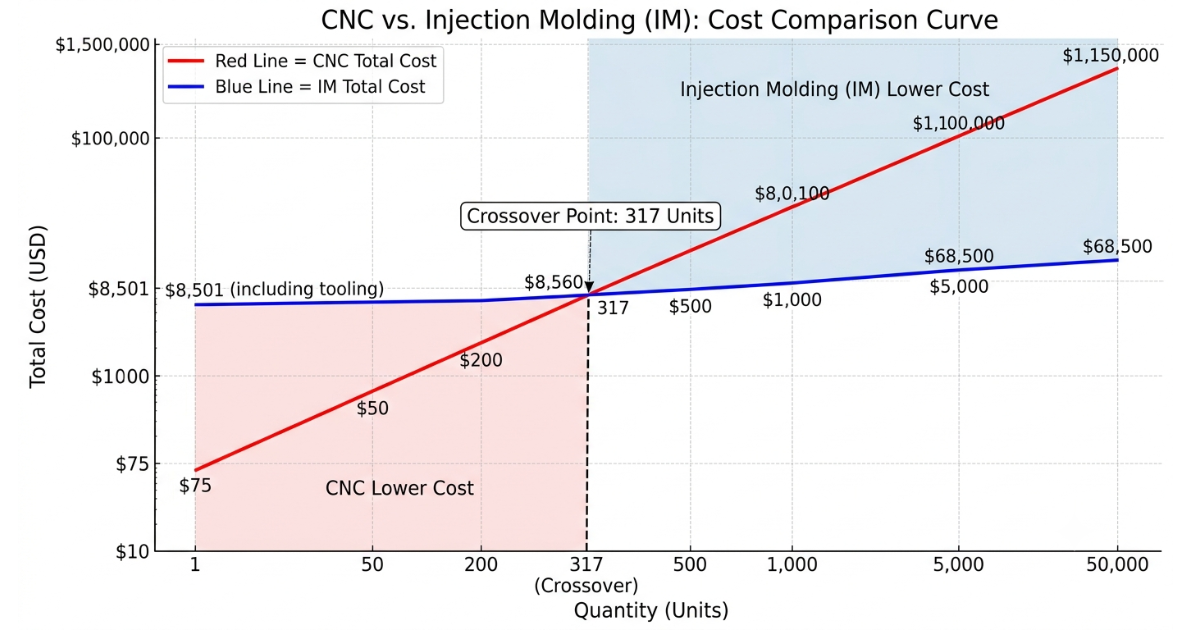
Twelve months later, the product is in production at 5,000 units per year. The CNC parts still cost $28 each — $140,000 per year for the enclosures alone. The injection mold, at $8,500 tooling plus $1.20 per part, would have cost $14,500 in the first year and $6,000 every year after. The crossover point — where injection molding became cheaper than CNC — was at 317 units.
This guide provides the framework for making that decision deliberately, with the cost and engineering data to choose the right process for the quantity you actually need.
1. What Each Process Does Best
Injection molding and CNC machining both produce plastic parts to engineering specifications. They are not competing technologies — they solve different production problems.
CNC machining cuts a solid plastic blank into the finished part by subtractive manufacturing. A block of ABS, POM, PC, or PEEK is clamped into a 3-axis or 5-axis mill. The cutting tool removes material until the part geometry remains. There is no mold, no tooling, no minimum order. The first part costs the same as the 200th part — the entire cost is machine time, material, and fixturing labour.
CNC machining excels at:
- Quantities from 1 to approximately 500 units
- Parts with thick walls, solid sections, or no uniform wall thickness requirement
- Tight tolerances on specific features — a bearing bore, a datum surface, a seal groove — that can be machined in a secondary operation
- Engineering plastics that are difficult to mold due to high melt temperature or thermal sensitivity — PEEK, PPS, PTFE, UHMWPE
- Lead times measured in days, not weeks
Injection molding injects molten plastic into a steel mold under high pressure. The molten resin fills the cavity, cools, solidifies, and is ejected as a finished part. The mold is a precision steel tool that costs $4,000–$50,000 depending on complexity, cavity count, and material. Once the mold exists, each additional part costs the material weight plus machine time — typically $0.30–$3.00 for a part of the size described above.
Injection molding excels at:
- Quantities above approximately 500 units
- Parts with uniform wall thickness, ribs, bosses, and snap-fit features — geometry that CNC would struggle to machine efficiently
- Consistent cosmetic surface finish across all parts without secondary operations
- Multi-cavity production — 4, 8, 16 parts per cycle — driving per-part cost to fractions of a dollar
- Repeatability — the 50,000th part is identical to the first within the process capability of the mold
2. The Cost Crossover — Where the Lines Cross
The decision between CNC and injection molding is primarily an economics decision. Both processes can hit typical engineering tolerances. The variable is quantity, and quantity determines which process costs less.
For a mid-complexity plastic part — the 140 × 90 × 30 mm ABS enclosure from the scenario above:
| Quantity | CNC (per part) | CNC Total | Injection Molding (per part) | IM Total | Lower Cost |
|---|---|---|---|---|---|
| 1 | $75 (setup + programming amortized) | $75 | $8,501.20 (tooling + 1 part) | $8,501 | CNC |
| 50 | $35 | $1,750 | $8,560 | $8,560 | CNC |
| 200 | $28 | $5,600 | $8,740 | $8,740 | CNC |
| 317 | $27 | $8,559 | $8,880 | $8,880 | Crossover |
| 500 | $26 | $13,000 | $9,100 | $9,100 | IM |
| 1,000 | $25 | $25,000 | $9,700 | $9,700 | IM |
| 5,000 | $24 | $120,000 | $14,500 | $14,500 | IM |
| 50,000 | $23 | $1,150,000 | $68,500 | $68,500 | IM |
The crossover quantity depends on part complexity, size, and material. For a simple 2.5D part — a flat plate with drilled holes, no undercuts, no complex contours — the CNC crossover may be as high as 800–1,200 units because CNC machines this geometry efficiently. For a complex part with ribs, bosses, snap-fits, and undercuts, the crossover can drop to 150–300 units because the CNC programming and fixturing time multiplies with each additional feature orientation.
The rule of thumb: below 300 units, CNC is almost always cheaper. Above 1,000 units, injection molding is almost always cheaper. Between 300 and 1,000, calculate the crossover — it depends on the part.
3. Material Selection — Different Options for Each Process
Both CNC and injection molding can produce parts in engineering plastics. But the material options are not identical.
Materials Available to Both Processes
| Material | Injection Molding | CNC Machining | Notes |
|---|---|---|---|
| ABS | Excellent | Good — machines well, can melt at high spindle speeds | Most common consumer enclosure material |
| PC | Good — requires drying, high melt temp | Good — machines cleanly, stress-relieve after machining | Optical clarity, impact resistance |
| PP | Excellent — easy to mold | Difficult — gummy, deforms under cutting heat, poor surface finish | Low-cost, chemical resistant |
| PA (Nylon) | Good — moisture-sensitive | Good — machines well when dry | High strength, wear resistance |
| POM (Acetal/Delrin) | Moderate — outgassing risk, narrow melt window | Excellent — ideal machining plastic, tight tolerances | Bearings, gears, sliding parts |
| PMMA (Acrylic) | Good — drying required | Moderate — brittle, chip control critical | Optical clarity, scratch resistance |
Materials Where CNC Dominates
| Material | Why CNC Is Preferred |
|---|---|
| PEEK | Melt temperature 340–400°C requires specialized molding equipment. CNC machines it at room temperature. The cost adder for high-temp molding exceeds the CNC cost at quantities up to ~2,000 units. |
| PTFE (Teflon) | Cannot be injection molded in any practical process. Must be machined from stock. |
| UHMWPE | Very high melt viscosity — does not flow well in injection molding. CNC is the standard process. |
| PPS (Ryton) | High melt temp (315–345°C), corrosive off-gas at processing temperature. CNC eliminates the molding challenge. |
Materials Where Injection Molding Dominates
| Material | Why Injection Molding Is Preferred |
|---|---|
| PP, PE | Machining these produces gummy chips, poor surface finish, and dimensional instability. They mold beautifully and cost $1.20–2.50/kg. |
| TPE, TPU | Flexible materials are near-impossible to machine accurately — they deflect under cutting force. They injection-mold without issue. |
| Glass-filled materials | PA66-GF30 cuts like it is trying to kill the cutting tool — extreme abrasion on carbide. Injection molding handles glass-filled materials as standard production, short tool life. Injection molding handles glass-filled materials as standard production. |
4. Tolerances — Different Strengths
CNC machining and injection molding achieve precision through different mechanisms, and the tolerance capability on a given feature depends on which process created it.
| Tolerance Type | CNC Machining | Injection Molding | Winner |
|---|---|---|---|
| Feature-to-feature on one side of the part | ±0.01–0.05 mm | ±0.03–0.08 mm | CNC |
| Across the parting line (mold closure dimension) | ±0.01–0.05 mm (single setup) | ±0.05–0.15 mm | CNC |
| Bearing bore, seal groove, press-fit | ±0.01–0.02 mm achievable | ±0.03–0.05 mm typical | CNC |
| Across multiple setups or mold halves | ±0.05–0.10 mm | ±0.05–0.15 mm | Comparable |
| Repeatability over 10,000 parts | Operator and tool-wear dependent | ±0.05 mm within process window | IM |
CNC machining is the right choice when a specific feature requires ±0.01 mm — a bearing bore on a robot arm end-effector, a seal groove on a fluidic manifold, a press-fit dowel hole. The part can be machined from a solid blank, and that one feature gets the precision it needs. Injection molding will hold ±0.03–0.05 mm on that same bore across every part in the run, but it will not hold ±0.01 mm without post-mold machining.
Injection molding is the right choice when every part must be identical to every other part over a production run measured in years. The mold determines the dimensions, and the mold does not change — the 50,000th part matches the first within the process capability. CNC, run by an operator on a machine with a cutting tool that wears, drifts over time unless actively managed.
5. Geometry — What Each Process Cannot Do
Some geometries are impossible or impractical in one process and routine in the other.
CNC cannot produce: Deep ribs with high aspect ratios (the cutter deflects or breaks), internal snap-fit features without an access path for the tool, undercuts on internal surfaces (the tool cannot reach them), and uniform thin walls over large areas (the part deforms under clamping and cutting forces).
Injection molding cannot produce: Solid thick sections without sink marks (the cooling differential between the surface and the core produces voids and sink), sharp internal corners without a radius (the mold requires a fillet — the cutting tool that made the cavity had a radius), and features that change between production runs without modifying the mold (a CNC program can be edited in minutes; a mold requires steel modifications).
The practical question is not which process is “better” for the geometry — it is whether the geometry was designed for the process. A part designed for CNC has thick walls, simple geometry, and tolerances on accessible features. A part designed for injection molding has uniform wall thickness, ribs instead of thick sections, and draft angles. The right process is the one the part was designed for — the wrong process requires redesign. For a formal comparison of plastic injection molding against metal die casting for high-volume parts, see our process selection guide.
6. The Bridge Strategy — CNC While Waiting for the Mold
The most valuable use of CNC for an injection molding program is as a bridge: CNC-machine the first 200–500 parts while the injection mold is being built. The mold lead time is 4–6 weeks. The CNC lead time is 5–12 days. The gap is 3–5 weeks.
During those 3–5 weeks, the product development team gets real parts in the production material for:
- Beta testing with actual users, not prototype approximations
- Regulatory submission — real parts, real material, real process
- Assembly line validation — do the parts fit the fixtures?
- Early sales demos and trade show displays
The CNC bridge parts cost $25–35 each. The injection-molded parts will cost $1.50 each. The bridge is not the production solution — it is the timeline solution. It buys 3–5 weeks of parallel activity: mold is in build, beta is in testing, and the two do not wait for each other.
A CNC bridge order of 200 parts at $28 each = $5,600. A 4-week delay in product launch for a product doing $2 million in first-year revenue = approximately $154,000 in deferred revenue (assuming linear revenue across the year). The bridge cost is 3.6% of the revenue risk it hedges against.
When a CNC bridge makes sense:
- The mold lead time is on the critical path for a revenue event (launch, trade show, regulatory deadline)
- The part quantity needed for the bridge phase is 100–500 units
- The part can be CNC-machined from the intended production material (not all materials machine well — see Section 3)
When a CNC bridge does not make sense:
- The part quantity needed for validation exceeds 1,000 units — at this volume, a rapid aluminum mold is faster and cheaper
- The production material is a flexible, gummy, or glass-filled material that machines poorly — the bridge parts will not represent production part quality
- The part geometry includes features that CNC cannot produce (deep ribs, internal undercuts, uniform thin walls) — the bridge parts would be a different design than the production parts
Frequently Asked Questions
Can CNC-machined plastic parts match injection-molded surface finish?
A properly machined plastic part with polished toolpaths and appropriate feeds and speeds can achieve a surface finish comparable to SPI B-2 or B-1 on the machined surfaces. The difference is that an injection-molded part has a uniform finish determined by the cavity surface — every part matches every other part. CNC parts can vary slightly in surface finish depending on tool wear through a batch. For non-cosmetic surfaces, the difference is irrelevant. For A-side cosmetic surfaces, injection molding provides better batch-to-batch consistency.
What is the lead time difference between CNC and injection molding?
CNC: 5–12 business days from approved drawing for the first 50–200 parts. Injection molding: 4–6 weeks for mold build plus 3–5 days for T1 sampling and process adjustment. The CNC lead time is governed by programming time, machine availability, and part complexity. The injection molding lead time is governed by mold build duration — the cutting of steel.
Can I start with CNC and transition to injection molding later?
Yes — this is the bridge strategy described in Section 6. The caveat: design the part for injection molding from the start, even if the first batch is CNC-machined. A part designed for CNC (thick walls, no draft, sharp internal corners, no ribs) will require a redesign before an injection mold can be built. If the design target is injection molding production, design for that target and accept the slightly higher CNC machining cost for the bridge parts — redesigning the part twice costs more than machining a DFM-compliant part on a CNC once.
Does the CNC vs injection molding decision change for metal parts?
Yes — the economics are different. Metal injection molding (MIM) and die casting have different crossover points than plastic processes. This guide covers plastic parts only. For metal parts, the comparison is typically die casting vs CNC machining, which has a higher crossover quantity because die casting tooling is more expensive than plastic injection mold tooling.
CNC machining and injection molding are not competitors. They are sequential options along the product development timeline: CNC for the first hundred parts while the mold is in build, injection molding for the next hundred thousand after the mold is delivered. The skill is not in choosing one over the other — it is in knowing the crossover quantity for the specific part in front of you, and planning the transition so the CNC bridge delivers parts on the timeline the project demands while the injection mold delivers cost on the volume the market demands.
Request a quote for CNC bridge or injection molding production →
See our injection molding and mold manufacturing capabilities →