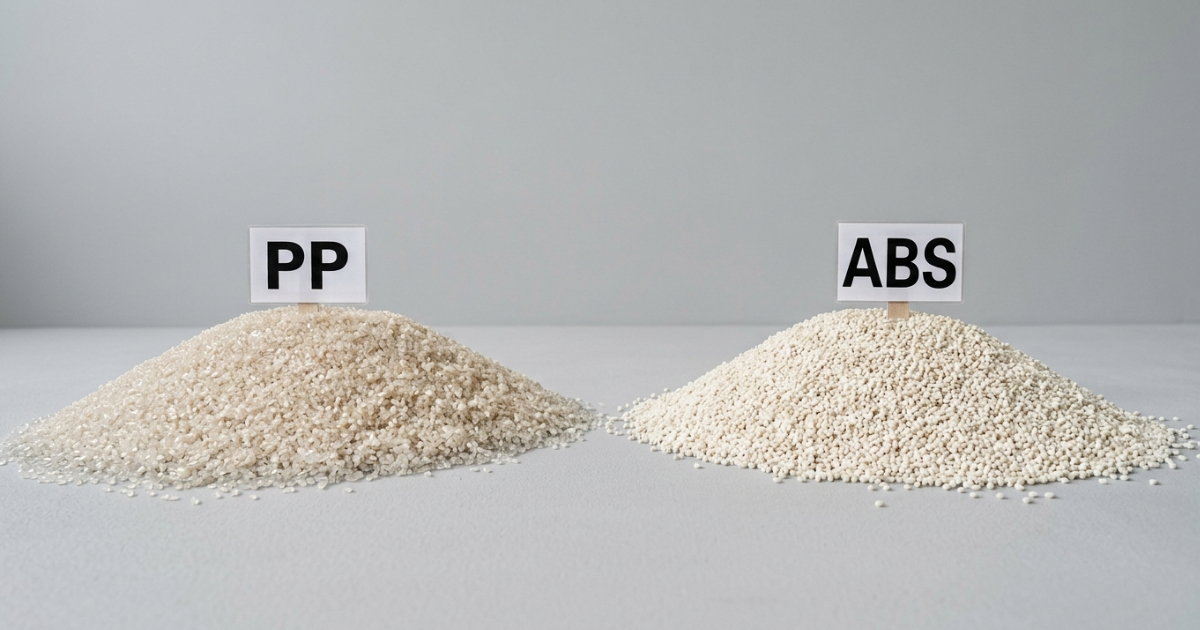
PP vs ABS — How to Choose the Right Material for Your Injection Molded Parts
A procurement engineer at an appliance brand is sourcing an enclosure for a countertop kitchen device. The part is a two-piece clamshell — 180 × 120 × 45 mm, 2.2 mm nominal wall, snap-fit assembly, exterior cosmetic surface. Annual volume is 350,000 units. The design team has not specified a material. The tooling supplier needs a decision to begin mold design.
The choice is between PP and ABS. The two resins together account for roughly half of all injection molded plastics by volume. They are commodity-priced and universally available. But they are not interchangeable — choosing the wrong one produces parts that warp, crack, stain, or fail to meet the cosmetic standard. Choosing the right one, with the correct grade and additive package, produces parts that meet specification at the lowest achievable per-unit cost.
This guide provides the technical comparison — not just the datasheet numbers, but the process behavior, the design implications, and the decision framework that determines which material makes sense for which part.
Material Property Comparison
| Property | PP (Polypropylene) | ABS (Acrylonitrile Butadiene Styrene) |
|---|---|---|
| Density | 0.90–0.92 g/cm³ | 1.04–1.06 g/cm³ |
| Tensile strength | 25–40 MPa | 40–55 MPa |
| Flexural modulus | 1.0–1.5 GPa | 2.0–2.5 GPa |
| Notched Izod impact (23°C) | 4–15 kJ/m² (grade-dependent) | 15–35 kJ/m² |
| Notched Izod impact (-20°C) | 2–4 kJ/m² (brittle) | 8–15 kJ/m² |
| HDT at 1.8 MPa | 50–60°C | 85–95°C |
| Melting point | 160–170°C | Amorphous — softens at ~105°C (Vicat) |
| Mold shrinkage | 1.0–2.5% | 0.4–0.7% |
| Surface finish range | Matte to semi-gloss | Semi-gloss to high-gloss (SPI A2 achievable) |
| Chemical resistance | Excellent — acids, bases, most solvents | Moderate — degraded by ketones, esters, aromatics |
| UV resistance | Poor without stabilization | Moderate; better retention than unstabilized PP |
| Flame retardancy | HB (standard); V-2 achievable with FR grades | HB (standard); V-0 achievable with FR grades |
| Food contact | FDA grades widely available | Limited; most ABS grades not food-contact rated |
| Relative material cost | ¥8–12/kg | ¥14–22/kg |
| Cycle time (2.5 mm wall) | 18–25 s | 22–35 s |
Key Differences — What the Datasheet Doesn’t Tell You
Impact Behavior: The Low-Temperature Cliff
The most consequential difference between PP and ABS does not appear on a standard property table: PP undergoes a ductile-to-brittle transition at approximately 0°C. At room temperature, a PP living hinge can flex millions of cycles without failure. At -10°C, the same hinge shatters on the first flex.
This transition is not gradual — it is abrupt. PP’s notched Izod impact drops from 10–15 kJ/m² at 23°C to 2–4 kJ/m² at -20°C. ABS, by comparison, retains 50–60% of its room-temperature impact strength at the same temperature. For any part that will be shipped, stored, or used in an unheated environment — an automotive interior trim clip, a tool housing on a construction site, a consumer electronic device in a delivery van in January — PP’s low-temperature brittleness is a failure mode that must be designed around or ruled out.
The fix for PP is not a different grade — it is design. A PP part that needs cold-temperature impact performance must eliminate sharp internal corners (minimum R0.5 mm at all transitions), avoid thick-to-thin transitions that create stress concentrations, and use toughened PP copolymer grades (PP-CO) rather than homopolymer. But even with these measures, PP cannot match ABS at low temperatures. If the part will see freezing conditions and impact loading, the material selection decision is already made.
Dimensional Stability: Why ABS Holds Tolerance Better
PP has a mold shrinkage of 1.0–2.5% — five to seven times the 0.4–0.7% typical of ABS. In practical terms, a 200 mm PP part shrinks 2–5 mm from mold dimensions. The exact shrinkage depends on wall thickness, mold temperature, injection speed, and packing pressure — four variables that interact non-linearly. A 5°C shift in mold temperature changes PP shrinkage by approximately 0.1–0.2 percentage points.
ABS shrinks less and shrinks more predictably. Its amorphous structure — polymer chains in a random, entangled arrangement rather than the semi-crystalline spherulite structure of PP — means there is no crystallization shrinkage component. All shrinkage is thermal contraction, which follows a linear relationship with mold temperature.
For parts with tight dimensional tolerances — snap-fit assemblies, gear meshes, optical alignments, PCB mounting features — ABS’s predictable, low shrinkage makes it the default choice. PP can achieve tight tolerances, but it requires a wider process window, more frequent dimensional checks, and acceptance of higher cavity-to-cavity variation.
Surface Finish: The SPI Scale Reality
ABS can achieve SPI A2 gloss straight from the tool — a mirror finish that requires no secondary processing. PP, even with a polished cavity, tops out at approximately SPI B1 semi-gloss. The semi-crystalline structure of PP scatters light at the spherulite boundaries, producing a characteristic haze that polishing cannot eliminate.
For cosmetic surfaces — consumer electronics enclosures, appliance fascias, retail packaging — ABS is the standard for a reason. The surface finish is achievable in the molding cycle with no post-processing. PP cosmetic parts require texturing (VDI 24–27) to hide the inherent surface haze, which adds mold cost and constrains draft angle design.
Chemical Resistance: PP’s Defining Advantage
PP is chemically inert to virtually all solvents, acids, and bases at room temperature. It is used for battery acid containers, bleach bottles, and laboratory chemical storage for exactly this reason. ABS, by contrast, is attacked by ketones (acetone, MEK), esters (ethyl acetate), aromatic hydrocarbons (toluene, xylene), and chlorinated solvents. A single wipe with acetone-based cleaner on an ABS cosmetic surface produces permanent damage — whitening, softening, and surface tack.
This is the decision that cannot be fixed with a mold design change. If the part will contact solvents, fuels, strong acids, or aggressive cleaning agents in service, ABS is simply not an option. Choose PP or evaluate chemical-resistant engineering resins such as PA, POM, or PBT.
Injection Molding Process Comparison
| Parameter | PP | ABS |
|---|---|---|
| Melt temperature | 200–250°C | 220–260°C |
| Mold temperature | 20–60°C | 50–80°C |
| Drying required | No (non-hygroscopic) | Yes — 80°C × 2–4 h |
| Injection pressure | 60–100 MPa | 80–120 MPa |
| Packing pressure | 50–80% of injection | 60–80% of injection |
| Cooling time (2.5 mm wall) | 10–15 s | 12–18 s |
| Typical cycle (2.5 mm wall) | 18–25 s | 22–35 s |
| Mold steel | P20 adequate | P20 or 718H |
| Shrinkage compensation | 1.5–2.0% (high — must be calculated per geometry) | 0.5–0.6% (standard Moldflow library value) |
| Gate type | Any — low viscosity fills easily | Pinpoint or side gate; avoid tunnel gates on cosmetic faces |
| Weld line behavior | Less visible (semi-crystalline) | More visible (amorphous — weld lines appear as hairlines on glossy surfaces) |
The processing cost difference between PP and ABS is not just the raw material price per kilogram. The cycle time — typically 20–30% longer for ABS due to higher melt temperature, higher mold temperature, and longer cooling — increases the per-part conversion cost. At 350,000 parts per year on a 4-cavity mold, a 25-second PP cycle versus a 32-second ABS cycle translates to approximately 1.1 million additional parts per year of capacity from the PP mold — or, viewed the other way, 28% more press time required for the ABS version.
Application Mapping — Which Material for Which Industry
| Application | Recommended Material | Reason |
|---|---|---|
| Food storage container | PP | FDA grades, microwave-safe, chemical inert |
| Power tool housing | ABS | Impact at low temp, structural, cosmetic surface |
| Automotive battery case | PP | Acid resistance, cost, toughness |
| Laptop bottom shell | ABS (or PC/ABS) | Dimensional stability, cosmetic, structural |
| Living hinge (flip cap) | PP | The only material that survives 1M+ flex cycles |
| Medical device enclosure | ABS | Dimensional stability, paint adhesion, gamma/EtO sterilizable |
| Chemical drum / tank | PP | Chemical inertness, weldable |
| Toy building brick | ABS | Dimensional precision (±0.005 mm), clutch force consistency |
| Garden furniture | PP | UV-stabilized grades, weather resistance, cost |
| Consumer electronics remote | ABS | Cosmetic surface, impact from drops, rigid feel |
| Syringe body (disposable) | PP | FDA, clarity (random copolymer), cost at high volume |
| Appliance control panel | ABS | Cosmetic, dimensionally stable for button alignment |
The Decision Framework
| Question | PP Answer | ABS Answer |
|---|---|---|
| Will the part see temperatures below 0°C in service? | Only if impact loads are low and toughened copolymer grade is used | Yes — retains impact strength at low temperature |
| Will the part contact solvents, fuels, or strong chemicals? | Yes — chemically inert to most substances | No — attacked by ketones, esters, aromatics |
| Is a Class A cosmetic surface required? | No — PP haze requires texturing to hide | Yes — SPI A2 gloss achievable as-molded |
| Are tight tolerances required (±0.1 mm or better)? | Difficult — high and variable shrinkage | Workable — low, predictable shrinkage |
| Is a living hinge required? | Yes — PP is the only practical choice | No — ABS cracks after ~100 flex cycles |
| Is the part large and flat (>150 mm span)? | Warpage risk from high shrinkage — requires DFM optimization | Lower warpage risk |
| Is food contact required? | Yes — FDA grades widely available | Generally no |
| Is UL V-0 flame retardancy required? | Achievable with FR PP grades | Achievable with FR ABS grades (more common) |
| Is cost the primary driver? | Yes — lower material and cycle time cost | No — premium material and longer cycle |
| Is the volume above 500,000/year? | PP cycle time advantage compounds | ABS press-time premium adds up |
Summary
PP and ABS are not competitors. They are complementary materials that each solve problems the other cannot.
Choose PP when the part needs chemical resistance, a living hinge, food contact compliance, or the lowest possible per-part cost — and when impact loading at low temperature is not a design condition. PP’s high mold shrinkage and limited cosmetic surface finish are constraints that must be accounted for in the part design — not surprises discovered at T1.
Choose ABS when the part needs impact resistance at low temperature, a Class A cosmetic surface, or tight dimensional tolerances — and when chemical exposure is limited to household cleaners and water. ABS’s longer cycle time and higher material cost are the price of its dimensional stability and surface quality.
When neither material fully meets the requirements — a chemical-resistant enclosure with a premium cosmetic surface, for example — the solution is not to compromise. It is to evaluate a higher-performance material: PC/ABS for impact and cosmetics with moderate chemical resistance, PA (Nylon) for chemical and temperature with structural performance, or POM for precision mechanical parts with solvent resistance.
The material decision should be made before the mold design begins — not after. Shrinkage compensation, gate sizing, cooling layout, and texture specification all depend on the material. Changing materials after the mold is cut means modifying steel, not just updating a specification sheet.
Material data: property tables for the common engineering and commodity resins in the injection molding materials guide →.
This guide covers the PP vs ABS decision framework for injection molded parts. For a material recommendation on your specific part — including grade selection, shrinkage analysis, and cost modeling — contact our engineering team with a 3D model and application requirements. DFM feedback within 24 hours.