How to Choose a High-Volume Injection Molding Supplier
A procurement manager signs a Chinese injection molding supplier after a flawless sampling process. T1 samples arrive in three weeks, dimensional reports are complete, the per-part price is 18% below the incumbent. Six months later, the program is at 250,000 pieces per year and falling behind: shipments slip by two weeks, a cavity in the 4-cavity tool starts flashing, and the supplier’s answer to a capacity question is “we will add a machine next quarter.”
The supplier was not dishonest. It was selected with low-volume criteria — sample quality, tooling price, response speed — for a high-volume job. At 1 million pieces per year, the criteria that matter are different: machine capacity, tool life planning, process control at speed, and supply continuity. This guide covers the checks that separate a supplier who can sample your part from one who can supply it for five years.
If you are starting from zero, read the general supplier selection criteria first — factory verification, IP protection, and communication standards apply at any volume. This post covers only what changes when the program crosses roughly 100,000 pieces per year.
What Changes at Volume
The physics of injection molding does not change at 1 million pieces per year. The economics and the failure modes do.
Cost structure shifts from tooling to cycle time. At 5,000 pieces, the tool cost dominates the per-part cost. At 1 million pieces, a 2-second cycle time difference on a multi-cavity tool is worth more than the entire tooling budget. A supplier optimized for low volume owns cheap single-cavity tooling and flexible changeovers; a supplier optimized for volume owns high-cavitation tools, hot runner systems, and the discipline to defend a validated cycle time.
Quality failures become systemic. At low volume, a defect is caught at final inspection and sorted out. At volume, a drifting cavity produces 10,000 out-of-spec parts between SPC checks if the checks do not exist. Process drift — gate wear, heater band degradation, material lot variation — is invisible without shot-by-shot process logging and statistical monitoring.
Supply becomes the product. A missed shipment at low volume is an inconvenience. A missed shipment on a volume program stops the customer’s assembly line. The supplier’s raw material stocking, tool maintenance schedule, and repeat-order lead time are part of the deliverable, not afterthoughts.
The supplier’s other customers now affect you. A shop with 10 machines and 40 active customers cannot reserve capacity for your 1M-piece program. Capacity claims must be verified against machine count, machine time, and the supplier’s existing load — not against promises.
These four shifts define the evaluation framework below. Each check is a question you can ask in an email or on an audit, and each has a verifiable answer.
The Five Checks That Matter at Volume
1. Capacity Verification — Machine Time Math, Not Machine Count
A supplier claiming “capacity for your program” should be able to produce the calculation, not the reassurance. The math is simple enough to do yourself:
Parts per hour = cavity count × (3,600 ÷ cycle time in seconds)
Example: an 8-cavity tool running a 25-second cycle produces 1,152 parts per hour. At 24/7 operation with 85% utilization — a realistic number for a maintained press fleet — one press delivers roughly 7 million parts per year on that tool.
Now compare against your program. A 1-million-piece annual requirement needs 15–20% of one press. A 5-million-piece requirement needs a dedicated press. A supplier should be able to state which press, at which tonnage, with which planned utilization your tool will run on — before you sign.
What to verify on the floor:
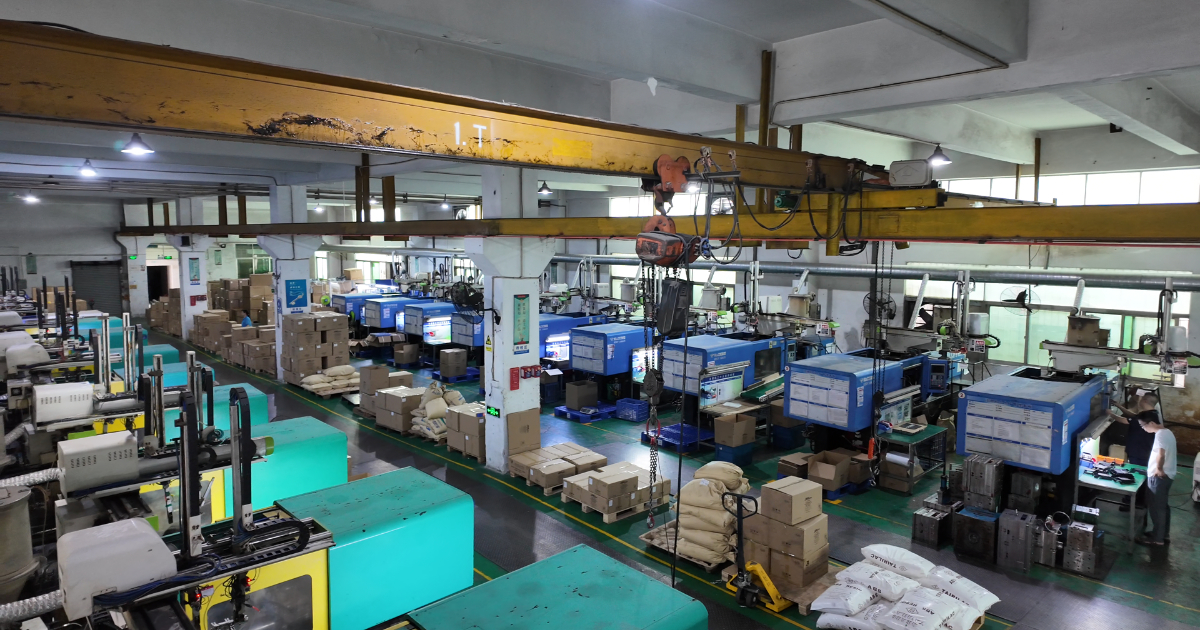
- Machine count and tonnage range. A volume supplier runs a fleet with depth in the 90–250T range where most multi-cavity production tools run. A supplier with three presses and a promise is a bridge-tooling shop, not a volume partner. JBRplas runs 27 presses from 90T to 650T, with 24 of 27 in the 90–250T multi-cavity range — the full inventory is published on the equipment list.
- Utilization reality. 24/7 operation is claimed by nearly every Chinese molder. Ask what percentage of presses run automated part removal (it determines whether night shifts actually produce), and ask for the current loading plan. Automation on 80% of the fleet is a verifiable floor signal.
- Load transparency. How many production programs does the toolroom currently support? A supplier running 40 simultaneous programs on 10 machines is promising everyone the same capacity. The question is not offensive — serious volume suppliers answer it.
2. Tool Life Planning — What Happens at Shot 400,000?
The tool is the asset that determines whether year three of your program costs the same as year one. A low-volume supplier treats tool life as the customer’s problem after delivery. A volume supplier plans it:
- Steel selection by shot count. P20 (28–34 HRC) is a 300K–500K shot steel. H13 (48–52 HRC) runs 500K–1M+ shots; 2344 runs 800K–1M+. If your program needs 3 million parts over three years on an 8-cavity tool, that is 375,000 shots — inside P20 range but with no margin. Ask which steel the supplier specifies and why, not just which one is cheapest.
- Maintenance schedule by shot count. Preventive maintenance should be scheduled on a shot counter, with spare inserts and ejector pins machined in-house before they are needed — not ordered from an outside shop after a breakdown. A supplier with an in-house toolroom (CNC, EDM, wire-cut, grinding) can machine a replacement insert in days; one without it waits weeks. JBRplas’ toolroom holds 9 CNC machining centers, 9 EDM sinkers, 7 wire-cut machines, and 6 surface grinders — the full tooling inventory is published.
- Cavity balance data. On multi-cavity tools, ask for cavity-to-cavity weight variation data from the process qualification. A 16-cavity tool with Cpk 1.52 on cavity weight balance (our published Type-C charger housing case) fills evenly; a tool with 8% weight spread between cavities produces parts that shrink, warp, and fit differently — at 2.5 million pieces per year, that becomes your assembly line’s problem.
3. Process Control Evidence — SPC Data, Not Inspection Promises
Every supplier promises “strict quality control.” The difference between inspection and process control is the difference between sorting scrap and preventing it. At volume, sorting is not economically or logistically viable — you need prevention.
Ask for these specific documents, not a summary:
- SPC charts with Cpk tracking on critical dimensions, measured every 50–100 shots during production — not a one-time capability study done on the sample run. The sampling interval matters: at a 25-second cycle, every 100 shots is roughly every 40 minutes. That is the detection window for drift.
- Shot-by-shot process logging. Injection pressure, fill time, and cycle time recorded for every shot means a process deviation is visible the shift it happens, not when the QC report lands next week.
- Defect rate commitments. An established volume program should run below 0.3% defect rate; new program ramp-up should target below 1% within 90 days. If the supplier will not commit numbers, they are planning to sort.
- Documentation infrastructure. FAI reports, MSA, Control Plan, PFMEA, PPAP Level 3 for automotive programs, and CoC per shipment are standard at volume — if these are “available on request” rather than default, ask why. See quality control in injection molding for what each document verifies.
4. Supply Continuity — The Mechanisms, Not the Promises
The most common reason buyers leave a Chinese molder is not quality — it is a missed shipment that stopped a line. Volume supply continuity runs on mechanisms, and each is checkable:
- Consignment / Kanban capability. A supplier who holds a finished goods buffer and ships on call-off removes your forecasting error from the supply chain. If the supplier has never run a consignment program, they will learn on yours.
- Repeat order lead time from a stocked mold. 7–15 business days is a healthy volume-supply figure. 4 weeks means the supplier molds to order and you carry the inventory risk.
- Material security. 500+ resin grades in-house with lot traceability is a stocking signal; single-source resin purchasing with no buffer is a single point of failure. Ask what happens when the resin supplier is 2 weeks late — the answer should involve buffer stock, not apologies.
- Tool ownership and transfer terms. The tool contract should specify ownership, guaranteed shot life, and the exit process — before the relationship is tested. See the tool transfer and mold maintenance resources.
5. Track Record at Volume — Numbers, Not Adjectives
A supplier’s volume claims should be verifiable against published programs with stated annual volumes. “We do high-volume production” is an adjective. “50 million pieces per year on 4 molds and 16 part numbers” is a track record.
When you evaluate case studies, look for:
- Stated annual volumes, not project counts. A case study without a volume figure tells you nothing about volume capability.
- Cavity counts and cycle times. These reveal whether the supplier understands volume economics. An 8-cavity smartwatch back cover at an 18–22 second cycle (case study) demonstrates cycle time discipline; a single-cavity “production” story does not.
- Program diversity. Toy bricks at 50M+ pieces (case study) prove high-cavitation commodity volume; an automotive HVAC bracket at 280K pieces (case study) proves regulated-industry volume. Both matter — one for speed, one for discipline.
The Red Flags
Some signals are disqualifying regardless of what the supplier says:
| Signal | Why It Matters |
|---|---|
| Cannot produce a machine-time calculation for your program | Capacity is a hope, not a plan |
| Quotes single-cavity tooling for a 1M+ piece program | Per-part cost will be 2–4× market by year two |
| No SPC data from running production programs | Process control exists only at inspection |
| Tool maintenance outsourced to another shop | Every repair is a 3-week supply interruption |
| No consignment/Kanban experience at your volume | You become the inventory buffer |
| Case studies without stated annual volumes | Volume track record is unverifiable |
| “No MOQ” as the lead sales message | The supplier’s economics are built on small batches — see our position on volume economics |
The last point deserves emphasis: a supplier whose homepage leads with “no minimum order, 500 pieces” has optimized its operation for prototype and bridge work. Nothing about that operation transfers to your 5-million-piece program — not the tooling, not the process discipline, not the supply chain. Choose the supplier whose lead message matches your requirement.
DFM Decisions That Belong in Supplier Selection
Volume economics are decided during DFM — before the tool is cut. Three decisions determine whether the program is profitable at volume, and they should be part of your supplier evaluation:
Cavitation. The cavity count is set against annual volume, part size, and press tonnage. One 16-cavity tool at a 20-second cycle outperforms four single-cavity tools on part cost, consistency, and floor space — but requires the press, the runner balancing, and the maintenance discipline to run it. See multi-cavity and family molds for the trade-offs.
Runner system. At volume, hot runner systems (Yudo, Mold-Masters, Husky, Synventive) eliminate the sprue, shorten the cycle, and cut material waste. They also add maintenance complexity. A supplier who cannot discuss hot runner trade-offs for your material has not run volume tools.
Tool steel and surface treatment. Steel grade is a shot-life decision, not a cost decision. Specifying P20 on a 2-million-shot program saves $3,000 at tooling buy and costs $50,000 in downtime and repairs over the life. See the mold maintenance and tool life guide for the full logic — and the injection molding cost breakdown for how tooling, material, and cycle time interact at volume.
Frequently Asked Questions
What annual volume counts as “high volume”? We define 100K–1M pieces per year as medium volume (2–4 cavity H13 tooling) and 1M+ as high volume (high-cavitation, hot runner tooling). The evaluation criteria in this post start to matter around 100K pieces per year and become decisive above 1M.
How do I verify a supplier’s capacity claim remotely? Ask for the machine-time calculation for your program: cavity count, cycle time, press tonnage, and planned utilization. Then ask for the equipment list with brands and tonnage — and check it against the floor on the audit. A supplier with 27 presses publishes the list; a supplier with 5 presses talks about “flexible capacity.”
What data should I request before signing a volume contract? SPC charts from a running production program, cavity balance data from the process qualification, defect rate history, repeat-order lead time from a stocked mold, and the tool maintenance schedule by shot count. If any of the five is missing, price it as risk.
How is tool maintenance handled at 1M+ shots? Preventive maintenance scheduled on shot counters, with spare inserts and cavity repairs machined in the supplier’s own toolroom. H13 and 2344 steels are selected for 500K–1M+ shot life at the quoting stage. See mold maintenance and tool life.
Should I ask for consignment or Kanban supply at volume? Yes. A finished goods buffer with call-off shipping removes your forecast error from the supply chain and converts the supplier’s lead time into your flexibility. It is standard practice on volume programs and a useful test of the supplier’s logistics maturity.
How do I structure the commercial terms for a volume program? Price breaks by cumulative volume, capacity reservation terms for the press allocation, tool ownership and guaranteed shot life in writing, and an exit clause covering tool transfer. The cost breakdown guide shows where volume discounts come from — use it to judge whether a quote’s price breaks are real or cosmetic.
The Selection Question in One Line
For a low-volume program, the question is: can this supplier make my part well? For a high-volume program, the question is: can this supplier keep making my part well, on time, for five years, at a defensible cost — and prove it with numbers?
Review our high-volume manufacturing capability — 27 presses, 24/7 operation, multi-cavity tooling, PPAP and SPC systems, and published case studies from 280K to 50M+ pieces per year — or submit your part for a volume feasibility review.