Export Packaging for Injection Molds and Plastic Parts — Crating, Container Loading, and Damage Prevention
A buyer in Germany approves T2 samples. The mold — a 1,200 kg P20 4-cavity tool — is finished. The forwarder books a 40-foot container. The mold maker wraps the tool in stretch film, bolts it to a wooden pallet, and loads it. No desiccant. No VCI. No steel frame. The container spends 28 days at sea, crosses the equator twice, and arrives in Hamburg in February.
The crate has absorbed moisture. The stretch film trapped condensation against the mold surface. The A-plate parting line has flash rust on three edges. The ejector pins — unprotected, uncoated — have surface corrosion. The buyer files a claim. The forwarder points to the packing method. The mold maker points to the shipping conditions. The insurance adjuster points to inadequate packaging as the proximate cause. The mold requires $1,200 in polishing and pin replacement before it can run production. The delay is 10 days.
This guide covers what a buyer needs to know about export packaging for injection molds and plastic parts — crating standards, moisture protection, container loading, and parts packaging options. It is written for buyers who have never received an international mold shipment and want the tool to arrive in the same condition it left the toolroom.
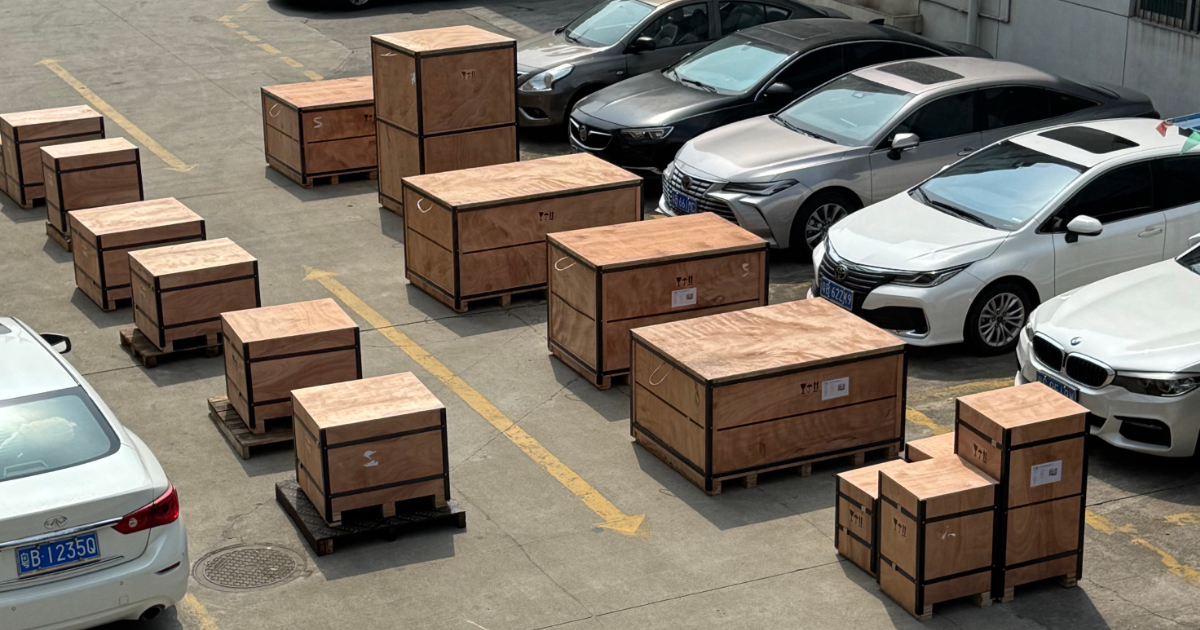
1. Mold Crating Standards
A mold is not a generic piece of freight. It is a precision steel assembly weighing 200 kg to 15,000 kg, with polished surfaces, hardened ejector pins, sliding components, and machined parting lines that must seal under injection pressure. The crate that protects it during international shipping is not packaging — it is insurance.
Weight Classes and Crate Specifications
| Mold Weight | Crate Type | Requirements |
|---|---|---|
| < 200 kg | ISPM 15 treated plywood box | 12–15 mm plywood, internal blocking, bolt-down base |
| 200–500 kg | ISPM 15 treated plywood + steel reinforced base | 15–18 mm plywood, steel angle brackets at corners, fork pockets |
| 500–2,000 kg | Steel frame crate with treated wood panels | Welded steel tube or angle frame, 18 mm plywood infill panels, bolted closure, 4-point lift eyes |
| > 2,000 kg | Heavy-gauge steel frame, open or enclosed | Structural steel frame, lift eyes rated for total weight + 50% safety factor, bolted to container floor with steel strapping |
ISPM 15 compliance. All wood used in international shipping crates must be ISPM 15 treated — heat-treated to a core temperature of 56°C for at least 30 minutes and stamped with the IPPC mark. This is not optional. Containers arriving with non-compliant wood are quarantined, treated at the buyer’s expense, or re-exported. The IPPC stamp must be visible on at least two faces of the crate.
Steel frame requirement. Molds over 500 kg should not be shipped in all-wood crates. The dynamic loads during container handling — a 1,200 kg mold inside a crate experiences effective loads of 2–3× its static weight during container loading, truck transport, and crane handling — will crack a wood-only crate. A welded steel tube frame with bolted wood infill panels transfers the load to the steel structure. The crate costs $200–600 more than an all-wood equivalent and prevents damage that costs 5–20× that amount to repair.
Internal Blocking
The mold must be immobilized inside the crate. A mold that can shift 5 mm inside its crate during transit will hammer against the crate wall for 28 days. The result: damaged mold components, cracked crate panels, and a shipment that arrives in worse condition than it left.
Internal blocking requirements:
- Bolted, not screwed. The mold is bolted to the crate base through its platen mounting holes or dedicated lift points. Wood screws pull out under dynamic load. Use M12–M20 bolts through the crate base into threaded inserts in the mold base or through-bolted with lock nuts.
- No contact with polished surfaces. Blocking timber must contact only the mold base, clamp plates, or designated non-critical surfaces. Never block against the parting line, cavity surfaces, ejector plates, or any polished or machined face.
- Zero-gap blocking. Wood blocks wedged between the mold and crate walls must be tight-fit. A 2 mm gap allows the mold to accelerate over 2 mm before impact — the peak force at impact is multiples higher than if the block is tight.
2. Moisture Protection
The most common damage mechanism in international mold shipments is not impact. It is corrosion.
A sealed shipping container is a condensation chamber. Daytime sun heats the container interior, warm air holds moisture, and at night the container cools and water condenses on the coldest surfaces — the steel mold. Over 28 days of thermal cycling, the mold is repeatedly wetted and dried. Unprotected polished steel surfaces will show flash rust within 72 hours.
The Protection Layers
| Method | What It Does | Required For |
|---|---|---|
| VCI (Volatile Corrosion Inhibitor) | Releases molecules that form a monomolecular protective layer on steel surfaces | All steel molds. Minimum standard |
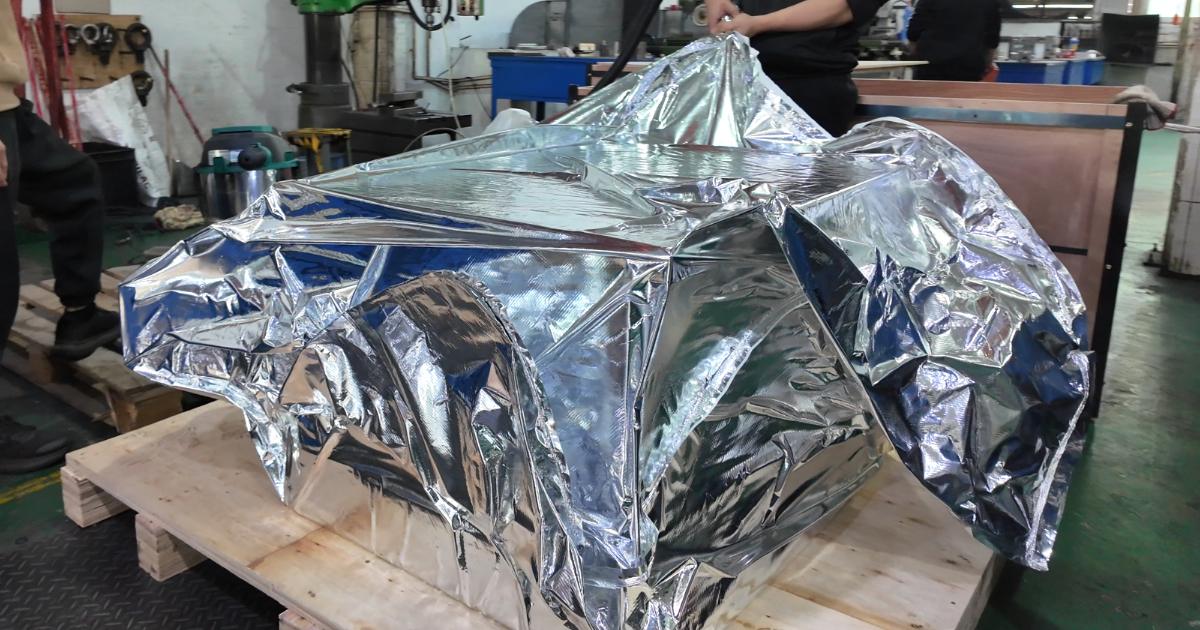
| VCI film wrap | VCI-impregnated PE film, seals the mold from ambient air | Molds with polished surfaces, ejector pins, slides |
| Desiccant packs | Absorb residual moisture inside the sealed wrap | All sealed-wrap applications. 500g–1kg per cubic metre of enclosed volume |
| Vacuum sealing with VCI | Full barrier — VCI film + vacuum + heat seal | Molds with SPI A-1/A-2 surfaces, optical molds, long transit (> 30 days) |
| Cosmetic oil / rust preventative | Applied directly to exposed steel surfaces | Backup protection. Compatible with the molding material — some oils contaminate medical or optical parts |
The standard procedure for a production mold (500–2,000 kg, P20 or H13 steel, international container shipment):
- Clean all surfaces — remove coolant, fingerprints, machining residue
- Apply light rust-preventative oil to all exposed steel (parting line, cavity inserts, ejector pins, leader pins, clamp surfaces)
- Wrap the entire mold in VCI film, sealed with tape at all seams
- Place 1–2 kg of silica gel desiccant inside the VCI wrap
- Bolt the wrapped mold to the crate base
- Install internal blocking
- Close and seal the crate
This procedure adds $80–150 in materials and 2 hours of packing labour. The cost of not doing it: $500–3,000 in corrosion repair and 5–15 days of production delay.
3. Container Loading
How a mold is positioned and secured inside a shipping container determines whether it arrives at the receiving dock or the claims adjuster’s desk.
Load Distribution
Molds are dense — a 1,500 kg tool occupies perhaps 2 cubic metres. The container floor loading at the crate footprint is 5–10× higher than the average floor loading for general cargo. Position heavy molds:
- Over the container axle points, not at the centre of the span. The container floor is strongest at the ends and weakest at the midpoint of an unsupported span during lifting.
- Distributed across the container width. Two 750 kg crates positioned side-by-side distribute the load across the cross-members.
- Never concentrated on one side rail. An unbalanced container is unstable during crane handling and will tilt — potentially dropping the load.
Securing the Crate
A 1,200 kg mold crate inside a container must survive emergency braking, rough seas, and crane handling. The securing method depends on the crate design:
| Crate Type | Securing Method |
|---|---|
| Wood crate, < 500 kg | Steel strapping (2×) through crate base to container lashing rings. Wood dunnage between crate and container walls. |
| Steel frame crate, > 500 kg | Bolted to container floor through pre-drilled bolt holes in the steel frame base. Steel strapping as backup. |
| Open-top crate (mold with protruding components) | Covered with waterproof tarp secured to crate frame. Container must be placed below-deck or use a waterproof container. |
What goes in the same container with the mold. If the mold and the first production parts are shipping together — common for T2/T3 shipments — the parts cartons must not be loaded against the mold crate. Parts cartons are crushable. A mold crate that shifts 10 mm against a carton wall destroys the contents. Either load parts in a separate container, or build a plywood divider wall between the mold crate and the parts pallets.
4. Plastic Parts Packaging
The mold is one half of the shipment. The parts it produces are the other half — and parts packaging ranges from bulk industrial to retail-ready.
Packaging Options
| Method | Cost per Part | Best For | Notes |
|---|---|---|---|
| Bulk (polybag + carton) | $0.01–0.03 | Internal components, non-cosmetic parts, B-side surfaces | Parts contact each other. Some surface marring expected. |
| Layer-pack (PE foam sheet between layers) | $0.03–0.08 | Cosmetic parts, painted surfaces, A-side Class A | Eliminates part-to-part contact. Labour-intensive packing. |
| Partitioned carton (individual cells) | $0.05–0.15 | Small cosmetic parts, lenses, medical device components | Maximum protection. Each part isolated. |
| Vacuum-formed tray + carton | $0.10–0.30 | Retail-ready, automated assembly feed | Trays designed to part geometry. Reusable in production. |
| Retail-ready (printed box + insert + barcode) | $0.20–0.60+ | Consumer products, aftermarket parts | Full brand presentation. Includes UPC/EAN, instruction insert. |
The carton specification. Export cartons for plastic parts must be rated for the stacking height of a container load — typically 6–8 cartons high, with the bottom carton bearing 50–80 kg of static load for 4–6 weeks. Standard export carton spec: double-wall corrugated (BC flute, 6–7 mm combined thickness), burst strength ≥ 1,200 kPa, edge crush ≥ 6.0 kN/m. Single-wall cartons are acceptable only for parts under 5 kg gross carton weight and only when palletized.
Palletization. Hand-stacked cartons shift during transit. Palletized loads — cartons stacked on an ISPM 15 treated pallet, stretch-wrapped, and optionally strapped — are handled by forklift at origin and destination. Palletization adds $15–25 per pallet and reduces handling damage by an order of magnitude.
5. Documentation and Marking
A properly packed shipment arrives with documentation that allows customs clearance and receiving inspection without opening every crate.
Crate marking requirements:
- Shipper and consignee name and address (matches commercial invoice)
- Crate number (e.g., “1 of 3”)
- Gross and net weight (kg)
- Dimensions (L × W × H, cm)
- Handling symbols: “TOP” arrow, “FRAGILE”, “KEEP DRY” — stencilled in black, minimum 80 mm height
- IPPC stamp (on wood crates, minimum 2 faces)
- Center of gravity mark for crates over 2,000 kg or with asymmetric weight distribution
Documentation packet:
- Commercial invoice (packed in a waterproof envelope attached to crate #1 and emailed separately)
- Packing list (same attachment method)
- Bill of lading / airway bill copy
- Certificate of origin (if required by destination country)
- ISPM 15 compliance certificate (if required)
The documentation packet attached to the crate should be inside a self-adhesive waterproof document pouch — not taped, not stapled. Tape fails in humidity and staples puncture the documents.
Frequently Asked Questions
How much does export crating add to the mold cost?
For a 500–2,000 kg mold, an ISPM 15 steel frame crate with VCI protection and internal blocking costs $300–$800 depending on the mold size and crate complexity. This is 2–5% of a typical production mold cost and is included in the mold quote from any supplier with export experience. If a quote does not include export crating, confirm whether it is a line item — or whether the supplier expects domestic pickup.
Can I ship the mold by air freight instead of sea?
Yes, but the economics rarely work. Air freight costs 5–10× sea freight per kilogram, and a mold is among the densest cargo you will ship. A 1,000 kg mold from Shenzhen to Frankfurt costs roughly $400–600 by sea (LCL or FCL share) and $4,000–$6,000 by air. Air freight makes sense only when the production delay from a 28-day sea transit costs more than the air freight premium — for example, a mold needed to meet a regulatory submission deadline or a production line that is stopped waiting for the tool.
What is the difference between LCL and FCL for mold shipments?
LCL (Less than Container Load) means your crate shares a container with other cargo. FCL (Full Container Load) means you control the entire container. For molds over 500 kg, FCL is strongly preferred — a 1,200 kg mold in an LCL container is loaded, unloaded, and reloaded at consolidation and deconsolidation points, multiplying the handling damage risk. The cost difference for a single 20-foot container from Shenzhen to a European port is typically $400–800 more for FCL versus the LCL share. For a $15,000–50,000 mold, this is not the place to save money.
Export packaging is the last step in the mold manufacturing process, and it determines whether the tool that arrives at your facility is the same tool that left the factory floor. Specify the crating requirements in the RFQ — ISPM 15, steel frame for tools over 500 kg, VCI wrap, desiccant, bolt-down blocking. Inspect the crate by photo before the mold leaves the supplier. A $500 crate that prevents a $3,000 repair and a two-week delay has the highest ROI of any line item on the mold purchase order.
These packaging standards apply regardless of destination. Customs clearance, port-of-entry procedures, and transit times vary by country — for market-specific logistics, see our guides for buyers in the US and Germany, or browse all regions in our sourcing and buying guides.
Submit your part file for a free DFM review and mold cost estimate →