Clean Room Molding and Assembly — Why the Handoff Between Them Is Where Yield and Cleanliness Are Lost
A molded part leaves a clean room press at ISO 8 cleanliness. Then it is bagged, boxed, trucked to an assembly house, unpacked on an open floor, handled, and either re-cleaned or simply accepted. Whatever the clean room produced, the transfer between molding and assembly is where it degrades — and nobody owns that step, because the molder’s scope ends at the shipping carton and the assembler’s scope begins at the receiving dock.
There is a second, less visible cost. Assembly imposes requirements on the molded part that the molder never sees on the drawing. On a USB Type-C charger housing we mold, the upper and lower shells are joined by ultrasonic welding, and the welding plane must be flat to within ±0.03mm across the full 32mm perimeter. A gap larger than 0.05mm at any point on that joint line reduces the energy transfer efficiency and produces a weak or incomplete weld — a defect that only appears after assembly, on the assembler’s floor, long after the molding tool was signed off.
Both problems have the same root cause: molding and assembly are treated as two purchases instead of one process.
Why the Handoff Is the Weak Point
The contamination budget changes between the two steps
Molding and assembly add different contaminants, and a clean room designed for one is not automatically adequate for the other.
Molding contributes polymer volatiles and particulate from resin handling. These are managed with sealed hoppers, a dedicated dryer, and dedicated presses.
Assembly contributes three categories the molding cell does not have to deal with:
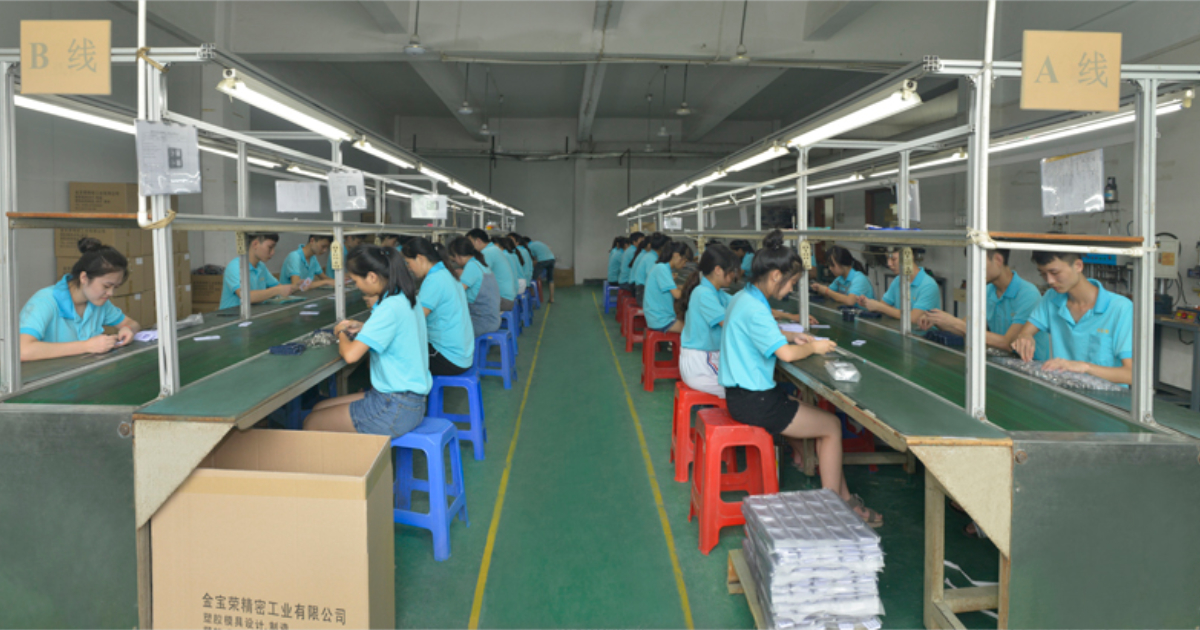
People. Personnel are the dominant particle source in any clean room, and assembly is more labour-intensive than molding — more operators per part, at more stations, doing more manual operations. Gowning protocol and air-shower entry at the gowning area are what hold this in check.
Consumables. Tape, adhesive, wipes, labels, and — the classic offender — corrugated cardboard. Our clean room prohibits cardboard and personal items inside the cell for exactly this reason, and packaging material is single-use and controlled.
Process debris. Ultrasonic welding generates particulate at the joint interface. Heat-staking inserts abrades the insert knurl against the boss. Screw driving produces wear particles. These are generated at the assembly station, downstream of every molding control you established.
If assembly happens outside the controlled environment, all three categories land on a part that was clean when it was molded.
Assembly is what actually defines several molding tolerances
This is the engineering argument that gets missed in sourcing.
An ultrasonic weld joint flatness callout is not a cosmetic requirement — it is a welding process requirement. The same is true of a snap-fit engagement depth, a press-fit boss diameter, an O-ring groove compression, and a connector insertion clearance. These dimensions exist because of a downstream assembly step, and they are the dimensions that determine assembly yield.
Consider two real parts:
| Part | Assembly-driven requirement | Consequence of drift |
|---|---|---|
| USB Type-C charger housing (two-piece PC, ultrasonic welded) | Joint plane flat to ±0.03mm across the 32mm perimeter | Gap >0.05mm reduces weld energy transfer → weak or incomplete weld |
| Blood glucose meter internal bracket (0.8mm wall PA, ±0.05mm assembly features) | ±0.05mm on all assembly interfaces | 0.05mm drift shifts the test strip connector against the housing slot → field insertion errors |
Neither dimension can be evaluated by the molder alone, because the acceptance criterion is “does it assemble and pass the functional test” — not “is it within the drawing tolerance”. When the molder and the assembler are different companies, the tolerance stack is split across a purchase-order boundary, and the party who discovers a problem is never the party who caused it.
The ultrasonic welding guide covers the joint design rules behind these numbers; the point here is that they are assembly requirements that must be pushed upstream into the molding drawing.
Re-qualification is the hidden cost of a separate assembly step
Buying molding and assembly separately forces one of two choices.
Either the parts are re-cleaned and re-verified on receipt at the assembly house — which adds a process, a cost, a validation, and a new failure mode, since particle removal from a molded part is harder than keeping it clean in the first place. Or the transfer is accepted as uncontrolled, and the clean room you paid for delivers a clean part that arrives at assembly at whatever cleanliness the journey produced.
Neither option appears on a quotation. Both appear later.
What an Integrated Cell Looks Like
Molding and assembly in the same controlled environment
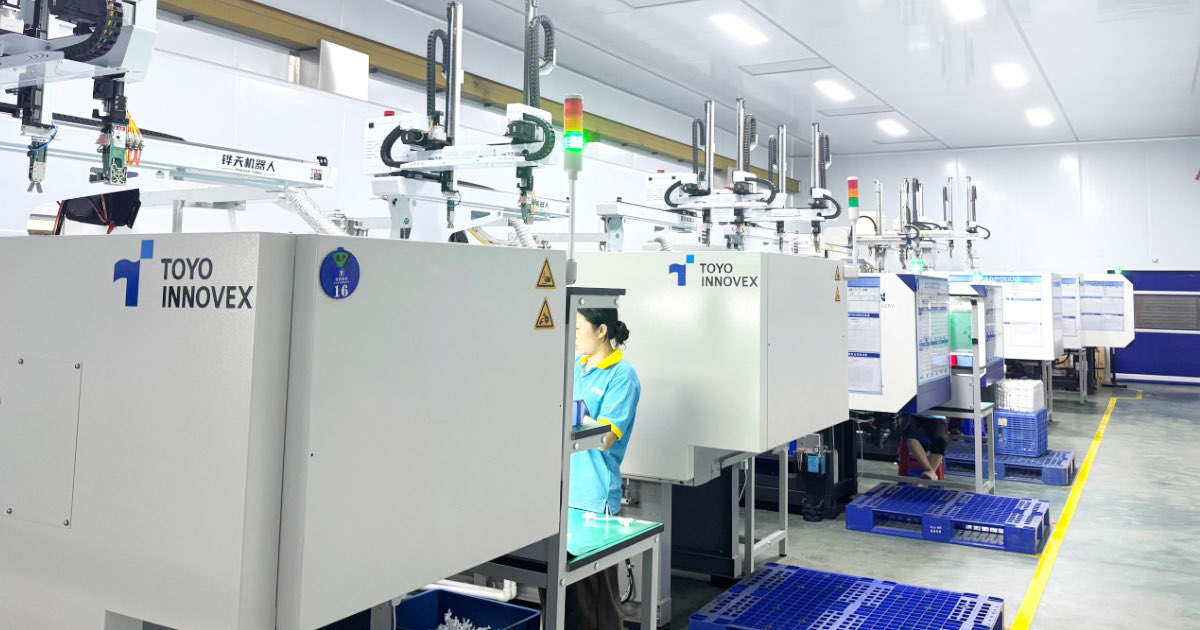
In our Shenzhen facility the ISO 8 cell contains both the molding zone and the assembly zone, so parts move between them without leaving the controlled environment.
| Parameter | Specification |
|---|---|
| Cleanliness class | ISO 8 / Class 100,000 (ISO 14644-1) |
| Particle limit ≥0.5µm | 3,520,000 particles/m³ |
| Particle limit ≥5.0µm | 29,300 particles/m³ |
| Filtration | HEPA, 99.97% at 0.3µm |
| Air pressure | Positive — outward flow |
| Temperature | 20–24°C ±2°C |
| Relative humidity | 40–60% RH |
| Air changes | Minimum 20 per hour |
| Monitoring | Particle counter, temperature, RH — logged per shift |
| Molding presses | Dedicated 90T–250T servo-hydraulic, robot part removal |
| Material handling | Sealed hoppers, dedicated dryer, no shared resin |
| Mold storage | Temperature and humidity controlled, inside the controlled area |
| Packaging | Bagged and sealed inside the cell |
| Personnel | Full gowning, air-shower entry, no cardboard, dedicated tools |
The cell specification is described in full on the clean room injection molding page; the point that matters for this article is that the assembly stations are inside it, not downstream of it.
What assembly processes run in the cell
The same controlled environment handles the steps that would otherwise breach the clean boundary:
- Snap-fit and press-fit assembly
- Screw fastening with torque verification — including the wear-particle control that screw driving requires
- Springs and clips, hinge and pivot mechanisms
- Gaskets and seals — including silicone O-rings for IP-rated enclosures
- Cable and connector attachment
- Ultrasonic heat-stake inserts (brass, stainless, aluminium) and press-fit metal bushings
- Molded-in insert positioning and overmolding
- Ultrasonic welding — horn diameter 15–50mm, hermetic seal capability for IP54 and IP67 rated assemblies, with weld strength testing per batch
Post-assembly verification covers what the customer’s incoming inspection would otherwise have to find: 100% visual inspection against the cosmetic standard, colour match, assembly completeness and correctness, and label and marking accuracy; CMM dimensional verification; go/no-go gauge checks on functional interfaces; and AQL sampling per ANSI/ASQ Z1.4 Level II. Functional testing programs include snap and release force, fluid pressure and leak testing (pressurized or vacuum), IP rating verification by spray or immersion, and electrical continuity for embedded components.
Electronics need a second control layer
For electronics and precision applications, the cell also carries ESD control, because static discharge is both a contamination risk and a component-damage risk:
- Conductive flooring with grounding straps
- Ionising air blowers at the assembly stations
- ESD-safe packaging — anti-static bags and conductive trays
- Carbon-filled ESD-safe material grades where the application requires them
The ESD arrangement is a useful illustration of the integrated approach: an ionising blower at an assembly station only makes sense if that station is inside the controlled area under the same gowning and monitoring regime as the presses.
Two parts that ship as assemblies, not as parts
The clearest way to see the difference is in parts we ship as finished assemblies.
For a portable point-of-care diagnostic analyser, we mold a two-part USP Class VI polycarbonate housing in the ISO 8 cell and deliver it as a 2-piece clamshell assembly (top and bottom) — 15,000 assemblies per year, 30,000 molded parts — with full lot traceability, a first article inspection report, and documentation structured to support the client’s 510(k) submission and Device History Record. See the medical diagnostic device housing case study.
For a Class II medical device SOS pendant — 30 × 55 × 10mm medical-grade ABS at 7g with 1.6mm ultra-thin walls — moulding and assembly both feed an IP67 rating delivered by a silicone O-ring seal, with ISO 10993-5 biocompatibility and a silver-ion antimicrobial coating. That program ships 50,000 assembled units per year from 100,000 molded parts. See the personal emergency alert pendant case study.
In both cases the part-to-assembly ratio is 2:1, and in both cases the cleanliness and the sealing performance are properties of the assembly, not of either molded half.
One documentation trail, not two
A split supply chain produces two record sets that have to be reconciled. An integrated cell produces one, covering both steps:
| Document | Content |
|---|---|
| Lot Traveller | Date, shift, machine, operator, material lot, quantity |
| Clean Room Production Log | Particle counts, temperature, humidity — per shift |
| Material Certificate | USP Class VI or ISO 10993 certificate per resin lot |
| First Article Inspection | All drawing dimensions, measured and recorded |
| Dimensional Report | CMM data with Cp/Cpk for critical dimensions |
| Certificate of Conformance | Per shipment, signed by the Quality Manager |
This package supports FDA 510(k) submissions, CE marking technical files, and ISO 13485 external audits, and records are retained for a minimum of 10 years. What each document proves — and how to verify it rather than accept it — is covered in our medical molding documentation guide.
Integrated vs Separate Sourcing
| Factor | Molding and assembly in one clean room | Separate molder and assembler |
|---|---|---|
| Part cleanliness at assembly | Preserved — parts never leave the controlled environment | Degraded in transit, storage, and unpacking; re-cleaning may be required |
| Assembly-driven tolerances | Owned by one process; joint flatness and clearance requirements sit on the molding drawing | Split across a purchase-order boundary; failures surface at the assembler |
| Transfer handling | None — controlled transfer between zones | Bagging, transport, unpacking, re-handling |
| Contamination from assembly | Managed in the same gowning, monitoring, and consumable regime | Introduced on an uncontrolled floor |
| ESD control | Extends from molding to assembly stations | Must be re-established at the assembler |
| Documentation | One record set covering both steps | Two sets to reconcile; traceability gap at the handoff |
| Qualification and auditing | One supplier, one audit, one QMS | Two audits, two quality systems, two change-control agreements |
| Lead time and logistics | No intermediate shipment | Extra leg, extra handling, extra buffer stock |
| Best fit | Medical devices, diagnostic components, optical and connector parts, IP-rated enclosures | Large assemblies with many commodity parts bought from multiple specialist suppliers |
A clean room is not automatically the right answer for every assembly. It becomes the right answer when the part’s function depends on cleanliness at the point of assembly — a fluid path, a patient-contact surface, an optical interface, a fine-pitch connector, or a seal that must be assembled without contaminating the sealing face.
What to Specify
1. Set the class per step, not for the whole process. The correct class is determined by the most contamination-sensitive step in the sequence, not by the class of the molding cell. Determining which step that is — and whether an ISO 8 cell (Class 100,000) is sufficient — is the same analysis described in our clean room injection molding guide.
2. Push assembly requirements into the molding drawing. Joint flatness for ultrasonic welding, press-fit boss diameters, snap-fit engagement depth, gasket groove compression, connector insertion clearance. If these live only in the assembler’s process sheet, the molder is being asked to hold tolerances nobody measured.
3. State the transfer method explicitly. “Molded in a clean room” says nothing about what happens in the twenty minutes afterwards. Specify whether parts transfer directly to an adjacent controlled assembly zone, or are packed and re-opened.
4. Name the assembly consumables and their restrictions. Adhesives, tapes, wipes, and labels are all potential contamination sources, and packaging material type matters as much as the packaging process. Ask directly whether cardboard is permitted inside.
5. Decide whether ESD control is in scope. If the assembly contains electronics, ESD-safe handling, grounding, and packaging are a separate control layer from particulate cleanliness, and both are needed.
6. Specify packaging location. Parts sealed inside the controlled cell arrive in the condition they were produced. Parts packed outside it do not.
7. Require one documentation package for both steps. A lot traveller that stops at the molding press leaves the assembly step undocumented.
Three traps worth naming
Assembly tolerances that never reached the molder. The most common cause of good parts that will not assemble. If the assembler has a joint flatness requirement, it belongs on the molded part drawing.
Re-cleaning as a substitute for control. Cleaning a molded part is harder than keeping it clean, and every cleaning step needs its own validation and its own residue assessment — which matters a great deal for patient-contact parts.
A class mismatch between molding and assembly. If the assembly step requires a cleaner environment than the molding step, running assembly in the molding cell’s class is a compromise that the assembly process, not the molding process, has to absorb.
Frequently Asked Questions
Do molding and assembly have to happen in the same clean room?
No, but if they do not, the transfer between them becomes an uncontrolled step that has to be managed deliberately — either by re-cleaning and re-verifying on receipt, or by packaging in a way that genuinely preserves cleanliness until the part is assembled. Doing both in one controlled environment removes that step rather than managing it.
What ISO class do I need for molding compared with assembly?
The class is set by the most contamination-sensitive step in the sequence. Many medical device programs run both molding and assembly at ISO 8 (Class 100,000), which covers the majority of diagnostic, drug delivery, and patient monitoring components. Where a component requires ISO 7 — implantable parts, parts entering the sterile field, optical-grade surfaces — that requirement usually applies to the assembly step as much as to molding.
Can ultrasonic welding be done inside a clean room?
Yes, and it is a common reason to integrate assembly: welding generates particulate at the joint, so doing it in a controlled environment with the same monitoring regime as molding keeps that particulate inside a managed space. Hermetic ultrasonic welding for IP54 and IP67 rated assemblies runs in our cell, with weld strength testing per batch.
How does assembly affect molding tolerances?
Assembly methods impose dimensional requirements that pure part function does not. An ultrasonic weld joint must be flat enough to transfer energy across the whole joint line; a press-fit requires a controlled interference; an O-ring groove must compress the seal uniformly. These are real tolerances with real drift consequences, and they have to be on the molded part drawing.
What contamination does assembly add that molding does not?
Three things. People, because assembly is more labour-intensive per part. Consumables, including adhesives, tapes, wipes, labels, and packaging material such as cardboard. And process debris generated at the station itself — weld flash and particulate from ultrasonic welding, wear particles from heat-staking and screw driving. All three are downstream of every molding control.
Do I need ESD control as well as a clean room?
Only if the assembly contains electronic components or fine-pitch contacts, where static discharge can damage the part as well as attract particles. ESD control is a separate layer: conductive flooring and grounding, ionising air at the assembly stations, ESD-safe packaging, and where required, carbon-filled material grades.
Molding and Assembly in One Controlled Cell
We run the ISO 8 clean room cell and the assembly and packaging operation in the same controlled environment — dedicated servo-hydraulic presses from 90T to 250T with robot part removal, sealed material handling, controlled mold storage, gowning and air-shower entry, per-shift environmental monitoring, and ESD control extending to the assembly stations where electronics are involved.
Assembly scope covers snap-fit and press-fit, screw fastening with torque verification, springs, hinges, gaskets and seals, cable and connector attachment, ultrasonic heat-stake inserts, press-fit bushings, and ultrasonic welding with per-batch strength testing. Post-assembly verification includes 100% visual inspection, CMM dimensional checks, go/no-go gauging, AQL sampling per ANSI/ASQ Z1.4 Level II, and functional testing for snap force, leak and pressure, IP rating, and electrical continuity. Packaging runs from blister and clamshell to anti-static tray and custom foam insert, with barcode, serial, and laser marking.
Our assembly and packaging service covers the process detail; our medical device page covers the device categories we produce.
If you are currently buying molding and assembly from two suppliers and want to see where the handoff is costing you, send us the part drawing and the assembly process description. We will tell you which assembly-driven dimensions should be on the molding drawing, and what the transfer between the two steps needs to look like.
Send your drawing and assembly process for a combined review →