Working With a Chinese Injection Molding Supplier: 10 Buyer Fears and How We Answer Them
If you read the sourcing forums long enough, a pattern appears: buyers are not afraid of Chinese suppliers, they are afraid of what they cannot see. The price is fine. The samples are fine. The worry is what happens in month six, or when a specification is quietly changed, or when the tool that was supposed to be built in a modern factory turns out to have been subcontracted to a shed.
That fear is not prejudice. It is accumulated experience, and it is rational.
This page takes the ten concerns that come up most often in buyer discussions and answers each one directly: what the fear is, what we specifically do about it, and — this is the part most supplier pages skip — what you should verify yourself, including with us. Where we are genuinely weaker than some alternatives, it says so.
A note on how to read this. Every claim below is either a document we can send you or a facility you can walk through. If something here cannot be verified, treat it as marketing.
1. Quality That Drifts After the First Batch
The fear. The first article is flawless. So is the first shipment. By the fourth production run the wall is thinner, the gate looks different, and nobody can explain what changed.
What we do. The mechanism that prevents drift is not goodwill, it is measurement with a defined frequency:
- In-process dimensional checks at critical machining stages, not only at final inspection
- SPC monitoring on critical dimensions every 50–100 shots, automated — the data is generated by the process, not by a person deciding to check
- CMM verification on two SEREIN / VMT coordinate measuring machines
- Cpk data available on request, per critical dimension
The relevant number is not “we have SPC” — most factories will say that — it is the sampling frequency. A control plan that checks once per shift cannot detect a drift that develops over 200 shots. Ours runs every 50–100.
What to check. Ask for the control plan and look at the sampling frequency column. Then ask for the last three months of SPC data on one specific dimension of one part you already buy. If the data does not exist, the system is a certificate on a wall.
2. Your Files Leaving the Building
The fear. You send the CAD. Six weeks later a near-identical product is on Taobao or Amazon under a different brand, and your NDA is a PDF that means nothing across borders.
What we do. The protection here is procedural rather than legal, because the legal route is unreliable for everyone:
- NDA signed before a single file is opened. Not before production — before the file is opened. We do not download or distribute 3D files until a signed NDA is in place.
- A one-page mutual NDA in plain English, downloadable from our IP protection page, or use yours.
- Three named people can access a customer’s files: the project engineer doing the DFM, the tooling design engineer, and the quality manager setting the inspection plan. No one else.
- Files live on an access-controlled network drive, not on individual workstations, and every file open, copy or export is logged with timestamp and user ID.
What to check. Ask which specific individuals will see your files, and ask what happens to them after the project ends. A supplier who answers “our team” has not thought about it.
Where we are honest. A procedural system reduces the risk; it does not eliminate it. What it does is make misuse traceable to a person and a timestamp. That is a meaningful difference when something goes wrong, and it is the honest ceiling of what any supplier can offer.
3. Silent Material Substitution
The fear. The quote says PC. The part arrives looking right. It is ABS. The cost saving went into someone else’s margin and your product fails in the field two years later.
What we do. Material is a specification, not a cost variable:
- The material and grade are stated on the drawing and on the order, and material certificates are provided per lot — the certificate carries the grade designation and the lot number, which is what makes substitution detectable after the fact
- Substitution requires written approval from the customer before it happens. Not notification after — approval before
- For regulated work, incoming material inspection and lot traceability are part of the documented process, because ISO 13485 does not permit an unrecorded material change
What to check. Take a part you have received and ask for the material certificate for the exact lot. Check the grade designation against your drawing. Then ask what the procedure is if the specified grade is out of stock — the good answer is “we tell you and wait”, the bad answer is “we would find an equivalent”.
4. The Order That Was Actually Made Somewhere Else
The fear. You visit a clean, modern factory. You place the order. The order is passed down a chain to a workshop you would not have approved, and nobody can tell you where your parts were actually molded.
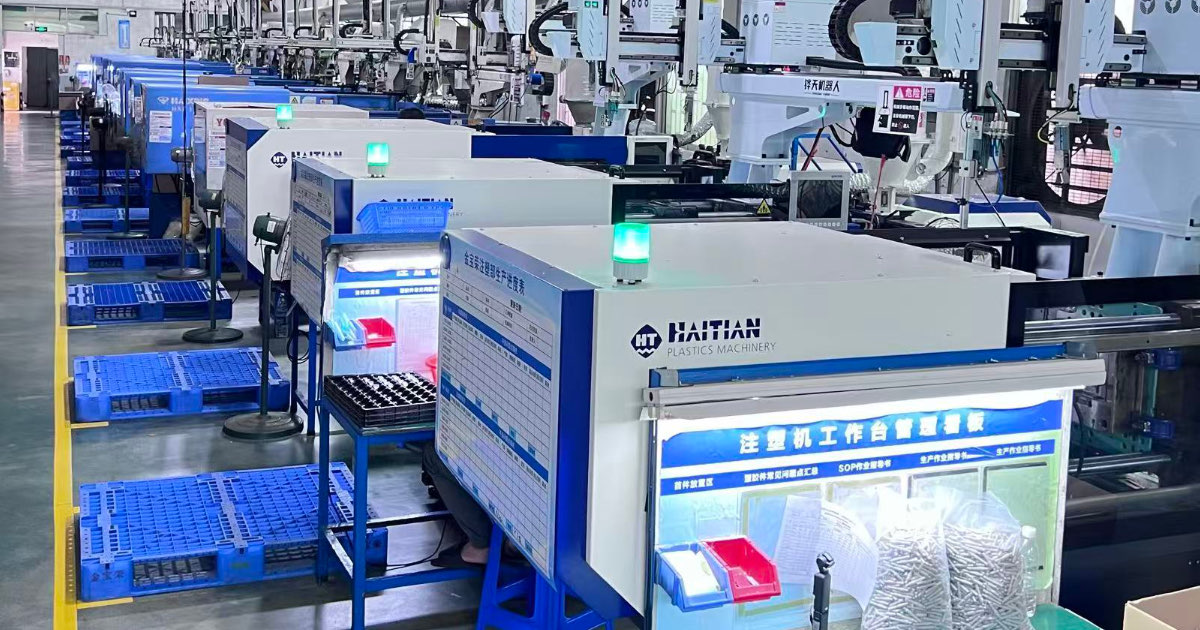
What we do. The toolroom and the press floor are the same building, and the equipment list is published down to model numbers:
| Capability | In-house equipment |
|---|---|
| Injection molding | 27 machines, 90T–650T (including a 6500 kN HAITIAN MA6500) |
| CNC machining | 9 machines |
| EDM (sinker) | 10 machines |
| Wire-cut EDM | 7 machines |
| Surface grinding | 6 machines |
| Metrology | 2 CMM (SEREIN / VMT), plus test instruments |
The full equipment list carries brand, model, dimensions and accuracy for every machine. Toolmaking, sampling, molding and inspection are all performed on site — which is why a T1 date is a number we can commit to rather than a number we hope a third party will meet.
What to check. Ask which operations are in-house and which are subcontracted, in writing. Then ask to see the subcontracted list — every factory has one. The problem is not that subcontracting exists; it is that it is invisible.
5. Communication That Nods and Fails
The fear. The answer is always “yes, no problem”. The drawing is never questioned. Then the part arrives with a feature that cannot be molded, and three weeks are gone.
What we do. The countermeasure to “yes-man” communication is written engineering output, because a document cannot nod:
- Quotation plus a free DFM report within 24 hours of receiving files
- The DFM report is a markup drawing with specific findings, not a summary — zero-draft surfaces, wall thickness transitions, gate locations that will leave a witness mark, tolerances the process cannot hold
- Findings are raised before the tool is cut, which is the only time they are cheap to fix
Who sets the standard. English-language technical communication runs through our General Manager, Steven Liang — second generation, UK-educated, joined the company in 2017 and appointed GM in 2021. His stated priorities on taking the role were documented quality (FAI reports, certificates of conformance and material traceability as standard deliverables), communication standards (structured project updates, committed lead times, and transparent escalation when a problem arises), and international growth built on reliability rather than price.
That is not a biographical footnote. A communication standard that depends on one diligent individual collapses in a busy quarter; attaching it to a management role is what makes it hold.
A supplier that agrees with everything you send has either not read it or will not tell you what it found. A written DFM report is the evidence that someone actually opened the file.
What to check. Send a drawing with one deliberate problem in it. A supplier with a real DFM process will flag it. A supplier without one will quote it.
6. Dates That Move and Tracking That Does Not
The fear. The promised date slips twice. Then a tracking number is issued for a shipment that has not left. The buyer finds out from a forwarder, not from the supplier.
What we do. Dates are built from a real tooling sequence rather than a sales estimate. The mold programs on our floor run 22–28 business days to T1 for typical tools; a complex multi-slide program can run to 48. Those are the numbers in our published case studies, not round figures invented for a brochure.
On logistics, we work with the buyer’s chosen Incoterm rather than a single default — EXW, FOB, CIF and DDP are all handled, and the shipping page sets out exactly who is responsible for what under each. Standard recommendation is FOB Shenzhen for buyers with a forwarder relationship; CIF for first-time importers who want a delivered cost.
What to check. Ask what the T1 date is measured from — tool design start, steel order, or PO date. The gap between those three answers is often three weeks, and it is where “the date moved” comes from.
7. Who Answers After Delivery
The fear. The machine or tool is installed, something goes wrong, and the supplier has moved on. Spare parts take three months and the technical answer is “it should work”.
What we do — and an honest boundary. We do not sell CNC machines or injection molding machines, so the machine-support version of this fear does not apply to us. What we supply is molds and molded parts, and the support structure around that is:
- Replacement cores, cavity inserts and slide components can be produced from the retained tool drawings and 3D data, which we keep for the life of the tool
- Tool transfer support for buyers moving an existing mold onto our presses — including inspection, refurbishment and re-qualification
- Engineering response on process problems with the part or the tool, referenced against the original DFM and T1 documentation
What to check. Ask who owns the tool drawings after the project, and ask what the lead time is for a replacement cavity insert on your specific part. If those cannot be answered before the order, they will not be answered after it.
8. No Instant Quote, No Card Payment
The fear. Domestic platforms quote in seconds and take a card. This supplier wants an email, a drawing review, and a bank transfer — which feels like 2009 and feels like risk.
What we do — and where we are genuinely slower. This is the one item on the list where we are deliberately not the fastest option, and it is worth being straight about:
- There is no instant-quote engine. Files are reviewed by an engineer, and you get a quotation plus a DFM report within 24 hours. For a commodity part with a simple geometry, Xometry or PCBWay will beat that. For a tool where the DFM review changes the design, 24 hours is the fastest honest answer.
- Payment terms are 50% with order and 50% before shipment. This is standard for custom tooling, and it is not the same as a card checkout — a buyer who needs card payment or escrow will find us inflexible on that point.
What to check. Decide which you are buying: a part, or a tool with engineering review attached. The trade-off only makes sense for the second.
9. A Website That Cannot Be Trusted
The fear. Stock photos, spelling errors, a @gmail.com address. If the digital front door is careless, the precision claim behind it is hard to believe.
What we do. The site is the evidence, so it is worth auditing rather than asserting:
- Photographs of our own floor and our own people, not stock imagery, including a factory tour with captions describing the actual equipment
- Named team members with roles and engineering backgrounds on the team pages
- Certificates shown as documents — ISO 9001:2015 (Guangdong Quality Testing CTC, valid to 18 January 2028) and ISO 13485:2016 (GICG, valid to 27 August 2029), both under annual surveillance audits, with copies provided with each order
- Case studies with real specification data — mold steel, cavity count, shot life, T1 lead time — rather than “a leading customer”
- Contact on our own domain, not a free mailbox
- The site publishes in five languages, which is a cost a supplier does not pay unless it expects to be read
What to check — including against us. Read the ISO 13485 scope on our certifications page exactly as written: production and sales of plastic molds and plastic parts for medical devices. It does not say design. We could have written a scope that looked broader; the certificate is the authority and we quote it as it stands. That is the standard to hold any supplier to.
10. Nobody Will Say “We Got It Wrong”
The fear. Something fails. The conversation becomes about whose fault it is, and the answer is never the supplier’s.
What we do. The structural answer is that disagreements should be resolvable against documents rather than against status:
- The DFM findings exist as a markup drawing issued before tooling — so “this feature was never discussed” is checkable
- T1 produces a measurement report against the drawing, not a verbal “looks good”
- The inspection plan is defined by the quality manager and attached to the order
- Non-conformance is recorded, and the record is what the corrective action is written against
That does not make mistakes disappear. It makes them attributable to a document and a date, which is the difference between a supplier that argues and a supplier that fixes.
What to check. Ask to see a real corrective action report from the last year — including what went wrong. A supplier with none has either never had a problem (implausible) or does not record them.
Where We Are Actually Weaker
A page like this loses credibility the moment it implies we are the answer to every item. Four places where we are genuinely not:
We cannot mold parts above 650 tonnes. The press line runs 27 machines from 90T to 650T, and 650T is the ceiling. Large single-cavity automotive parts, big crates or appliance panels that need 800–2,500T go to a different supplier. We will say so at RFQ rather than quote a tool we cannot run.
Our ISO 13485 scope excludes design. It covers production and sales of plastic molds and plastic parts for medical devices. If your regulatory pathway requires the contract manufacturer to hold design control — documented design inputs, design verification, design transfer — that is outside our certificate, and you should place the program with a supplier whose scope includes it.
We do not quote in seconds and we do not take cards. Covered above, but it belongs on this list: an engineer reviews every file, quotes arrive in 24 hours, and payment is a 50/50 bank arrangement. Buyers who need card payment, escrow or a self-service checkout will find us the wrong supplier, and that is a legitimate reason to choose someone else.
Our published portfolio is narrower than our actual work. 26 case studies are on this site. A meaningful number of programs are under customer NDA and cannot be shown — including every one of our PVC programs. So the portfolio you can audit understates the work. That cuts both ways: it means we cannot prove depth on certain materials, and you should treat the gap as unproven rather than assume it.
None of these are disqualifying for most programs. All of them are disqualifying for some.
What This Page Is Actually For
None of the above proves we are trustworthy. A page written by a supplier about trustworthiness cannot prove it — the reader should assume that.
What it can do is give you a checklist that works on any supplier, including this one:
| Question to ask | Good answer looks like | Bad answer looks like |
|---|---|---|
| Control plan sampling frequency? | A number, per dimension | “We have SPC” |
| Who can access my files? | Named roles, logged access | “Our team” |
| Material certificate for this lot? | Grade + lot number on paper | “It is the same as the sample” |
| What is subcontracted? | A written list | “We do everything” |
| What did DFM change? | A markup drawing with findings | “No problems found” |
| T1 date measured from what? | A named milestone | A date with no reference |
| Replacement insert lead time? | Weeks, quoted | “We will check” |
| Scope on the ISO certificate? | Quoted exactly | Paraphrased upward |
| A corrective action report? | One, with the failure described | None exist |
If you want to test the list against us, the fastest route is to send a drawing with a known problem in it and read our DFM report. It arrives within 24 hours, it costs nothing, and it tells you more than any page on this site — including this one.