China vs Mexico vs Vietnam Injection Molding — Cost and Supply Chain Comparison
An OEM sourcing director is evaluating three locations for a plastic housing program: China, Mexico, and Vietnam. The mold quotes arrive — China is lowest. The freight quotes arrive — Mexico is fastest. The labour cost charts arrive — Vietnam looks cheapest per hour. Each dataset answers a different question, and none of them answers the one that matters: where does this specific product, at this specific volume, get made most reliably for the next five years?
This post compares the three locations on the variables that actually decide injection molding programs — mold tooling capability, per-part cost structure, supply chain maturity, and logistics — and ends with the decision framework we recommend to buyers. Cost data is approximate and should be re-verified against current rates before any sourcing decision.
The Cost Structure Difference
| Variable | China | Mexico | Vietnam |
|---|---|---|---|
| Mold tooling cost | Baseline | 1.3–2× China | 0.9–1.1× China |
| Machine-hour rate | $18–35 (mid-size press) | $25–45 | $15–28 |
| Engineering resin availability | All grades, local distribution | Import-dependent, 2–4 week lead | Growing, gaps remain |
| Sea freight to US (typ.) | 4–6 weeks | 3–7 days by truck | 5–7 weeks |
| Air freight to US | 3–5 days | 1 day | 3–5 days |
| Minimum realistic volume | Any | Mid-high (mold cost amortization) | Low-mid |
| Tooling ecosystem depth | Deepest — 30+ year industrial cluster | Shallow; molds mostly imported from China or US | Emerging; molds often imported |
The structural fact: molds are still overwhelmingly built in China. Mexico’s molding industry runs largely on molds imported from China or the US, and Vietnam’s is the same with fewer local toolrooms. This is why the location decision is rarely about mold cost — it is about where the mold lives and where the parts run.
What Each Location Is Actually Good At
China — Precision Tooling and High-Volume Programs
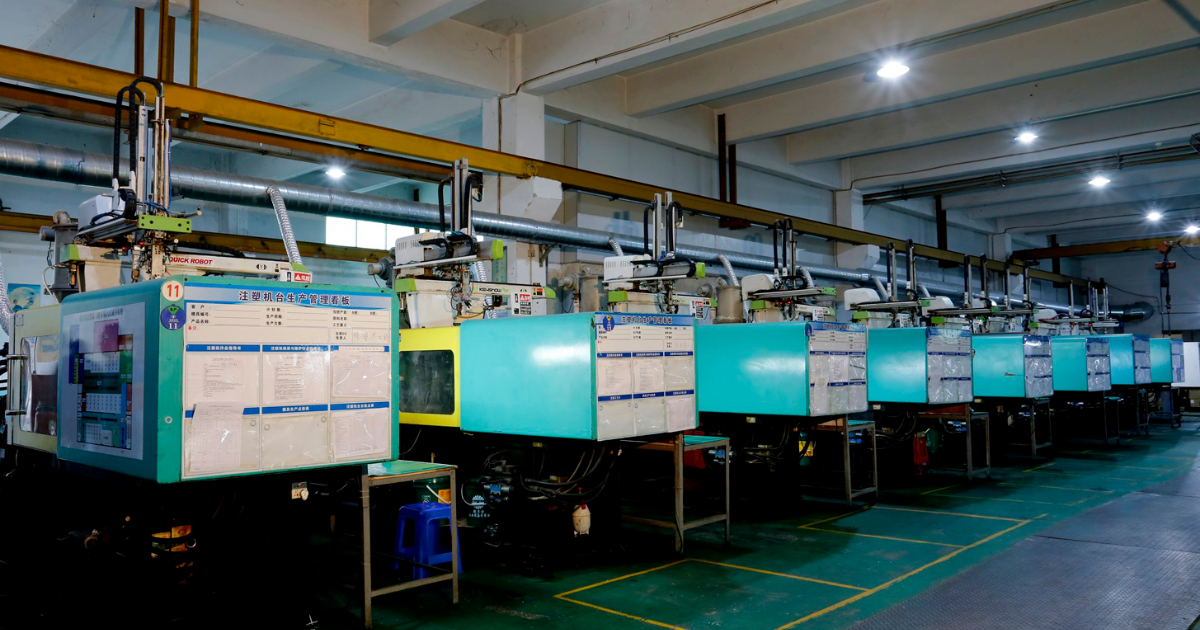
China’s advantage is the tooling ecosystem. The Shenzhen–Dongguan cluster contains thousands of mold shops, material distributors for every engineering resin, heat treatment, EDM electrode supply, texture etching, and hot-runner service — all within an hour’s drive. That density is what enables a high-volume multi-cavity program with H13 tooling, hot runners, and PPAP documentation to run without the supply chain stalling on a missing electrode or a delayed resin lot.
China is the strongest choice when the part demands engineering depth: multi-cavity tools, tight tolerances, exotic materials, moldflow-driven design. The cost advantage is real but secondary — the primary advantage is that everything the program needs exists within one industrial cluster.
For US buyers, the trade-off is logistics: 4–6 weeks on the water and customs handling at the destination. Our US buyer guide covers freight, duties, and documentation specifics.
Mexico — Nearshore Speed for Established Programs
Mexico’s advantage is geography. Truck delivery to US plants in days, minimal inventory in transit, no ocean schedule risk. The trade-off is the tooling base: mold making in Mexico is a fraction of China’s scale, and most Mexican molding programs run on imported molds.
Mexico fits best when: the program is already validated (mold built and proven), volumes are steady, and supply-chain responsiveness — not tooling engineering — is the constraint. Many buyers run a hybrid: build the mold in China, qualify it, then ship the tool to Mexico for production near the end market. The tool transfer documentation question matters in exactly this scenario.
Vietnam — Labour-Cost Arbitrage, With a Young Tooling Base
Vietnam’s per-hour labour rate is the lowest of the three, which matters most for labour-intensive secondary operations — assembly, pad printing, packaging — rather than for the molding cycle itself, which is machine-time dominated. Vietnam’s mold-making capacity is newer and thinner than China’s; precision multi-cavity tools are typically still sourced from China.
Vietnam fits best for: simple parts, labour-heavy post-molding work, or programs where tariff structures make Vietnam the rational choice at a given moment. Tariff policy toward all three locations has changed repeatedly in recent years — treat any tariff comparison as a snapshot, and re-verify with your customs broker before committing a program.
The Decision Framework
Three questions resolve most location decisions:
1. Where is the tooling engineering? If the program needs DFM depth, Moldflow analysis, multi-cavity design, or tight tolerances, the tool should be built where that engineering is densest — typically China — regardless of where the parts run. A mold is a one-time investment that determines five years of part quality; it deserves the strongest tooling base available.
2. What does the part cost actually consist of? A part whose cost is 50% material and 30% machine time gains little from low labour rates. A part with heavy manual secondary operations gains more from Vietnam’s labour structure. Run the numbers with the cost breakdown method — material, machine time, labour, secondary ops — before comparing locations.
3. What is the cost of the supply chain, not just the part? Freight weeks, in-transit inventory, customs delays, and the management overhead of a remote program are real line items. Nearshoring saves weeks; those weeks have a carrying cost that varies with your working capital. A total program comparison treats logistics as a cost driver, not an afterthought.
How We See the Split
We build molds for buyers who run production in China, and for buyers who build with us and transfer tools to Mexico, the US, or Europe for local production. The pattern that works most often:
- Prototype and bridge tooling — build in China, run in China, air-freight parts. Fastest path to samples; see rapid tooling.
- Volume production with engineering depth — build and run in China, ocean-freight to market. The tooling ecosystem pays for the freight weeks.
- Validated programs near the end market — build and qualify in China, transfer the tool, run locally. The supplier qualification and tool transfer checklists apply twice — once for us, once for the receiving plant.
Bottom Line
China wins on tooling capability and total cost for engineering-heavy programs. Mexico wins on responsiveness for validated programs near North American plants. Vietnam wins on labour cost for simple parts and manual operations. The wrong choice is usually not the location itself — it is choosing a location before understanding which cost driver dominates your part, or treating a tariff snapshot as a permanent fact.
Send your part file with annual volume and destination market. Our DFM review returns material, cavitation, and location recommendations with the cost comparison behind them — within 24 hours, no obligation.