PP Injection Molding: Properties, Grades, Applications and DFM Notes
Polypropylene is the highest-volume commodity resin used in injection molding, and it is also the one most often specified for the wrong reason. Buyers pick it because it is cheap and chemically inert; they then discover that a 1.0–2.5% shrinkage range is not a tolerance, that a living hinge only works in one grade family, and that a part designed like ABS will warp in PP.
This page covers what PP is, the three grade families that change every number in the datasheet, the parts it is genuinely the right material for, and the DFM issues that decide whether a PP part passes or fails.
If you are choosing between PP and ABS rather than working within PP, the side-by-side comparison lives in PP vs ABS — which material for which part. This page does not repeat that comparison.
What PP Is — and What It Is Not
PP is a semi-crystalline commodity polyolefin. The semi-crystalline structure is what drives most of its behaviour in a mold:
- High, wide shrinkage. 1.0–2.5% depending on grade, wall section and mold temperature — an order of magnitude more than amorphous resins and, more importantly, a range rather than a number. Crystalline regions pack differently from amorphous ones, so the same part can shrink differently in thick and thin sections.
- Good chemical resistance. Unaffected by most acids, bases and solvents, which is why chemical drums and tanks are PP.
- Low service temperature under load. HDT at 1.8 MPa is only 50–60 °C, even though the melting point is 160–170 °C. Parts that must hold load at temperature need a glass-filled grade or a different resin.
- Poor UV resistance without stabilization. Unstabilized PP degrades outdoors. Outdoor parts need a UV-stabilized grade — it is a grade decision, not a process fix.
What PP is not: it is not a dimensionally stable engineering resin, it does not hold a Class A cosmetic surface the way ABS does, and it does not tolerate being designed with the same wall-thickness logic as an amorphous material.
PP Properties at a Glance
The three grade families most programs use differ enough that a single “PP” datasheet is misleading.
| Property | PP homopolymer | PP copolymer | PP-GF20 |
|---|---|---|---|
| Density | 0.90 g/cm³ | 0.90 g/cm³ | 1.04 g/cm³ |
| Tensile strength | 25–40 MPa | 20–30 MPa | 60–80 MPa |
| Flexural modulus | 1.0–1.7 GPa | 0.8–1.4 GPa | 3.5–4.5 GPa |
| HDT at 0.45 MPa | 100–115 °C | 90–105 °C | 140–155 °C |
| Mold shrinkage | 1.0–2.5% | 1.0–2.5% | 0.3–0.7% |
| Relative cost | $ | $ | $$ |
General PP values that apply across the family — useful when comparing against an engineering resin:
| Property | PP |
|---|---|
| Notched Izod impact, 23 °C | 4–15 kJ/m² (grade-dependent) |
| Notched Izod impact, −20 °C | 2–4 kJ/m² |
| HDT at 1.8 MPa | 50–60 °C |
| Melting point | 160–170 °C |
| Cycle time at 2.5 mm wall | 18–25 s |
| Relative material cost | ¥8–12/kg |
Note on HDT. The two HDT rows above are quoted at different loads — 0.45 MPa and 1.8 MPa. They are not contradictory; they describe different test conditions, and mixing them is the most common way a PP specification ends up wrong. State the load on the drawing.
PP Grade Families
Homopolymer — the stiffest and cheapest of the three, and the reference material for living hinges. Its flexural modulus (1.0–1.7 GPa) and tensile strength (25–40 MPa) are the highest of the unfilled grades, but low-temperature impact is the weakest: 2–4 kJ/m² at −20 °C, which is where PP parts crack in cold-climate service.
Copolymer — lower stiffness (0.8–1.4 GPa) and lower tensile strength (20–30 MPa) in exchange for better impact behaviour. This is the default when a part must survive drops or cold, and the reason “PP” alone is an incomplete specification: homo and copolymer differ in stiffness by roughly 25% while carrying the same generic name.
PP-GF20 — 20% glass fibre raises tensile strength to 60–80 MPa, flexural modulus to 3.5–4.5 GPa and HDT (at 0.45 MPa) to 140–155 °C, while cutting shrinkage to 0.3–0.7%. That is the grade to reach for when PP has been chosen for chemical resistance but the part also needs stiffness or heat resistance. The trade-off is abrasion: glass-filled PP wears the mold, which changes the steel choice.
Flame-retardant and UV-stabilized versions exist within each family. Standard PP is UL 94 HB; V-2 is achievable with FR grades. Both are grade decisions made before tooling, not process adjustments after.
Where PP Fits in Production
PP is the right answer where its specific strengths line up with the part’s dominant requirement:
- Food storage containers — FDA-rated grades are widely available, the resin is microwave-tolerant and chemically inert, and the part cost is the lowest of any engineering-capable resin.
- Automotive battery cases — acid resistance, toughness and cost, in a part where dimensional precision is secondary.
- Living hinge flip caps — PP homopolymer is the only common material that survives 1,000,000+ flex cycles at a hinge. Nothing else in the commodity range comes close, and this is the single application where PP is not substitutable.
- Chemical drums and tanks — chemical inertness plus the ability to be welded, which matters more than strength in tank construction.
- Garden furniture and outdoor parts — UV-stabilized grades with weather resistance, at a cost that no engineering resin matches.
Outside these, PP is usually being specified for cost rather than for a property, and the design then has to absorb the shrinkage and the low heat-deflection limit. That is a legitimate trade — but it should be a decision, not a discovery at T1.
PP Projects From Our Floor
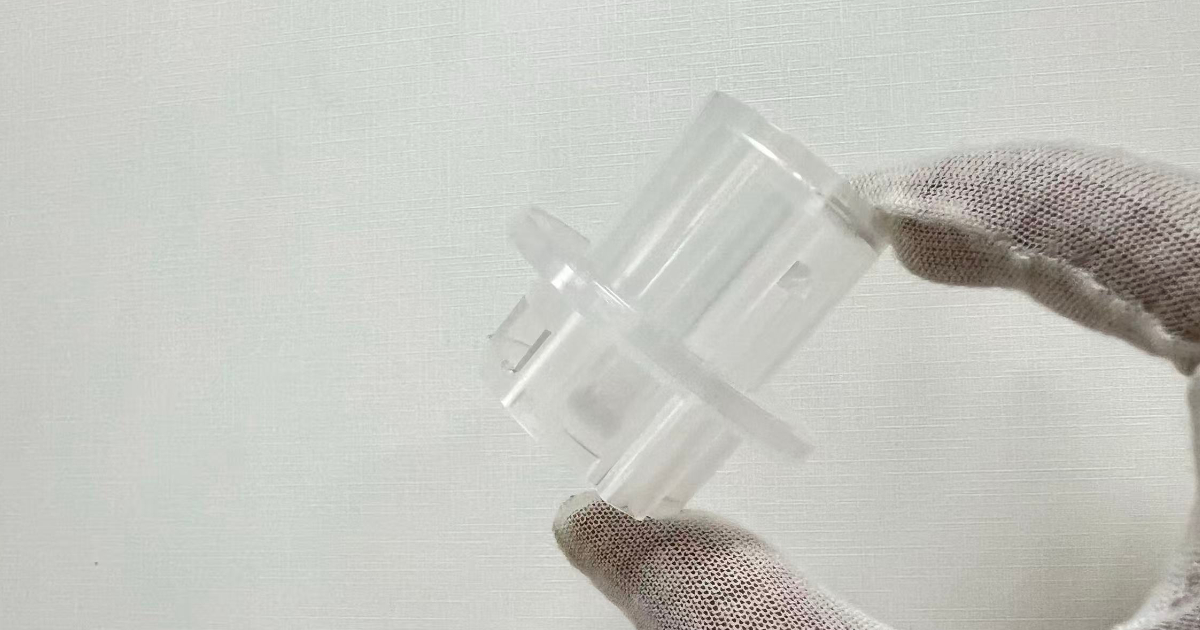
Plastic connector — PP-PR350, 2-cavity hot runner, H13 / 420 SS.
| Parameter | Specification |
|---|---|
| Material | PP-PR350 |
| Part dimensions | Ø52.48 × 47.86 mm |
| Mold configuration | 2 cavities, Hasco standard base |
| Mold steel | H13 / 420 SS |
| Injection machine | 120 T |
| Target mold life | 1,000,000 shots |
The program was driven by DFM rather than by toolmaking. The first review found vertical cavity surfaces modeled at 0° draft — walls that can only release if the plastic shrinks away from the steel, which in a 2-cavity tool with this geometry it does not. The findings were documented as markup drawings with specific draft corrections, then fed back into the tool design before cutting started.
Read the full case: Plastic connector mold — DFM-driven draft optimization.
We run one PP program of this type on the floor today. That is a small sample, and we would rather say so than imply a deep PP portfolio we do not have. What we do have across the wider material range is documented in the case studies index.
DFM Notes Specific to PP
Shrinkage Is a Range, Not a Number
1.0–2.5% is the published band, and the actual value for your part depends on wall section, mold temperature, packing pressure and flow orientation. Two consequences:
- Cavity sizing needs a nominated shrink grade. Do not accept “PP, 2%” on a drawing. Specify the shrinkage the tool will be cut to, and confirm which grade and wall section that number came from.
- Thick and thin sections in the same part shrink differently. A uniform wall is not merely good practice in PP; it is what keeps the part from warping, because differential shrinkage between sections is the mechanism.
Living Hinges Need Homopolymer and Geometry
If the part has a hinge, the material is homopolymer and the geometry is not negotiable — thickness, radius and land length are the three parameters that decide whether the hinge survives one cycle or a million. Those relationships are covered in the living hinge design guide; the material point here is that a copolymer or glass-filled grade will not substitute.
Weld Lines Are Less Visible but Structurally Weak
Semi-crystalline resins show weld lines less than amorphous ones — the hairline that ruins a glossy ABS part is usually absent in PP. That is an appearance advantage and a mechanical trap: an invisible weld line is still a weak line, and PP weld lines sit at roughly the strength of the unfilled polymer matrix. Gate position decides where the weld lands, so place gates away from the highest-stress region rather than designing around cosmetics alone.
Chemical Resistance Does Not Mean Stress-Crack Immunity
PP resists most acids, bases and solvents, which is why it is used for chemical containment. It is still susceptible to environmental stress cracking where molded-in stress, a stress concentrator and a compatible fluid coincide. Annealing and generous radii are cheaper than a field failure.
UV Stabilization Is a Grade, Not a Coating
Unstabilized PP chalks and embrittles outdoors. A UV-stabilized grade must be selected before tooling, because the additive package can shift shrinkage slightly — which loops back to cavity sizing.
Mold Steel Depends on Whether the Grade Is Filled
Unfilled PP is not abrasive: P20 is adequate for standard applications. Glass-filled PP is abrasive, and the site’s steel guidance is explicit — H13 for volumes above roughly 100,000 shots, with P20 acceptable only at low volume. Choosing P20 for a PP-GF20 part at volume is a maintenance problem scheduled for later.
Gate and Ejection Marks Show on Matte Surfaces
PP parts are typically matte to semi-gloss, and a matte surface hides flow marks but not mechanical damage. Ejector pin witness marks and gate vestiges read more clearly on matte PP than on a textured engineering resin, so gate and ejector positions are worth agreeing on the drawing rather than at T1.
Related Process Pages
- Injection molding services — machine range, tonnage and what each press class is used for
- Mold manufacturing — how the tool is built, and where draft and steel decisions are locked in
- Material selection guide — how to narrow a resin list before committing
- PP vs ABS comparison — the side-by-side decision between these two resins
- Materials library — the same property / grade / DFM treatment for other polymers
- Injection molding tolerances — what a tolerance callout actually permits on a shrinking material
Getting PP Right on Your Part
The three things that decide a PP program are the grade family, the shrinkage the tool is cut to, and whether the part geometry suits a semi-crystalline material at all. All three are decided before steel is cut.
Send the 3D file and the target volume. We will tell you which grade family fits the requirement, what shrinkage we would cut the cavity to, and which of the DFM findings are likely on your geometry — before the tool is made rather than after T1.