759,000 Pieces in One Week: JBRplas Sets a Single-Week Output Record
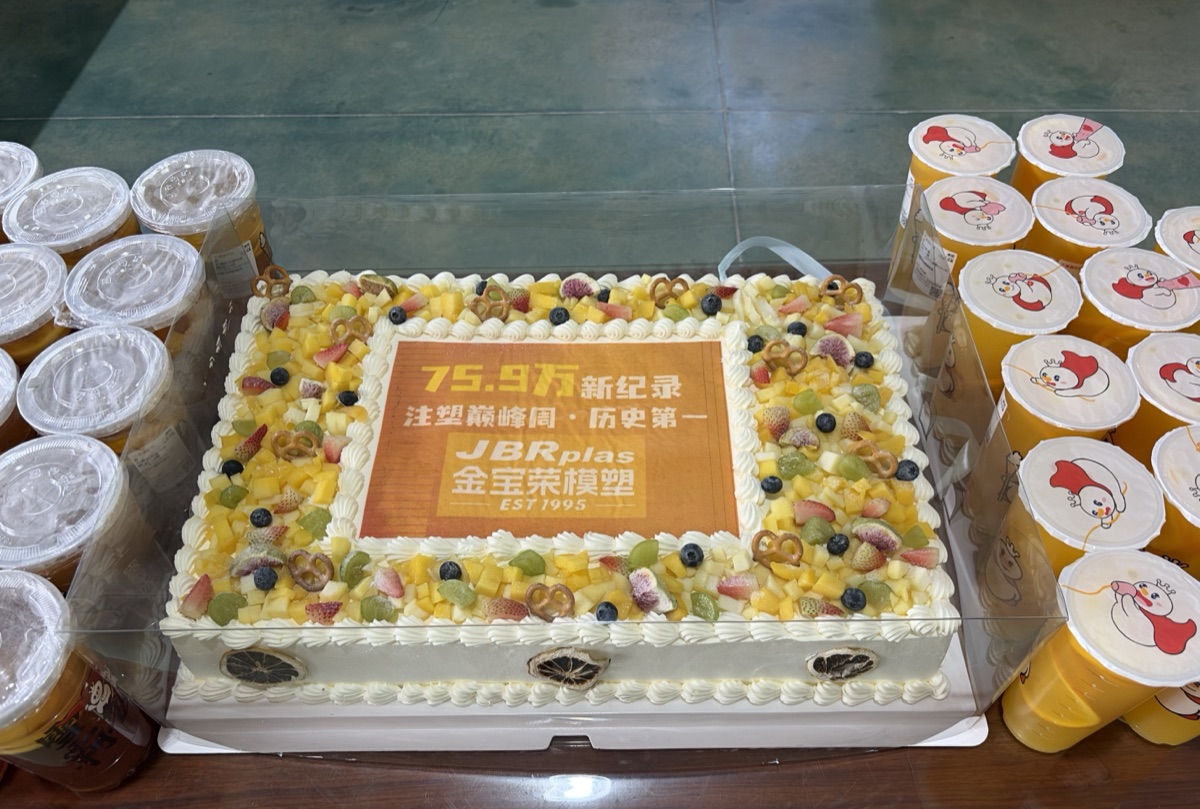
JBRplas' injection molding department produced 759,000 good parts in Week 44 of 2026 — a new single-week record, 15.6% above the previous 656,800 pieces.
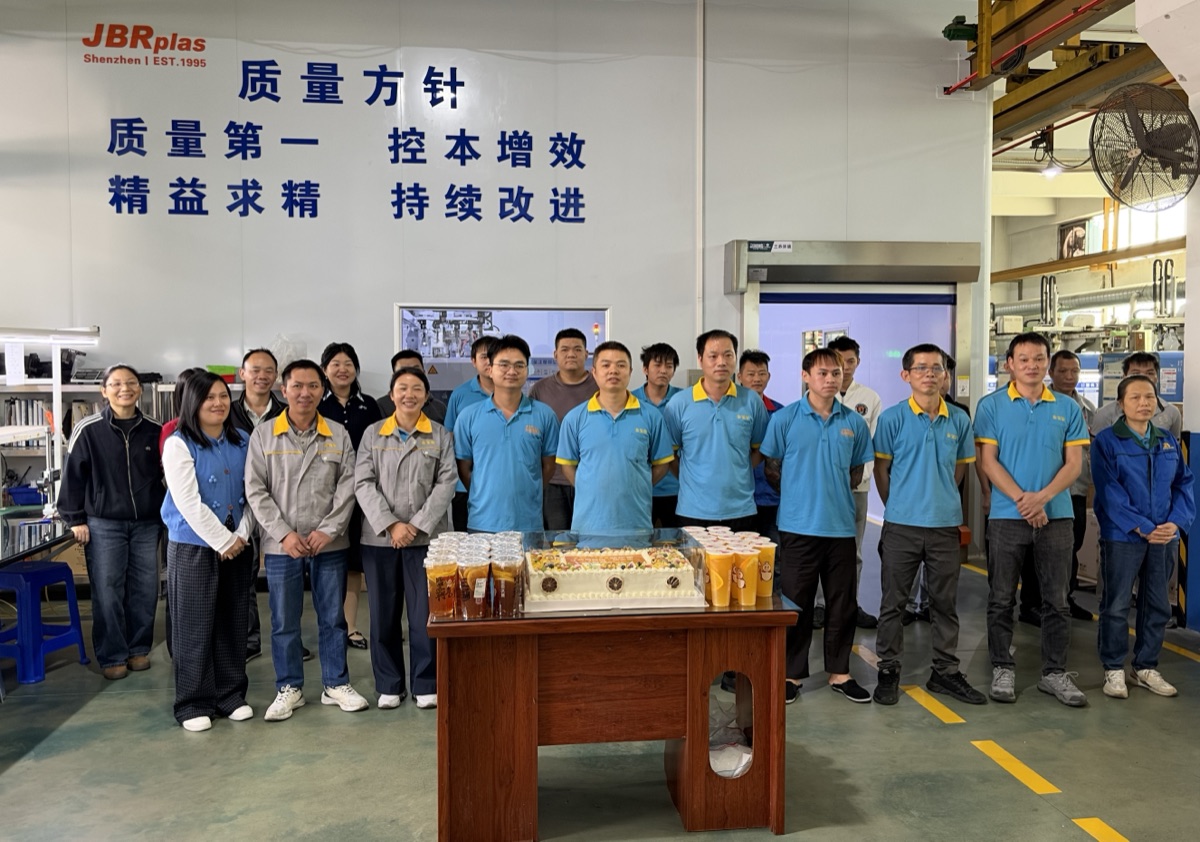
[Shenzhen, China] – JBRplas’ injection molding department produced 759,000 good parts in a single week during Week 44 of 2026 — the highest weekly output recorded since the company was founded in 1995, and 15.6% above the previous single-week record of 656,800 pieces.
The count was reconciled after the week closed; the department marked the result on 10 November.
A weekly output figure measures one thing: how many parts left the department in seven days. On its own it says nothing about how the week was run — so the sections below look at what 759,000 pieces normalises to, what has to hold for a week at that level, and what the number does and does not change for customers.
What 759,000 Pieces Represents
Weekly totals are hard to compare across factories because a “week” can mean five days of two shifts, seven days of three shifts, or anything in between — and because one plant counts shots while another counts good parts. This figure counts good parts: pieces that passed inspection, not total moulded parts including rejects. Normalising the number makes it readable:
| Measure | Figure |
|---|---|
| Output, Week 44 (good parts) | 759,000 pieces |
| Previous single-week record | 656,800 pieces |
| Increase over previous record | +102,200 pieces (+15.6%) |
| Per calendar day (7 days) | ~108,400 pieces |
| Per working day (5 days) | ~151,800 pieces |
| Per machine per week (27-machine inventory) | ~28,100 pieces |
| Per machine per working day (5 days) | ~5,600 pieces |
These are arithmetic, not utilisation figures. The 27-machine figure is the published equipment inventory — 90T to 650T — not the number of presses that happened to be running on any given shift, and no two weeks distribute work across the fleet in the same way.
What Has to Hold for a Week at This Level
A single week’s total is set less by the fastest machine than by the slowest one to recover. Five things have to hold at the same time:
- Press availability. An unplanned stop on a large press can cost more parts in an afternoon than a small press produces in a shift. The weekly number is decided by the machines that did not stop.
- Tool condition. Cavity wear, gate freeze-off, and cooling-channel fouling all show up as cycle drift or dimensional drift before they show up as a stoppage. Tool maintenance scheduled inside the week is what keeps cavities in spec at higher shot counts.
- Material supply and drying. A moisture excursion does not slow the cycle — it produces scrap at full rate. Continuous drying and resin supply have to match the press schedule, not follow it.
- Inspection throughput. If quality control cannot keep pace with the presses, parts queue instead of shipping, and a production record becomes a warehouse record.
- Scheduling. Which jobs run next to each other decides setup losses. Grouping by material and colour, and sequencing tools by tonnage, is what turns available machine hours into parts.
The week where all five hold together is the week a record is possible. That is the part worth recording.
The Team Behind the Number
The result came from the production floor working with engineering, quality control, and management on the same schedule — mold changes, process adjustments, and inspection plans coordinated within the week rather than around it.
The management team credited the department as a whole rather than any single shift or machine group, and attributed the week to lean manufacturing processes and supply-chain reliability holding at higher output — the two things that decide whether a high-output week is repeatable or a one-off.
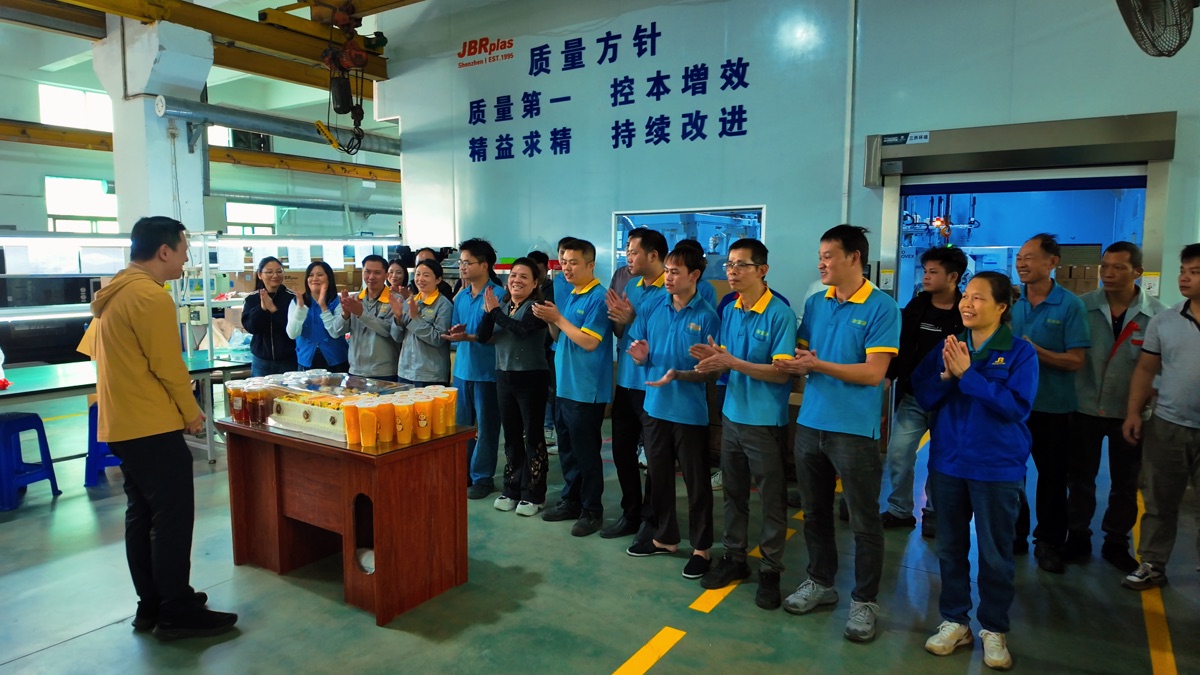
General Manager Steven Liang addressed the department at the celebration.
The Celebration
The department marked the week on the factory floor with a cake and drinks, in front of the quality-policy wall that carries the four statements the plant works to:
| Chinese | English |
|---|---|
| 质量第一 | Quality First |
| 控本增效 | Cost Control |
| 精益求精 | Striving for Perfection |
| 持续改进 | Continuous Improvement |
Read as operating instructions rather than slogans, the four lines describe the trades the department manages every week — output against quality, and cost against improvement. A week at 759,000 pieces is only worth recording if those trades were kept.
What This Means for Clients
Existing programs are unaffected. No process, tooling, or documentation change follows from the week — the same DFM review, first-article reporting, and process validation apply.
It is a validated capacity datapoint, not a claim. A customer planning a program at a few hundred thousand parts per month can treat 759,000 good parts in a week as output the plant has actually reached, not a modelled figure — and because the count excludes rejects, it is a shipping number rather than a press-hours number. If a schedule depends on that order of output, raise it during quoting rather than after tooling is cut.
Capacity reservation is a quoting conversation. For programs above 500,000 pieces per year, press allocation and weekly output commitments are discussed at quote stage — see high-volume manufacturing for how that is scoped, and quality control in injection molding for the inspection side of running at rate.
Related reading: the 2026 production capacity upgrade, the full equipment list, and the factory tour for the floor this ran on. For programs that need this order of weekly output, request a quote →