Project Overview
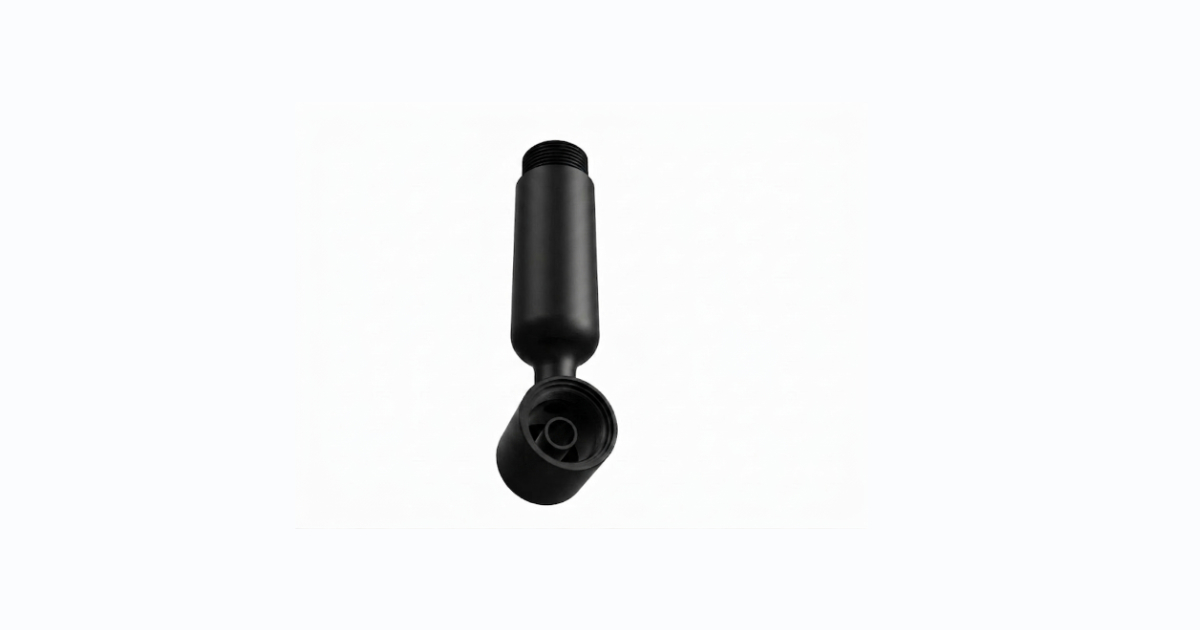
An environmental monitoring equipment manufacturer required a precision-molded housing for a continuous water quality sensor probe — a slim cylindrical component designed for permanent or long-term submersion in municipal water systems, aquaculture tanks, and industrial process water lines. The housing protects internal electrode and electronic sensing elements while remaining in constant contact with water that varies in pH, chlorine content, temperature, and dissolved mineral concentration over years of service.
The client specified PEEK (polyether ether ketone) as the housing material — a decision driven by the combination of continuous chemical exposure, elevated water temperatures in some industrial applications, and a multi-year service life expectation that ruled out lower-cost engineering resins.
Part Specifications
| Parameter | Specification |
|---|---|
| Part dimensions | 32.6 × 137 × 32.6mm (cylindrical probe housing) |
| Part weight | 64g |
| Material | PEEK, industrial/medical grade |
| Wall thickness | 1.8mm nominal (hollowed cylindrical body) |
| Sealing requirement | IP68 — continuous submersion |
| Critical features | O-ring seal grooves, threaded probe connection, internal electrode boss |
| Operating temperature | -10°C to +95°C continuous (process water applications) |
| Chemical exposure | Chlorine, chloramine, varying pH (3–11), dissolved minerals |
| Annual volume | 18,000 pieces |
Engineering Approach
Why PEEK — and Why It’s Difficult to Mold
PEEK was specified for three reasons that no lower-cost resin could satisfy simultaneously:
- Hydrolysis resistance — continuous water immersion over a multi-year service life degrades most engineering plastics through hydrolytic attack. PEEK’s aromatic backbone is essentially inert to this mechanism.
- Chemical resistance — municipal and industrial water lines expose the housing to chlorine, chloramine, and pH swings that would stress-crack or degrade ABS, PC, or even PPS over time. PEEK resists virtually all of these without measurable degradation.
- Dimensional stability under thermal cycling — sensor calibration accuracy depends on the housing maintaining consistent internal geometry as water temperature fluctuates seasonally and during process upsets. PEEK’s low coefficient of thermal expansion keeps electrode spacing stable.
These same properties make PEEK one of the most demanding materials to injection mold:
- Melt temperature: 360–400°C — far above standard engineering resins (ABS: ~240°C, PC: ~300°C), requiring specialized barrel heating and screw design
- Mold temperature: 150–200°C — the mold itself must run hot to control crystallinity and avoid warping; this requires oil-based mold temperature controllers rather than standard water circuits
- Crystallization sensitivity — cooling rate directly affects the degree of crystallinity, which in turn affects mechanical strength, chemical resistance, and dimensional stability. Inconsistent cooling produces inconsistent parts
- Abrasive to tooling — PEEK’s high processing temperature and stiffness accelerate wear on standard mold steel, particularly at gate locations and narrow flow channels
Mold Design for High-Temperature Processing
Steel selection: We specified H13 hardened to 50 HRC rather than standard P20. At PEEK processing temperatures sustained over thousands of cycles, P20’s lower hardness leads to premature gate erosion and dimensional drift in critical sealing features — unacceptable for a part where O-ring groove tolerance directly determines IP68 sealing performance.
Oil-based mold temperature control: Standard water-based mold cooling cannot reach the 150–200°C mold temperature PEEK requires. We designed the mold with oil-circuit channels, fed by a dedicated oil temperature control unit (TCU) capable of sustained operation at 180°C — a different mold cooling architecture than 95% of the molds we produce.
Gate design for thermal stability: A single submarine gate was positioned at the base of the cylindrical body, away from the critical O-ring sealing zone. This kept the highest-shear, highest-temperature region of the melt path away from dimensionally critical features, reducing the risk of localized warping near the seal grooves.
Venting for high-viscosity melt: PEEK’s high melt viscosity compared to commodity resins required wider venting than standard practice — 0.02mm vent depth at the parting line versus our typical 0.015mm — to avoid trapped gas and short shots at the far end of the elongated 137mm cavity.
Achieving IP68 Sealing Performance
The O-ring seal grooves at each end of the housing are the single most dimensionally critical feature on the part. Sealing performance at depths and pressures associated with industrial water lines required:
- Groove width and depth controlled to ±0.02mm — tighter than our standard ±0.05mm precision tolerance, achieved through EDM finishing of the groove inserts rather than standard CNC machining
- Surface finish of SPI A2 (fine diamond polish) on sealing surfaces to ensure consistent O-ring contact and eliminate micro-leak paths
- Post-mold dimensional verification of every sealing groove via CMM before parts are released to the client’s assembly line
Validation Under Real-World Conditions
Standard First Article Inspection was supplemented with application-specific validation given the severity of the service environment:
- Dimensional inspection — CMM verification of all critical dimensions, with particular attention to seal groove geometry and electrode boss alignment
- Pressure/leak test — sample housings were pressure-tested to 2 bar submerged, simulating worst-case installation depth, with zero leakage across the test sample
- Thermal cycling — sample parts were cycled between 5°C and 90°C for 50 cycles to verify dimensional stability at sealing surfaces; no measurable distortion was recorded
- Chemical exposure check — surface inspection after 72-hour immersion in 10ppm chlorine solution showed no visible degradation, consistent with PEEK material data
Tooling Details
| Parameter | Detail |
|---|---|
| Mold type | 1-cavity, cold runner, submarine gate |
| Mold base | LKM standard, modified for oil-circuit cooling |
| Core / cavity steel | H13, hardened to 50 HRC |
| Mold temperature control | Oil-based TCU, sustained 180°C |
| Sealing groove finish | EDM + SPI A2 diamond polish |
| Ejection | Stripper plate (avoids ejector pin marks on sealing-adjacent surfaces) |
| Gate | Submarine gate, base of part, away from seal zone |
Timeline
| Milestone | Duration |
|---|---|
| DFM report issued | Day 4 (PEEK-specific processing review) |
| Mold design complete | Day 14 |
| Customer design approval | Day 17 |
| Steel ordered and received | Day 21 |
| Machining and EDM finishing | Day 28 |
| T1 trial (PEEK process qualification) | Day 32 |
| T1 samples shipped to customer | Day 34 |
| Pressure/thermal validation complete | Day 45 |
| Production release | Day 48 |
The extended T1-to-production-release window compared to standard engineering resin programs reflects the additional validation steps appropriate for a multi-year submersion application — time invested upfront to avoid field failures.
Results
| Metric | Target | Achieved |
|---|---|---|
| Seal groove tolerance | ±0.02mm | ±0.015mm |
| IP68 pressure test | Zero leakage at 2 bar | ✅ Pass, zero leakage |
| Thermal cycling stability | No measurable distortion | ✅ Confirmed, 50 cycles |
| Chemical resistance (72h, 10ppm Cl) | No visible degradation | ✅ Confirmed |
| T1 lead time | 35 days | 32 days |
| Production Cpk (seal groove width) | ≥1.33 | 1.61 |
The mold has been in production for over 14 months, supplying the client’s continuous water quality monitoring product line. No field reports of seal failure or housing degradation have been received to date, consistent with the validation data and PEEK’s established long-term performance in aqueous chemical environments.
This case study demonstrates JBRplas’s capability to process high-performance engineering resins like PEEK — including specialized oil-based mold temperature control, EDM-finished sealing surfaces, and application-specific validation protocols for components in continuous chemical and aqueous exposure.