Project Overview
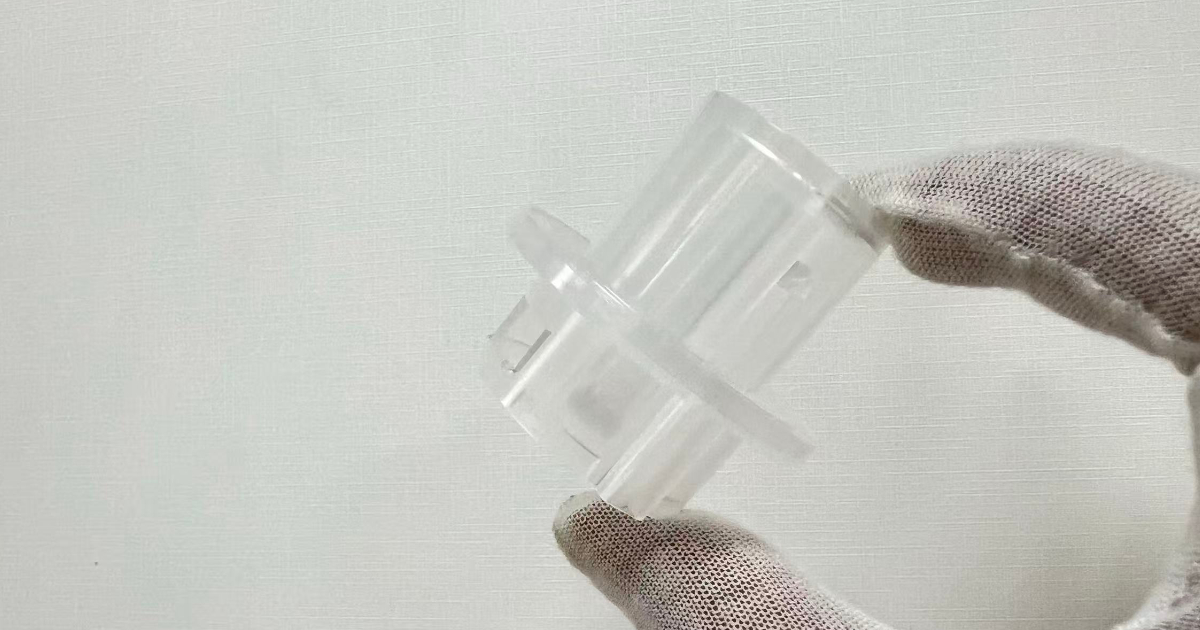
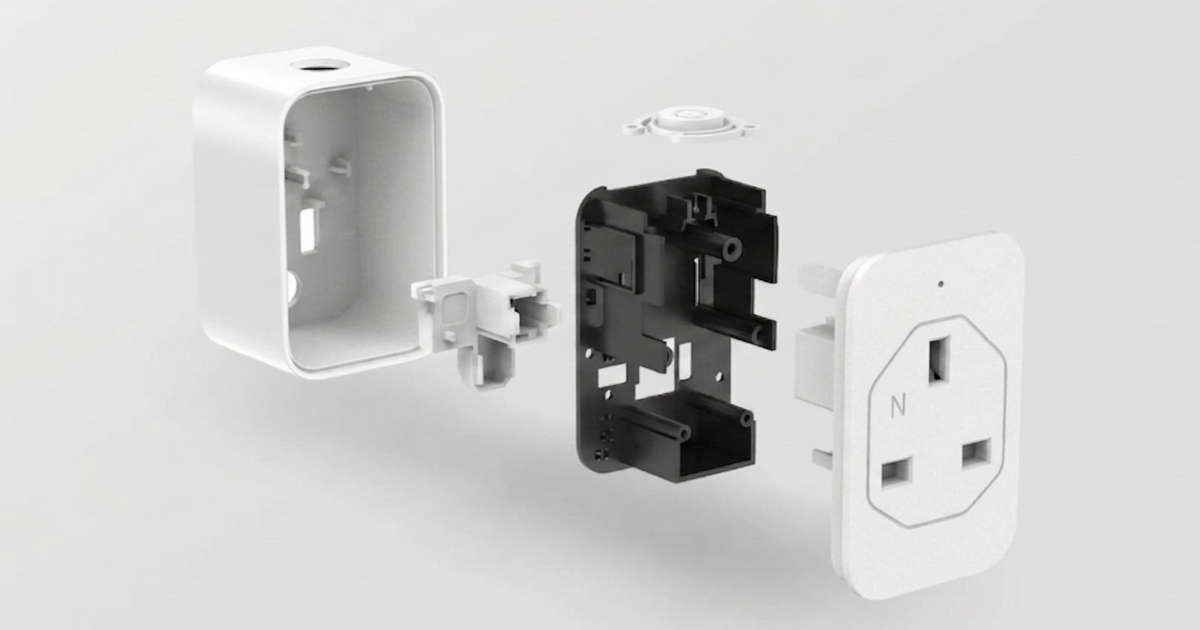
A European smart home brand developing a new Wi-Fi smart plug required a production mold for the enclosure assembly — a two-piece housing consisting of a main body and snap-fit top cover. The enclosure is a mains-connected device (230V AC) requiring UL 94 V-0 flame retardant rating, a compact internal volume to accommodate the PCB and relay, and a cosmetic exterior finish suitable for a premium consumer product sold at retail.
The client required 2.5 million enclosures per year across EU, UK, and US plug variants. The three regional versions share an identical top cover and main body shell, with only the pin carrier insert changing — a modular tooling strategy.
Challenge: The main body wall thickness was specified at 1.2mm for internal volume reasons — close to the minimum flow limit for V-0 ABS. Combined with the 8-cavity layout, achieving balanced fill without short shots or burn marks required precise gate design and venting.
Part Specifications
| Parameter | Main Body | Top Cover |
|---|---|---|
| Dimensions | 52 × 48 × 35mm | 52 × 48 × 8mm |
| Wall thickness | 1.2mm nominal | 2.0mm nominal |
| Material | ABS FR, UL 94 V-0 at 1.2mm | ABS FR, UL 94 V-0 at 2.0mm |
| Exterior finish | SPI B1 semi-gloss per surface finish standards, all visible faces | SPI B1 semi-gloss |
| Cosmetic standard | Class A on all exterior surfaces | Class A on top face |
| Colour | RAL 9016 Traffic White | RAL 9016 Traffic White |
| Annual volume | 2,500,000 | 2,500,000 |
| Internal features | PCB bosses, pin carrier slot, snap-fit undercuts | Snap-fit tabs, LED light pipe window |
Engineering Approach
Thin-Wall Fill Challenge
At 1.2mm wall thickness with V-0 FR ABS, the main body was approaching the practical flow limit. Standard V-0 ABS has lower melt flow than general-purpose ABS — typically 15–25 g/10min versus 30–40+ for standard grades.
Our Moldflow analysis identified a fill time of 0.42 seconds to reach the farthest cavity extremity before the flow front froze — tight but achievable with correct gate sizing. We selected LG Chem AF-3128 V-0 ABS (MFR 28 g/10min at 220°C/10kg), one of the highest-flow V-0 ABS grades available, and confirmed material availability with 4-week lead time before committing the mold design.
Gate strategy: Each cavity was fed by a single tunnel gate at Ø1.4mm, positioned on the bottom face of the main body (non-visible when plugged into a wall socket). Gate diameter was increased from the standard Ø1.0mm to compensate for the lower melt flow of V-0 ABS.
Venting: Full-perimeter parting line venting at 0.012mm depth on each cavity — FR ABS generates more off-gas than standard ABS, and at 1.2mm wall the fill speed leaves no margin for inadequate venting.
Modular Tooling for Regional Variants
The enclosure design used a modular insert system for the pin carrier:
- Fixed cavity: Main body + top cover — identical for all regions (8+8 cavities)
- Interchangeable inserts: Pin carrier insert block — 3 variants (EU Type F, UK Type G, US Type B)
- Changeover time: 15 minutes to swap all 8 pin carrier inserts
This avoided three separate mold sets — a family mold approach with interchangeable inserts — and reduced total tooling investment by approximately 40%.
Snap-Fit Assembly Design
The top cover snaps onto the main body with 4 perimeter clips. The snap-fit requires a precise interference fit — 0.35mm per clip — to ensure the cover cannot be removed without a tool (required by the client’s safety specification for a mains-powered product with no user-serviceable parts).
Our DFM review identified that the original clip root thickness of 0.9mm would not survive ejection stresses. We recommended increasing the root fillet radius from R0.3mm to R0.8mm, which reduced the ejection stress concentration by 47% in simulation while maintaining the same clip deflection force.
Tooling Details
| Parameter | Main Body | Top Cover |
|---|---|---|
| Mold type | 8-cavity cold runner, tunnel gate | 8-cavity cold runner, tunnel gate |
| Mold base | LKM, 600 × 500mm | LKM, 500 × 400mm |
| Steel | 718H, 33 HRC | 718H, 33 HRC |
| Runner | H-pattern, 5mm diameter, naturally balanced | H-pattern, 5mm diameter |
| Gate | Ø1.4mm tunnel gate per cavity | Ø1.2mm tunnel gate per cavity |
| Cooling | 8mm lines, 18mm from cavity | 8mm lines, 18mm from cavity |
| Ejection | 6× Ø3mm ejector pins + 2× blade ejectors per cavity | 4× Ø3mm ejector pins per cavity |
| Interchangeable inserts | Pin carrier block (3 regional variants) | N/A |
| Mold weight | 2,100kg | 1,450kg |
Cycle Time and Production Capacity
| Phase | Time |
|---|---|
| Injection | 1.5s |
| Pack / hold | 3.5s |
| Cooling | 14.0s |
| Ejection / open-close | 3.0s |
| Total cycle | 22.0s |
At 22-second cycle time with 8 cavities:
- Production rate: 163 shots/hour × 8 cavities = 1,304 parts/hour
- Annual capacity: 1,304 × 20 hours × 280 days = 7.3 million parts (2.9× over the 2.5M requirement)
Results
| Metric | Target | Achieved |
|---|---|---|
| UL 94 V-0 | Required at 1.2mm wall | Confirmed (LG AF-3128, UL Yellow Card) |
| Cycle time | <25s | 22.0s |
| Cosmetic rejects (Class A) | <0.5% | 0.15% |
| Cavity weight variation (8-cavity) | <2% | 1.1% |
| Snap-fit engagement force | 12N ±3N per clip | 13.2N mean, σ = 0.8N |
| T1 lead time | 28 days | 26 days |
| Colour match to RAL 9016 | ΔE < 1.0 | ΔE = 0.7 |
| Insert changeover time | <20 min | 15 min |
The molds entered volume production 7 weeks after project kickoff. The product received CE and UKCA certification and launched across Europe on schedule. The modular insert system has since been used for an Australian variant (Type I plug) with no additional mold investment beyond a single insert block.
This case study demonstrates JBRplas’s high-volume, multi-cavity production capability for smart home devices — including thin-wall FR ABS molding, modular regional variant tooling, and snap-fit assembly engineering for consumer safety compliance.