Project Overview
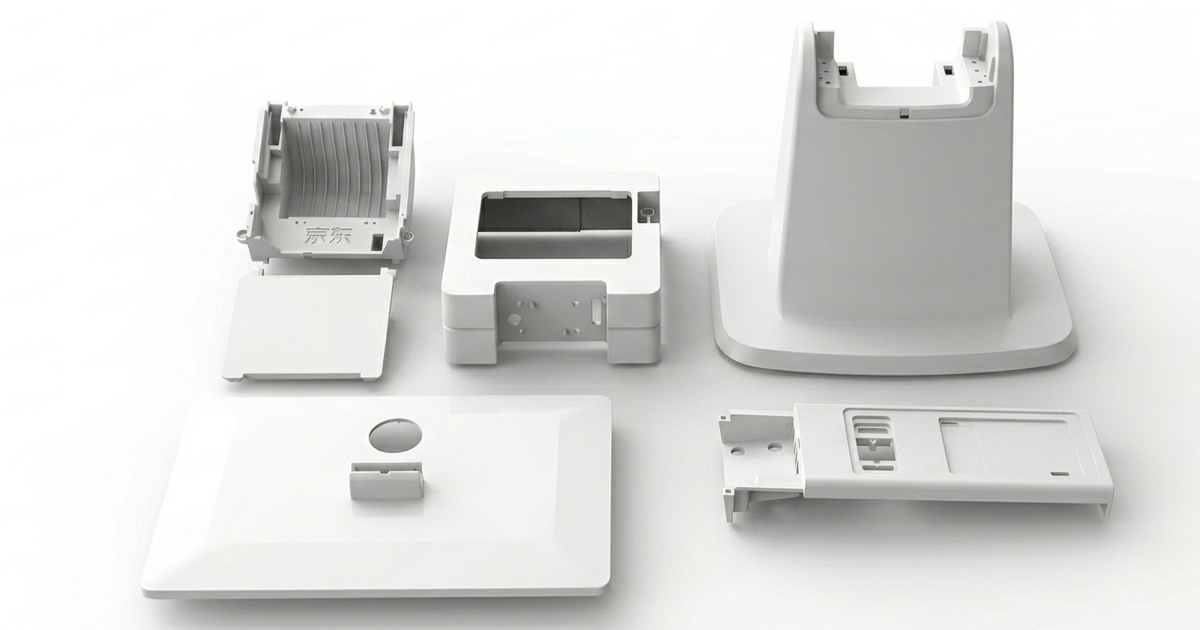
A payment terminal manufacturer developing a PCI PTS-compliant countertop POS terminal required a production mold for the PIN entry pad enclosure — the customer-facing component that houses the keypad, display window, and EMV chip card reader slot. The enclosure is the primary user interaction surface of the terminal and directly incorporates security features that are part of the device’s tamper-evidence architecture.
The part combines three demanding requirements in a single molding: precision tolerances for the EMV card reader slot, tamper-evident snap-fit geometry for PCI PTS enclosure requirements, and ESD-safe material properties to protect sensitive payment processing electronics.
Challenge: The EMV card slot aperture required ±0.05mm dimensional accuracy on width and straightness across an 82mm span — essentially mold-plate precision on a production injection molded part. Achieving this consistently without post-mold machining required a combination of H13 hardened steel, precision wire-EDM slot forming, and real-time process control.
Part Specifications
| Parameter | Specification |
|---|---|
| Part | POS terminal PIN pad enclosure (top housing) |
| Dimensions | 195 × 92 × 18mm |
| Wall thickness | 2.2mm nominal |
| Material | PC/ABS FR, UL 94 V-0, carbon-filled ESD-safe grade |
| Surface resistivity | 10⁴–10⁶ Ω (ESD-safe) |
| Exterior finish | VDI 24 fine matte texture (fingerprint-resistant) |
| Display window aperture | 72 × 48mm, with 0.5mm recess for lens gluing |
| EMV card slot | 86 × 3.2mm through-slot, ±0.05mm width |
| Keypad apertures | 16× Ø18mm ±0.10mm positions |
| Cosmetic standard | Class A on all exterior visible surfaces |
| Tamper-evident features | 6× snap-fit bosses with calibrated break-away geometry |
| Annual volume | 350,000 pieces |
Engineering Approach
EMV Card Slot Precision
The card reader slot is the most dimensionally demanding feature on the part. EMV chip cards are 85.6 × 53.98 × 0.76mm per ISO/IEC 7816, and the reader slot must guide the card reliably through thousands of insertions without binding or excessive play. Achieving ±0.05mm on an 82 mm slot width demands precision molding process control — mold temperature held within ±1°C and injection velocity profiled to prevent flash at the slot edges.
The slot is formed by a precision-ground H13 insert pair — one insert in the cavity, one in the core — that meet at the parting line to form the full slot profile:
- Insert material: H13 hardened to 52 HRC, wire-EDM cut to ±0.003mm
- Slot width: 3.20mm ±0.05mm (card is 0.76mm thick; slot provides clearance for card + protective EMV contact springs)
- Slot straightness: ±0.03mm across the 82mm visible slot length
- Card entry chamfer: 15° ±1° lead-in on both sides of the slot
The slot inserts are ground and wire-EDM finished, then verified on CMM before mold assembly. In production, slot width is checked on 5 parts per 2-hour shift using a calibrated Go/No-Go gauge. Full CMM slot profile verification is performed on 1 part per shift.
Tamper-Evident Snap-Fit Geometry
The PIN pad enclosure attaches to the terminal base via 6 snap-fit clips designed to break visibly if the enclosure is pried open — a requirement under PCI PTS for tamper-evident enclosure design:
- Clip engagement: 0.7mm interference per clip
- Clip root thickness: 1.4mm with R1.0mm fillet — designed to fracture at >80N pry force
- Material behavior: Carbon-filled PC/ABS FR is more brittle than unfilled grades — the carbon filler reduces elongation at break from typically >10% to approximately 3–5%, making it inherently more tamper-evident
The snap geometry was validated through physical testing on T1 samples. Clips fractured cleanly at 85N ±8N mean force — above the 60N assembly retention requirement but below the threshold where surrounding housing material would deform rather than fracture.
ESD-Safe Material Processing
Carbon-filled PC/ABS FR presents specific molding challenges:
- Increased melt viscosity — carbon filler reduces melt flow by ~25% versus unfilled FR PC/ABS
- Abrasive to tool steel — H13 required to resist the abrasive effect of carbon filler over production shot life
- Surface appearance — carbon filler produces a naturally matte, slightly textured surface; VDI 24 texture applied to make the surface uniform and fingerprint-resistant per surface finish standards
- Weld line visibility — carbon-filled grades show weld lines more prominently; gate position was selected so the primary weld line falls across the bottom face (non-visible when terminal is assembled)
Keypad Aperture Positioning
The 16 keypad button apertures must align precisely with the membrane keypad and PCB contacts beneath. Cumulative position error across the full 195mm part length must stay within ±0.15mm.
We applied Moldflow shrinkage prediction with the specific carbon-filled PC/ABS grade to calculate compensated cavity dimensions. The mold was machined to compensated dimensions, and T1 parts were measured to verify that actual shrinkage matched the prediction within 0.05%.
Tooling Details
| Parameter | Detail |
|---|---|
| Mold type | 2-cavity cold runner, side gate |
| Mold base | LKM, 550 × 550mm |
| Steel | H13, 50±2 HRC |
| Card slot inserts | H13, 52 HRC, wire-EDM finished |
| Runner | H-pattern, 5mm diameter, naturally balanced |
| Gate | Side gate per cavity, 2.0 × 1.2mm |
| Cooling | 10mm lines, 20mm from cavity; conformal around card slot area |
| Ejection | 12× Ø4mm ejector pins per cavity (bottom face only) |
| Surface | VDI 24 fine matte on cavity face |
| Mold weight | 1,720kg |
Results
| Metric | Target | Achieved |
|---|---|---|
| Card slot width | 3.20mm ±0.05mm | Cpk = 1.73 |
| Card slot straightness | ±0.03mm / 82mm | ±0.018mm |
| Keypad aperture positions (16×) | ±0.10mm each | All within ±0.06mm |
| Surface resistivity | 10⁴–10⁶ Ω | 2.8 × 10⁵ Ω |
| UL 94 V-0 | Required | Confirmed |
| Tamper clip fracture force | >60N, <100N | 85N ±8N |
| Cosmetic rejects (Class A) | <0.8% | 0.31% |
| T1 lead time | 32 days | 30 days |
The mold entered production 9 weeks from project kickoff. The terminal enclosure passed PCI PTS physical security evaluation on first submission. The client has since placed orders for a second mold set to support increased terminal demand.
This case study demonstrates JBRplas’s precision molding capability for payment hardware — including EMV card slot tolerances, tamper-evident enclosure geometry, ESD-safe material processing, and documentation traceability for financial device programs.