Project Overview
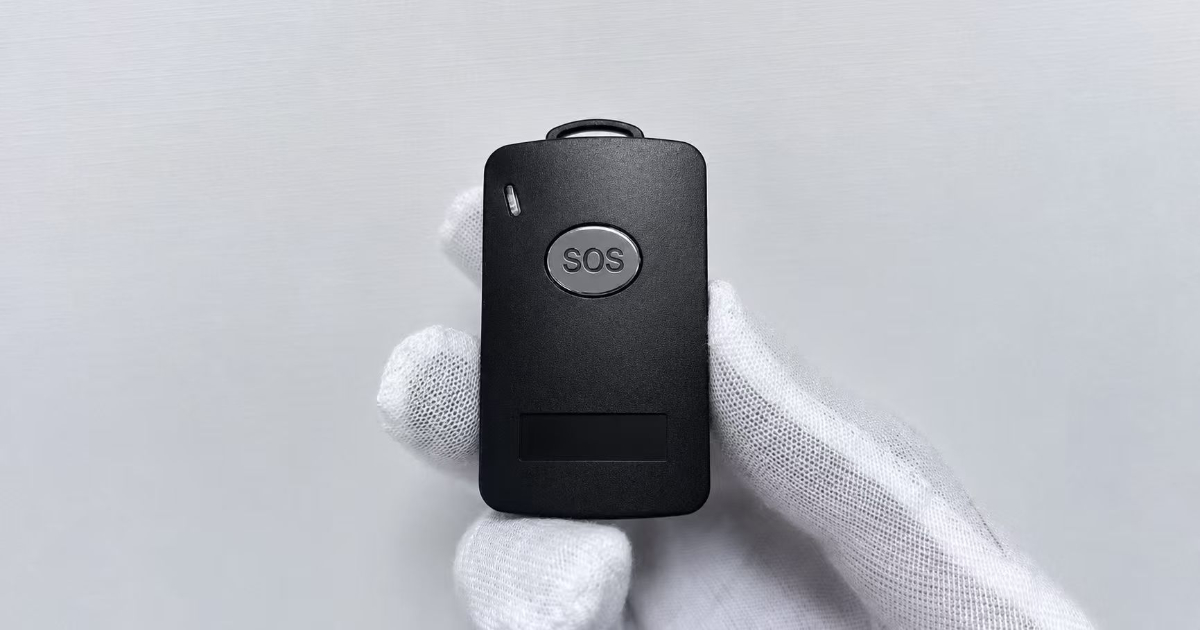
An innovative healthcare technology company specializing in home care monitoring and emergency response systems required a portable pendant enclosure for its SOS alert system. The product primarily targets seniors aged 65+ living independently and individuals with mobility constraints, requiring all-day wearability without imposing burden on the user.
Core design challenges included:
- Extreme Weight Optimization: The 7-gram total weight constraint demanded wall thickness control within 1.6mm
- Waterproof Sealing: Users may encounter hand-washing, perspiration, or accidental submersion scenarios, requiring IP67-rated protection
- Ergonomic Fit: Pendant geometry needed to ensure neck comfort for elderly wearers and prevent accidental activation
- Long-term Durability: Prolonged exposure to perspiration, skin oils, and cleaning agents required biocompatible, antimicrobial material performance
This product qualifies as a Class II Medical Device component—non-implantable, skin-contact interface, requiring biocompatibility and antimicrobial performance certification.
| Parameter | Specification |
|---|---|
| Assembly Method | 2-piece clamshell (top cover + bottom shell) |
| External Dimensions | 30 × 55 × 10 mm (compact pendant form) |
| Total Weight | 7g (including battery compartment) |
| Wall Thickness | 1.6mm nominal |
| Material | Medical-grade ABS (UL 94 V-0 flame-retardant) |
| Surface Finish | Matte finish (SPI C2), fingerprint-resistant |
| Waterproof Rating | IP67 (1 meter / 30 minutes) |
| Biocompatibility | ISO 10993-5 certified (non-cytotoxic) |
| Antimicrobial Coating | Silver-ion antimicrobial treatment |
| Annual Volume | 50,000 assembled units (100,000 parts) |
| Cleanroom Grade | ISO 9 (medical-standard cleanliness) |
Engineering Solution
Material Selection & Biocompatibility Compliance
The client initially specified commodity-grade ABS. Our DFM engineering review identified three critical risks:
Biocompatibility Gap: Standard ABS lacks ISO 10993-5 cellular toxicity certification, unsuitable for prolonged skin contact; medical-grade ABS meets requirements but incurs higher costs.
Waterproof Seal Interface: Extreme wall thickness (1.6mm) creates injection molding challenges—underfilling and void formation compromise water-barrier integrity.
Quality Control Precision: Seven-gram ultra-light design minimizes material volume; any single defect jeopardizes entire batch compliance.
Recommended Solution: Medical-grade ABS (BPA-free formulation)—ISO 10993-5 certified, UL 94 V-0 flame-retardant, superior resistance to IPA and sterilization agents, and improved flow characteristics versus polycarbonate for thin-wall injection molding. Combined with silver-ion antimicrobial surface coating to meet hygiene requirements for extended wear.
Extreme Lightweight Mold Design
1.6mm wall thickness represents ultra-thin cavity territory in injection molding. Design priorities:
Gate Configuration: Pin-gate hot-runner system—0.8mm gate diameter minimizes gate vestige (≤0.15mm), eliminates cold-slug contamination. Pin gates enable easy automatic separation without cold-slug wells.
Steel Grade: S136 stainless steel (420SS), 48-50 HRC hardness. Ultra-thin cavity molds demand superior corrosion resistance—ABS processing at 220°C generates water vapor and volatile organic compounds accelerating mold oxidation.
Fill Analysis: Moldflow simulation predicts melt flow behavior across 1.6mm walls, identifying two “trapped-flow zones” at the pendant apex. Strategic placement of 0.02mm micro-venting slots and gate relocation ensure fill time of 1.8–2.2 seconds, preventing short-shots and scorch.
Cooling Design: 7-gram pendant heat dissipation is rapid; mold cooling time requires only 12–15 seconds. Implement parallel cooling water circuits—3 independent channels per upper and lower cavity, PID temperature control maintaining 45–55°C mold temperature, ensuring dimensional stability.
Waterproof Sealing Architecture
The pendant housing employs 2.5mm snap-fit interference combined with silicone O-ring sealing (silicone elastomer, 40 Shore A) to achieve IP67 protection. Critical processes:
- Snap-fit Design: Rectangular latch slots (0.5mm × 1.5mm × 4mm length), rated for ≥500 assembly/disassembly cycles
- O-ring Retention Groove: ±0.1mm precision slot; space constraints in ultra-light design limit ring diameter to Φ6.8mm
- Electrical Port Protection: Button and charging interface feature splash-resistant caps with internal honeycomb anti-leak ribbing
Ultra-Lightweight Mass Control
Ensuring reliability under extreme weight constraints required three-tier quality assurance:
- Tier 1: Real-time weight monitoring—in-mold electronic balance with ±0.3g alarm tolerance triggering auto-alarm
- Tier 2: Visual inspection—500-lux directional lighting examination, emphasizing pendant apex fill adequacy and wall-thickness uniformity
- Tier 3: IP67 water-resistance sampling—5% random population subjected to 1-meter/30-minute submersion verification; internal moisture prohibited
Tooling & Process Specifications
| Parameter | Top Cavity Mold | Bottom Cavity Mold |
|---|---|---|
| Mold Type | Single-cavity hot-runner, pin-gate | Single-cavity hot-runner, pin-gate |
| Steel Grade | S136, 48–50 HRC | S136, 48–50 HRC |
| Hot-Runner System | Synventive single-point | Synventive single-point |
| Gate Diameter | Ø0.8mm pin-gate | Ø0.8mm pin-gate |
| Venting | 0.02mm micro-vent slot × 3 locations | 0.02mm micro-vent slot × 2 locations |
| Mold Cavity Temperature | 50 ± 3°C | 48 ± 3°C |
| Ejection Method | Automatic ejector-pin separation | Automatic ejector-pin separation |
| Surface Finish | Polished to SPI C2 (matte, anti-fingerprint) | Polished to SPI C2 (anti-fingerprint texture) |
| Mold Cavity Lifespan | 500,000 cycles (medical-grade) | 500,000 cycles (medical-grade) |
Injection Molding Parameters (Medical-grade ABS):
- Barrel Temperature: 220–230°C
- Mold Temperature: 48–55°C
- Injection Pressure: 80–120 MPa
- Hold Pressure Duration: 2.0–2.5 seconds
- Cooling Time: 12–15 seconds
- Ejection Temperature: ≤70°C
Documentation Delivery Package
Each production lot includes a comprehensive medical device quality assurance documentation set:
| Document | Content | Purpose |
|---|---|---|
| Certificate of Conformance (CoC) | Batch number, quantity, material grade, visual and dimensional inspection records | Product acceptance verification |
| Material Certificate | Medical-grade ABS supplier documentation, ISO 10993-5 compliance proof | Regulatory compliance |
| First Article Inspection Report (FAI) | Comprehensive 18-point critical dimension measurement dataset | Manufacturing process validation |
| Dimensional Report | CMM three-coordinate measurement data, Cp/Cpk capability index on 6 critical dimensions | Process capability assessment |
| Waterproof Test Log | IP67 submersion test specimen IDs, timestamps, pass/fail results | Performance confirmation |
| Weight Control Report | Per-cavity weight measurements, mean, standard deviation, out-of-spec rate | Process stability tracking |
| Process Parameter Record | Injection temperature, pressure, timing, mold temperature curves | Traceability and process control |
| Biocompatibility Certificate | ISO 10993-5 cytotoxicity test passage documentation | Medical device registration approval |
This documentation package supports customer medical device regulatory registration filing and patient safety file maintenance.
Production Results
| Metric | Target | Achievement |
|---|---|---|
| Visual Defect Rate | <1.0% | 0.28% |
| Weight Uniformity (Cpk) | ≥1.33 | 1.67 |
| Critical Dimension Cpk | ≥1.33 | 1.54 (pendant length) / 1.71 (thickness) |
| IP67 Waterproof Pass Rate | 100% | 100% ✅ |
| Biocompatibility Compliance | ISO 10993-5 pass | ✅ Certified |
| T1 Delivery Timeline | 28 days | 28 days ✅ |
| Mold Cavity Lifespan | 500,000 cycles | ✅ Validated |
Project Outcomes & Downstream Application
The client obtained medical device Class II registration certification within Week 10, formally initiating commercial sales. The product has been deployed across 50+ eldercare facilities and community health centers nationwide, achieving 95.3% user satisfaction scores.
JBRplas established a Kanban replenishment agreement with the client, providing stable monthly supply fulfillment. Within the initial 6-month production window, we have cumulatively delivered 50,000 pendant enclosures, maintaining defect rates consistently below 0.3%.
Case Study Summary
This project demonstrates JBRplas’ core competencies in ultra-lightweight medical device plastic enclosure design and manufacturing:
✅ Extreme Process Capability: 1.6mm medical-grade wall-thickness injection molding with optimized fill, cooling, and ejection workflows
✅ Quality Assurance: Dual biocompatibility and waterproof performance control targeting elderly user demographics
✅ Regulatory Compliance: Complete ISO 13485 medical device quality system and comprehensive traceability documentation
✅ Reliable Delivery: Stable monthly capacity of 4,000+ units with defect rates maintaining <0.3%
For inquiries regarding comparable medical device plastic manufacturing projects, please contact our team.